External links
- D/1895 Q1 at the JPL Small-Body Database
| Discovery [1] | |
|---|---|
| Discovered by | Lewis A. Swift |
| Discovery site | Mount Lowe Obs. |
| Discovery date | 24 August 1895 |
| Orbital characteristics [2] [3] | |
| Epoch | 25 August 1895 (JD 2413430.5) |
| Observation arc | 166 days |
| Number of observations | 182 |
| Aphelion | 6.1609 AU |
| Perihelion | 1.2978 AU |
| Semi-major axis | 3.7293 AU |
| Eccentricity | 0.9725 |
| Orbital period | 7.2 years |
| Inclination | 2.9923° |
| 171.75° | |
| Argument of periapsis | 167.78° |
| Last perihelion | 21 August 1895 (observed) 17 February 2019 (calculated) |
| Next perihelion | 19 September 2026 (calculated) |
| TJupiter | 2.677 |
| Physical characteristics [4] | |
| 13.0 (1895 apparition) | |
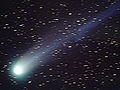
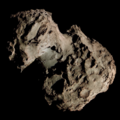
D/1895 Q1 (Swift) is one of 13 comets discovered by American astronomer, Lewis A. Swift. A Jupiter-family comet, it was last seen in February 1896 and was not observed since. [1]
On 15 September 1967, the Mariner 4 spacecraft encountered an intense "meteor storm" that lasted for 45 minutes, which may have partially damaged insulation and temporarily changed the attitude of the spacecraft. [5] [6] What caused it remained unidentified until 2006, when astronomer Paul Wiegert examined old comet data and found that Mariner 4 would have been 20 million km (12 million mi) from the possibly shattered nucleus of D/1895 Q1 (Swift). [1] However, Wiegert noted that the comet's orbit during its 1895 apparition was not precisely known, leading to a large potential error in the comet's expected location in 1967.