
Audi AG is a German automotive manufacturer of luxury vehicles headquartered in Ingolstadt, Bavaria, Germany. A subsidiary of the Volkswagen Group, Audi produces vehicles in nine production facilities worldwide.

DKW was a German car- and motorcycle-marque. DKW was one of the four companies that formed Auto Union in 1932 and thus became an ancestor of the modern-day Audi company.
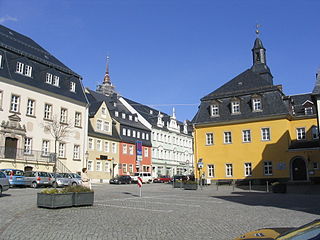
Zschopau, is a town in the Erzgebirgskreis district of Saxony, Germany.

Chemnitz is the third-largest city in the German state of Saxony after Leipzig and Dresden, and the fourth-largest city in the area of former East Germany after (East) Berlin, Leipzig, and Dresden.

Auto UnionAG was an amalgamation of four German automobile manufacturers, founded in 1932 and established in 1936 in Chemnitz, Saxony. It is the immediate predecessor of Audi as it is known today.

Barkas was the East German manufacturer of small delivery vans and minibuses named the B 1000. In addition to delivery vans, Barkas also made engines for Trabant cars.

Wanderer was a German manufacturer of bicycles, motorcycles, automobiles, vans and other machinery. Established as Winklhofer & Jaenicke in 1896 by Johann Baptist Winklhofer and Richard Adolf Jaenicke, the company used the Wanderer brand name from 1911, making civilian automobiles until 1941 and military vehicles until 1945.

Horch was a German car manufacturer, which traced its roots to several companies founded in the very late 19th and early 20th century by August Horch.
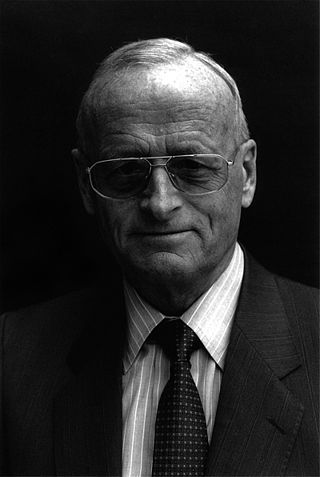
Carl Horst Hahn was a German businessman and head of the Volkswagen Group from 1982 to 1993. He served as the chairman of the board of management of the parent company, Volkswagen AG. During his tenure, the group's car production increased from two million units in 1982 to 3.5 million a decade later.

Chemnitz Hauptbahnhof is the main railway station in Chemnitz in Germany.

The DKW Meisterklasse, also known as the DKW F89, is a compact front-wheel drive saloon manufactured by Auto Union GmbH between 1950 and 1954. It was the first passenger car to be manufactured by the new Auto Union company in West Germany following the re-establishment of the business in the west in 1949.

Walter Kaaden was a German engineer who improved the performance of two-stroke engines by understanding the role of resonance waves in the exhaust system. Working for the MZ Motorrad- und Zweiradwerk part of the Industrieverband Fahrzeugbau (IFA), he laid the foundations of the modern two-stroke engine. His understanding of gas flow and resonance enabled him to make the first engine to achieve 200BHP/litre with his 1961 125cc racer. His motorcycle engines were ridden to 13 Grand Prix victories and a further 105 podium finishes between 1955 and 1976.

The Chemnitz–Riesa railway is a two-track and electrified mainline railway in the German state of Saxony, originally built and operated by the Chemnitz-Riesa Railway Company. The line was opened between 1847 and 1852 and is one of the oldest railways in Germany. The line runs from Riesa via Döbeln to Chemnitz and is part of the Berlin–Chemnitz route.
The Dresden–Werdau railway is an electrified, double-track main line in the German state of Saxony. It runs from Dresden via Freiberg, Chemnitz and Zwickau to Werdau wye, where it joins the Leipzig-Hof railway.

Yvan Goor, sometimes written as Ivan Goor, was a Belgian cyclist and motorcyclist.
Heiner Fleischmann was a German motorcycle racer before and after World War II.

Ewald Kluge was a German motorcyclist.
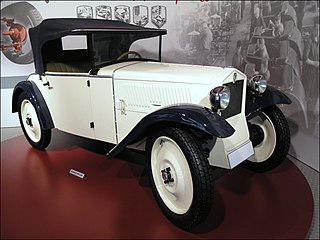
The DKW F1 was a small car mass produced by DKW between 1931 and 1932. It was launched at the Berlin Motor Show in February 1931.

The Solitude racetrack is an 11.4 km (7.1 mi) race circuit on public roads used for motorsport in the Leonberg area, west of Stuttgart, Germany. It is named after Castle Solitude and until 1965 has hosted various motorcycle and automobile races.
Richard Karl Wilhelm Bruhn was a German automobile manufacturer and entrepreneur.
This page is based on this
Wikipedia article Text is available under the
CC BY-SA 4.0 license; additional terms may apply.
Images, videos and audio are available under their respective licenses.
