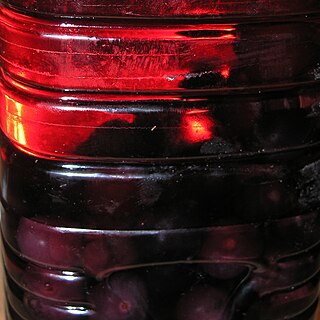
Gin is a distilled alcoholic drink that derives its predominant flavour from juniper berries. Gin is one of the broadest categories of spirits, all of various origins, styles, and flavour profiles, that revolve around juniper as a common ingredient.
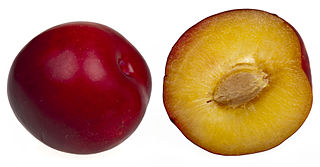
A plum is a fruit of the subgenus Prunus of the genus Prunus. The subgenus is distinguished from other subgenera in the shoots having terminal bud and solitary side buds, the flowers in groups of one to five together on short stems, and the fruit having a groove running down one side and a smooth stone.

A fruit tree is a tree which bears fruit that is consumed or used by humans and some animals — all trees that are flowering plants produce fruit, which are the ripened ovaries of flowers containing one or more seeds. In horticultural usage, the term 'fruit tree' is limited to those that provide fruit for human food. Types of fruits are described and defined elsewhere, but would include "fruit" in a culinary sense, as well as some nut-bearing trees, such as walnuts.

Sloe gin is a red liqueur made with gin and sloe (blackthorn) drupes, which are a small fruit relative of the plum. Sloe gin has an alcohol content between 15 and 30 percent by volume. However, the European Union has established a minimum of 25% ABV for sloe gin to be named as such. Sloe gin is technically a gin-based liqueur, but due to historical prevalence at the time of writing the EU spirit drink regulations the colloquial name 'sloe gin' was included in the legal definitions and as such is the only gin-based liqueur that can legally be called gin without the liqueur suffix. The traditional way of making sloe gin is to soak the sloes in gin. Sugar is required to ensure the sloe juice is extracted from the fruit.

Prunus spinosa, called blackthorn or sloe, is a species of flowering plant in the rose family Rosaceae. It is native to Europe, western Asia, and locally in northwest Africa. It is also locally naturalised in New Zealand, Tasmania and eastern North America.

Slivovitz, Slivovitza, Slivovitsa, Șliboviță, Šljivovica, Śliwowica, Schlivowitz, Slivovice, Slivovica or Slivovka is a fruit brandy made from damson plums, often referred to as plum brandy. Slivovitz is produced in Central and Eastern Europe, both commercially and privately. Primary producers are in Bosnia, Bulgaria, Croatia, Czech Republic, Hungary, Poland, Romania, Serbia, Slovakia and Slovenia. In the Balkans, Slivovitz is considered a kind of Rakia. In Central Europe it is considered a kind of Pálinka, corresponding to the distilled spirits category.

Plymouth Gin used to be Protected Geographical Indication that pertains to any gin distilled in Plymouth, England, but since February 2015 it isn't. Today, there is but one brand, Plymouth, which is produced by the Black Friars Distillery. The Black Friars Distillery is the only remaining gin distillery in Plymouth, in what was once a Dominican Order monastery built in 1431, and opens onto what is now Southside Street. It has been in operation since 1793.
The established distilling business of Fox & Williamson began the distilling of the Plymouth brand in 1793. Soon, the business was to become known as Coates & Co., which it remained until March 2004. In 1996, the brand was sold by Allied-Lyons to a management group headed by Charles Rolls who reinvigorated it. After turning the company around, they sold it in 2005 to the Swedish company V&S Group, who also made Absolut Vodka. The brand is now owned and distributed by the French company Pernod Ricard as a result of its purchase of V&S in 2008.

The bullace is a variety of plum. It bears edible fruit similar to those of the damson, and like the damson is considered to be a strain of the insititia subspecies of Prunus domestica. Although the term has regionally been applied to several different kinds of "wild plum" found in the United Kingdom, it is usually taken to refer to varieties with a spherical shape, as opposed to the oval damsons.
Preserving sugar is a kind of sugar used for making marmalades, jams and preserves using fruits that are naturally high in pectin. The large sugar crystals dissolve more slowly than those of standard granulated sugar and do not settle in the bottom of the pot or rise up as froth to the surface. This reduces the risk of burning and the consequent need for stirring. It also allows impurities to rise for easier skimming. Because it minimizes scum, it helps to make jams and jellies clearer.
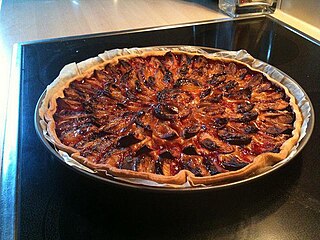
Quetschentaart, a popular Luxembourg speciality, is an open fruit tart with zwetschgen or damson plums. Traditionally, it is a seasonal dish served in the autumn after the local plums have ripened in September. The dough for the pastry base consists of flour, yeast, milk, and butter. It is kneaded and allowed to rise for half an hour. The base is then basted with egg, sprinkled with sugar, placed in a baking dish, and covered with halved plums arranged in circles. It is baked at 180 °C (356 °F) for 45 minutes or until ready.
Brachycaudus helichrysi is a species of aphid first described by the German naturalist Johann Heinrich Kaltenbach in 1843. Its common names include leaf curl plum aphid, and leaf-curling plum aphid, and it is a serious pest of plum and damson trees.

The zwetschge is a fruit-bearing tree, or its fruit. It is a subspecies of the plum Prunus domestica. The freestone fruit is similar to, but distinct from, the clingstone damson and is especially popular in Central Europe.
Brachycaudus cardui is a species of aphid, commonly known as the thistle aphid or the plum-thistle aphid. It infests trees in the genus Prunus in the spring and autumn, and mostly plants in the aster family in the summer.
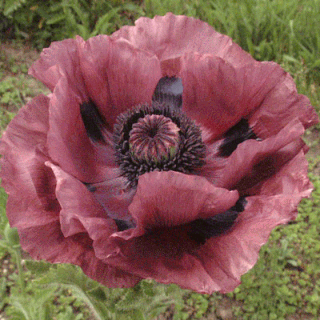
Patty's Plum is a poppy originally discovered growing in a compost heap at Kingsdon Nursery Garden, Somerset, UK, by Sandra Pope of Hadspen House, Somerset, UK, who had come to work in Mrs Patricia Marrow's garden. After the damson colour of the poppy was noticed, Marrow propagated it. She and Pope later came up with a name "Patty's Plum" because that is Marrow's first name, and it is typical of Marrow to describe the colour as "Plum".