
Virovitica is a Croatian city near the Hungarian border. It is situated near the Drava river and belongs to the historic region of Slavonia. Virovitica has a population of 14,688, with 21,291 people in the municipality. It is also the capital of Virovitica-Podravina County.

The national anthem of Austria, also known by its incipit "Land der Berge, Land am Strome", was adopted in 1946. The melody, originally attributed to Wolfgang Amadeus Mozart but now disputed among various composers, was matched with a text by Paula von Preradović the following year.

Paula Preradović, known professionally as Paula von Preradović or by her married name as Paula Molden, was an Austrian writer and poet.
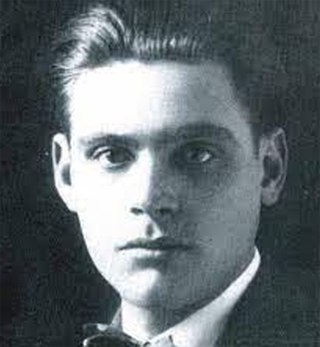
Vladan Desnica was a Yugoslav writer and translator.

Petar Preradović was a Croatian poet, writer, and military general. He was one of the most important Croatian poets of the 19th century Illyrian movement and the main representative of romanticism in Croatia.
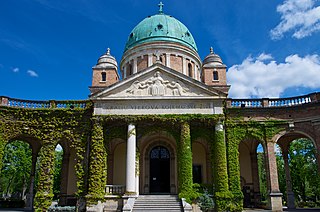
The Mirogoj City Cemetery, also known as Mirogoj Cemetery, is a cemetery park that is considered to be among the more noteworthy landmarks in the city of Zagreb. The cemetery inters members of all religious groups: Catholic, Orthodox, Muslim, Jewish, Protestant, Latter Day Saints; irreligious graves can all be found. In the arcades are the last resting places of many famous Croats.
Branko Mikša is a Croatian retired politician. He was Minister of Trade (1992), Minister of Tourism and Trade (1992–93), and later Mayor of Zagreb from April 1993 to March 1996, following the 1993 local election.

The Cathedral of the Transfiguration of the Lord is a Serbian Orthodox cathedral located on the Petar Preradović Square in Zagreb, Croatia. It was built in 1865–66 according to designs of architect Franjo Klein. It is ecclesiastically part of the Metropolitanate of Zagreb and Ljubljana and is known as the Zagreb Orthodox Cathedral.
Prof. Otto Molden was an Austrian publicist, federalist and author of various books about European identity and history. He founded the European Forum Alpbach in 1945.
Ernst Hermann Wilhelm Molden was an Austrian journalist and historian. An editor-in-chief of the Neue Freie Presse before WW2, he founded the Austrian daily newspaper Die Presse in 1946.
Grabrovnica is a village in Croatia located in the Pitomača municipality, Virovitica-Podravina County. The village is known as a birthplace of Croatian poet Petar Preradović (1818–1872). His birth house, built in 1775, was renovated in 1968 and 2019, and is open for visitors.

The Serbs of Zagreb are a traditional minority group that lives in the Croatian capital Zagreb.

Poraka is the sixth solo album by the Macedonian singer Kaliopi, released in the 2010.
Pavle Julinac (1730–1785) was a Serbian writer, philosopher, historian, traveler, soldier, and diplomat in the Imperial Russian service. As a historiographer, Julinac's "A Short Introduction to the History of the Slavo-Serbian People" published in Venice in 1765 was the most significant historical oeuvre of the period. Ten years later, Julinac's translation of Marmontel's "Bélisaire" became one of the most prominent works of the Enlightenment in Serbian literature, thanks to dramatists Marko Jelisejić (1760-1833), Joakim Vujić and others. The work of Marmontel soon popularized the philosophical ideas of the Enlightenment in Austria among the large Slavo-Serbian population there and in Russia.

NeBo is the seventh studio album by Croatian recording artist Nina Badrić, released in 2011 by Aquarius Records.
Preradović is a Serbian surname, derived from Prerad. The surname is traditionally widespread in territories of the historical Military Frontier. At least 100 individuals with the surname died at the Jasenovac concentration camp. It may refer to:
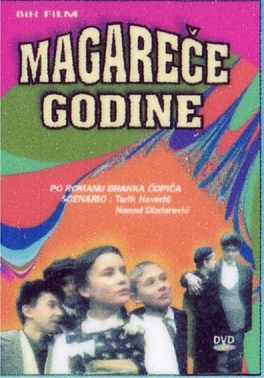
The Awkward Age is a 1994 Bosnian drama film directed by Nenad Dizdarević. The film was selected as the Bosnian entry for the Best Foreign Language Film at the 67th Academy Awards, but was not accepted as a nominee.

Oktogon is an urban passageway in central Zagreb, Croatia, connecting Petar Preradović Square with Ilica street through the building of the former First Croatian Savings Bank. It was designed by architect Josip Vancaš and built as part of the savings bank building between 1898 and 1900. The structure consists of two passageways connecting a middle octagonal atrium to the city streets.
Gabriel Millet was a French archaeologist and historian.
Rajko Depreradović also spelled Rajko Preradović was a leader of colonists who settled free lands in what is now known as Donbas that were offered for settlement in 1752 to Serbs, Vlachs and other Balkan people of the Christian Orthodox faith to ensure frontier protection and development of the steppes. The settlement was then called Slavo-Serbia. Slavo-Serbia was directly governed by Russia's Governing Senate and College of War. The settlers eventually formed the Bakhmut hussar regiment in 1764. Also in 1764, Slavo-Serbia was transformed into the Donets uyezd of Yekaterinoslav Governorate. Commandants of Slavo-Serbia were Colonels Rajko Preradović and Jovan Šević. These Serbian colonels led their soldiers in various Russian military campaigns; in peacetime, they kept the borderlands, along with the Cossacks, free from incursions by other states.


