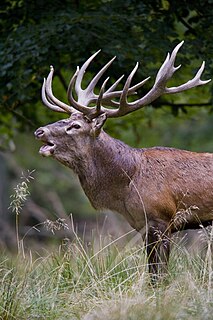
Horse teeth refers to the dentition of equine species, including horses and donkeys. Equines are both heterodontous and diphyodontous, which means that they have teeth in more than one shape, and have two successive sets of teeth, the deciduous and permanent sets.
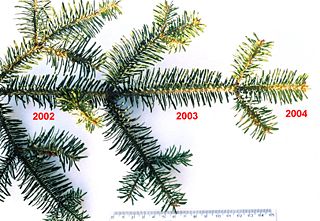
In botany, an evergreen is a plant that has leaves throughout the year that are always green. This is true even if the plant retains its foliage only in warm climates, and contrasts with deciduous plants, which completely lose their foliage during the winter or dry season. There are many different kinds of evergreen plants, both trees and shrubs. Evergreens include:

Dentition pertains to the development of teeth and their arrangement in the mouth. In particular, it is the characteristic arrangement, kind, and number of teeth in a given species at a given age. That is, the number, type, and morpho-physiology of the teeth of an animal.

In mammalian oral anatomy, the canine teeth, also called cuspids, dog teeth, fangs, or eye teeth, are relatively long, pointed teeth. However, they can appear more flattened, causing them to resemble incisors and leading them to be called incisiform. They developed and are used primarily for firmly holding food in order to tear it apart, and occasionally as weapons. They are often the largest teeth in a mammal's mouth. Individuals of most species that develop them normally have four, two in the upper jaw and two in the lower, separated within each jaw by incisors; humans and dogs are examples. In most species, canines are the anterior-most teeth in the maxillary bone.

The Yorkshire Terrier is a small dog breed of terrier type, developed during the 19th century in Yorkshire, England. Ideally its maximum size is 7 pounds (3.2 kg). A popular companion dog, the Yorkshire Terrier has also been part of the development of other breeds, such as the Australian Silky Terrier. It has a grey, black and tan coat, and the breed's nickname is Yorkie.

Wolf teeth are small, peg-like horse teeth, which sit just in front of the first cheek teeth of horses and other equids. They are vestigial first premolars and the first cheek tooth is referred to as the second premolar even when wolf teeth are not present. Torbjörn Lundström in Sweden reported that about 45-50% of 25000 horses had wolf teeth. They are much less common in the mandible than the maxilla although mandibular wolf teeth are found very occasionally.

The maxillary central incisor is a human tooth in the front upper jaw, or maxilla, and is usually the most visible of all teeth in the mouth. It is located mesial to the maxillary lateral incisor. As with all incisors, their function is for shearing or cutting food during mastication (chewing). There is typically a single cusp on each tooth, called an incisal ridge or incisal edge. Formation of these teeth begins at 14 weeks in utero for the deciduous (baby) set and 3–4 months of age for the permanent set.

a Maxillary canine is the third on the row

The maxillary first premolar is one of two teeth located in the upper jaw, laterally from both the maxillary canines of the mouth but mesial from both maxillary second premolars. The function of this premolar is similar to that of canines in regard to tearing being the principal action during mastication, commonly known as chewing. There are two cusps on maxillary first premolars, and the buccal cusp is sharp enough to resemble the prehensile teeth found in carnivorous animals. There are no deciduous maxillary premolars. Around 10-11 years of age, the primary molars are shed and the permanent premolars erupt in their place. It takes about 3 years for the adult premolar and its root to fully calcify.

Permanent teeth or adult teeth are the second set of teeth formed in diphyodont mammals. In humans and old world simians, there are thirty-two permanent teeth, consisting of six maxillary and six mandibular molars, four maxillary and four mandibular premolars, two maxillary and two mandibular canines, four maxillary and four mandibular incisors.

The maxillary second molar is the tooth located distally from both the maxillary first molars of the mouth but mesial from both maxillary third molars. This is true only in permanent teeth. In deciduous (baby) teeth, the maxillary second molar is the last tooth in the mouth and does not have a third molar behind it. The function of this molar is similar to that of all molars in regard to grinding being the principal action during mastication, commonly known as chewing. There are usually four cusps on maxillary molars, two on the buccal and two palatal.
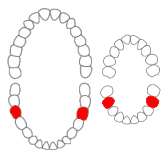
The mandibular first molar or six-year molar is the tooth located distally from both the mandibular second premolars of the mouth but mesial from both mandibular second molars. It is located on the mandibular (lower) arch of the mouth, and generally opposes the maxillary (upper) first molars and the maxillary 2nd premolar in normal class I occlusion. The function of this molar is similar to that of all molars in regard to grinding being the principal action during mastication, commonly known as chewing. There are usually five well-developed cusps on mandibular first molars: two on the buccal, two lingual, and one distal. The shape of the developmental and supplementary grooves, on the occlusal surface, are describes as being 'M' shaped. There are great differences between the deciduous (baby) mandibular molars and those of the permanent mandibular molars, even though their function are similar. The permanent mandibular molars are not considered to have any teeth that precede it. Despite being named molars, the deciduous molars are followed by permanent premolars.

Microdontia is a condition in which one or more teeth appear smaller than normal. In the generalized form, all teeth are involved. In the localized form, only a few teeth are involved. The most common teeth affected are the upper lateral incisors and third molars.

Dental anatomy is a field of anatomy dedicated to the study of human tooth structures. The development, appearance, and classification of teeth fall within its purview. Tooth formation begins before birth, and the teeth's eventual morphology is dictated during this time. Dental anatomy is also a taxonomical science: it is concerned with the naming of teeth and the structures of which they are made, this information serving a practical purpose in dental treatment.

Tooth loss is a process in which one or more teeth come loose and fall out. Tooth loss is normal for deciduous teeth, when they are replaced by a person's adult teeth. Otherwise, losing teeth is undesirable and is the result of injury or disease, such as dental avulsion, tooth decay, and gum disease. The condition of being toothless or missing one or more teeth is called edentulism.
This is a list of commonly used terms of location and direction in dentistry. This set of terms provides orientation within the oral cavity, much as anatomical terms of location provide orientation throughout the body.

Enamel hypoplasia is a defect of the teeth in which the enamel is deficient in amount, caused by defective enamel matrix formation. Defects are commonly split into one of four categories, pit-form, plane-form, linear-form, and localised enamel hypoplasia. In many cases the enamel crown has pits or a groove on it, and in extreme cases, sections of the tooth have no enamel, exposing the dentin. Enamel hypoplasia varies substantially among populations and can be used to infer health and behaviour in past populations. Defects have also been found in a variety of non-human animals.
Tooth ankylosis is the pathological fusing of cementum or dentine of a tooth root to the alveolar bone. Ankylosis of teeth is uncommon, it more often occurs in deciduous teeth than permanent teeth.