
In biochemistry, denaturation is a process in which proteins or nucleic acids lose folded structure present in their native state due to various factors, including application of some external stress or compound, such as a strong acid or base, a concentrated inorganic salt, an organic solvent, agitation and radiation, or heat. If proteins in a living cell are denatured, this results in disruption of cell activity and possibly cell death. Protein denaturation is also a consequence of cell death. Denatured proteins can exhibit a wide range of characteristics, from conformational change and loss of solubility or dissociation of cofactors to aggregation due to the exposure of hydrophobic groups. The loss of solubility as a result of denaturation is called coagulation. Denatured proteins lose their 3D structure, and therefore, cannot function.

In nuclear physics, a nuclear chain reaction occurs when one single nuclear reaction causes an average of one or more subsequent nuclear reactions, thus leading to the possibility of a self-propagating series or "positive feedback loop" of these reactions. The specific nuclear reaction may be the fission of heavy isotopes. A nuclear chain reaction releases several million times more energy per reaction than any chemical reaction.

Meringue is a type of dessert or candy, of French origin, traditionally made from whipped egg whites and sugar, and occasionally an acidic ingredient such as lemon, vinegar, or cream of tartar. A binding agent such as salt, flour or gelatin may also be added to the eggs. The key to the formation of a good meringue is the formation of stiff peaks by denaturing the protein ovalbumin via mechanical shear.
In nuclear engineering, fissile material is material that can undergo nuclear fission when struck by a neutron of low energy. A self-sustaining thermal chain reaction can only be achieved with fissile material. The predominant neutron energy in a system may be typified by either slow neutrons or fast neutrons. Fissile material can be used to fuel thermal-neutron reactors, fast-neutron reactors and nuclear explosives.

Nuclear weapon designs are physical, chemical, and engineering arrangements that cause the physics package of a nuclear weapon to detonate. There are three existing basic design types:
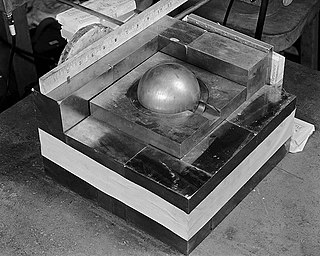
In nuclear engineering, a critical mass is the smallest amount of fissile material needed for a sustained nuclear chain reaction. The critical mass of a fissionable material depends upon its nuclear properties, density, shape, enrichment, purity, temperature, and surroundings. The concept is important in nuclear weapon design.
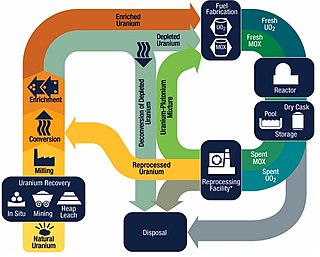
The nuclear fuel cycle, also called nuclear fuel chain, is the progression of nuclear fuel through a series of differing stages. It consists of steps in the front end, which are the preparation of the fuel, steps in the service period in which the fuel is used during reactor operation, and steps in the back end, which are necessary to safely manage, contain, and either reprocess or dispose of spent nuclear fuel. If spent fuel is not reprocessed, the fuel cycle is referred to as an open fuel cycle ; if the spent fuel is reprocessed, it is referred to as a closed fuel cycle.
Mixed oxide fuel, commonly referred to as MOX fuel, is nuclear fuel that contains more than one oxide of fissile material, usually consisting of plutonium blended with natural uranium, reprocessed uranium, or depleted uranium. MOX fuel is an alternative to the low-enriched uranium fuel used in the light-water reactors that predominate nuclear power generation.

A breeder reactor is a nuclear reactor that generates more fissile material than it consumes. These reactors can be fueled with more-commonly available isotopes of uranium and thorium, such as uranium-238 and thorium-232, as opposed to the rare uranium-235 which is used in conventional reactors. These materials are called fertile materials since they can be bred into fuel by these breeder reactors.

Egg white is the clear liquid contained within an egg. In chickens, it is formed from the layers of secretions of the anterior section of the hen's oviduct during the passage of the egg. It forms around fertilized or unfertilized egg yolks. The primary natural purpose of egg white is to protect the yolk and provide additional nutrition for the growth of the embryo . Egg white consists primarily of about 90% water into which about 10% proteins are dissolved. Unlike the yolk, which is high in lipids (fats), egg white contains almost no fat, and carbohydrate content is less than 1%. Egg whites contain about 56% of the protein in the egg. Egg white has many uses in food as well as many other uses.
Breeding is sexual reproduction that produces offspring, usually animals or plants. It can only occur between a male and a female animal or plant.
Supercritical may refer to:
Denaturation of fissile materials suitable for nuclear weapons is the process of transforming them into a form that is not suitable for weapons use and can not easily be reversely transformed. For uranium 235 this is straightforward, by mixing it with uranium 238, but for plutonium it is more difficult and/or less effective, because other plutonium isotopes are either also suitable for weapons or not available and impractical to produce, while mixing with a different element allows chemical separation.
The Fissile Material Cutoff Treaty (FMCT) is a proposed international treaty to prohibit the further production of fissile material for nuclear weapons or other explosive devices. The treaty has not been negotiated and its terms remain to be defined. According to a proposal by the United States, fissile material includes high-enriched uranium and plutonium. According to a proposal by Russia, fissile material would be limited to weapons-grade uranium and plutonium. Neither proposal would prohibit the production of fissile material for non-weapons purposes, including use in civil or naval nuclear reactors.
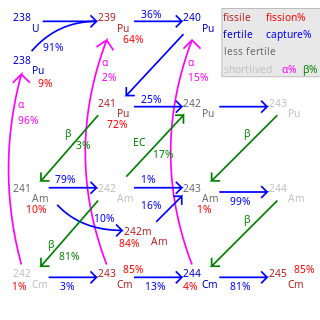
Fertile material is a material that, although not fissile itself, can be converted into a fissile material by neutron absorption.
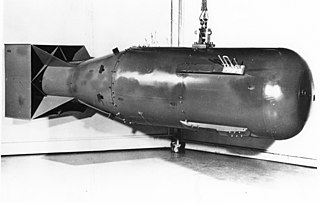
Weapons-grade nuclear material is any fissionable nuclear material that is pure enough to make a nuclear weapon and has properties that make it particularly suitable for nuclear weapons use. Plutonium and uranium in grades normally used in nuclear weapons are the most common examples.
Nuclear criticality safety is a field of nuclear engineering dedicated to the prevention of nuclear and radiation accidents resulting from an inadvertent, self-sustaining nuclear chain reaction.
Precipitation is any meteorological phenomenon featuring water falling from the clouds, such as rain, snow, or hail.

Extrusion in food processing consists of forcing soft mixed ingredients through an opening in a perforated plate or die designed to produce the required shape. The extruded food is then cut to a specific size by blades. The machine which forces the mix through the die is an extruder, and the mix is known as the extrudate. The extruder is typically a large, rotating screw tightly fitting within a stationary barrel, at the end of which is the die.

