Environment most often refers to:
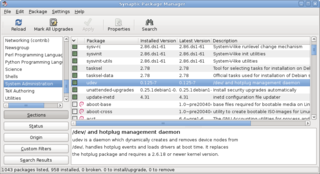
A package manager or package-management system is a collection of software tools that automates the process of installing, upgrading, configuring, and removing computer programs for a computer in a consistent manner.
In software engineering, version control is a class of systems responsible for managing changes to computer programs, documents, large web sites, or other collections of information. Version control is a component of software configuration management.
Life cycle, life-cycle, or lifecycle may refer to:
The Open Software License (OSL) is a software license created by Lawrence Rosen. The Open Source Initiative (OSI) has certified it as an open-source license, but the Debian project judged version 1.1 to be incompatible with the DFSG. The OSL is a copyleft license, with a termination clause triggered by filing a lawsuit alleging patent infringement.

Windows Update is a Microsoft service for the Windows 9x and Windows NT families of operating system, which automates downloading and installing Microsoft Windows software updates over the Internet. The service delivers software updates for Windows, as well as the various Microsoft antivirus products, including Windows Defender and Microsoft Security Essentials. Since its inception, Microsoft has introduced two extensions of the service: Microsoft Update and Windows Update for Business. The former expands the core service to include other Microsoft products, such as Microsoft Office and Microsoft Expression Studio. The latter is available to business editions of Windows 10 and permits postponing updates or receiving updates only after they have undergone rigorous testing.
Most software systems have installation procedures that are needed before they can be used for their main purpose. Testing these procedures to achieve an installed software system that may be used is known as installation testing. These procedure may involve full or partial upgrades, and install/uninstall processes.

In systems engineering, information systems and software engineering, the systems development life cycle (SDLC), also referred to as the application development life cycle, is a process for planning, creating, testing, and deploying an information system. The SDLC concept applies to a range of hardware and software configurations, as a system can be composed of hardware only, software only, or a combination of both. There are usually six stages in this cycle: requirement analysis, design, development and testing, implementation, documentation, and evaluation.
Software deployment is all of the activities that make a software system available for use.
Gluster Inc. was a software company that provided an open source platform for scale-out public and private cloud storage. The company was privately funded and headquartered in Sunnyvale, California, with an engineering center in Bangalore, India. Gluster was funded by Nexus Venture Partners and Index Ventures. Gluster was acquired by Red Hat on October 7, 2011.
This is a comparison of notable free and open-source configuration management software, suitable for tasks like server configuration, orchestration and infrastructure as code typically performed by a system administrator.
Platform as a service (PaaS) or application platform as a service (aPaaS) or platform-based service is a category of cloud computing services that allows customers to provision, instantiate, run, and manage a modular bundle comprising a computing platform and one or more applications, without the complexity of building and maintaining the infrastructure typically associated with developing and launching the application(s); and to allow developers to create, develop, and package such software bundles.
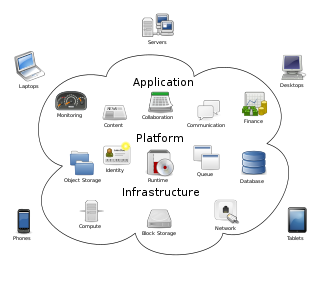
Cloud computing is the on-demand availability of computer system resources, especially data storage and computing power, without direct active management by the user. Large clouds often have functions distributed over multiple locations, each of which is a data center. Cloud computing relies on sharing of resources to achieve coherence and typically uses a "pay as you go" model, which can help in reducing capital expenses but may also lead to unexpected operating expenses for users.
NixOS is a Linux distribution built on top of the Nix package manager. It uses declarative configuration and allows reliable system upgrades. Several official package "channels" are offered, including the current Stable release and the Unstable release which follows the latest development. NixOS has tools dedicated to DevOps and deployment tasks.
In version control systems, a repository is a data structure that stores metadata for a set of files or directory structure. Depending on whether the version control system in use is distributed, like Git or Mercurial, or centralized, like Subversion, CVS, or Perforce, the whole set of information in the repository may be duplicated on every user's system or may be maintained on a single server. Some of the metadata that a repository contains includes, among other things, a historical record of changes in the repository, a set of commit objects, and a set of references to commit objects, called heads.
Continuous delivery (CD) is a software engineering approach in which teams produce software in short cycles, ensuring that the software can be reliably released at any time and, following a pipeline through a "production-like environment", without doing so manually. It aims at building, testing, and releasing software with greater speed and frequency. The approach helps reduce the cost, time, and risk of delivering changes by allowing for more incremental updates to applications in production. A straightforward and repeatable deployment process is important for continuous delivery.
A microservice architecture – a variant of the service-oriented architecture structural style – is an architectural pattern that arranges an application as a collection of loosely-coupled, fine-grained services, communicating through lightweight protocols. One of its goals is that teams can develop and deploy their services independently of others. This is achieved by the reduction of several dependencies in the code base, allowing for developers to evolve their services with limited restrictions from users, and for additional complexity to be hidden from users. As a consequence, organizations are able to develop software with fast growth and size, as well as use off-the-shelf services more easily. Communication requirements are reduced. These benefits come at a cost to maintaining the decoupling. Interfaces need to be designed carefully and treated as a public API. One technique that is used is having multiple interfaces on the same service, or multiple versions of the same service, so as to not disrupt existing users of the code.
In software deployment, an environment or tier is a computer system or set of systems in which a computer program or software component is deployed and executed. In simple cases, such as developing and immediately executing a program on the same machine, there may be a single environment, but in industrial use, the development environment and production environment are separated, often with several stages in between. This structured release management process allows phased deployment (rollout), testing, and rollback in case of problems.

