Related Research Articles

The House of Tudor was a royal house of Welsh-French origin that held the English throne, descended from the Tudors of Penmynydd and Catherine of France. Tudor monarchs ruled the Kingdom of England and its realms, including their ancestral Wales and the Lordship of Ireland from 1485 until 1603, with five monarchs in that period: Henry VII, Henry VIII, Edward VI, Mary I and Elizabeth I. The Tudors succeeded the House of Plantagenet as rulers of the Kingdom of England, and were succeeded by the House of Stuart. The first Tudor monarch, Henry VII of England, descended through his mother from a legitimised branch of the English royal House of Lancaster, a cadet house of the Plantagenets. The Tudor family rose to power in the wake of the Wars of the Roses (1455–1487), which left the Tudor-aligned House of Lancaster extinct in the male line.
Morganatic marriage, sometimes called a left-handed marriage, is a marriage between people of unequal social rank, which in the context of royalty or other inherited title prevents the principal's position or privileges being passed to the spouse, or any children born of the marriage.
The Grand Ducal Family of Luxembourg constitutes the House of Luxembourg-Nassau, headed by the sovereign Grand Duke, and in which the throne of the grand duchy is hereditary. It consists of heirs and descendants of the House of Nassau-Weilburg, whose sovereign territories passed cognatically from the House of Nassau to a cadet branch of the House of Bourbon-Parma, itself a branch of the Spanish Royal House which is agnatically a cadet branch of the House of Capet that originated in France. This is descended from the Capetian dynasty – itself a derivative dynasty from the Robertians.
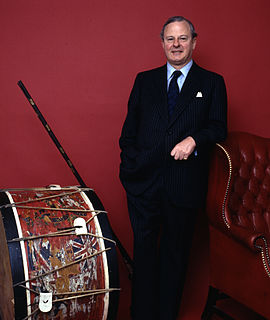
James George Alexander Bannerman Carnegie, 3rd Duke of Fife was a British landowner, farmer and peer. He was the grandson of Louise, Princess Royal, a daughter of King Edward VII and Queen Alexandra. As a female-line great-grandson of a British sovereign, he did not carry out royal or official duties or receive any funds from the Civil List. He was the second cousin of Queen Elizabeth II and Princess Margaret, Countess of Snowdon, and King Harald V of Norway. Through his maternal grandfather, he was also a descendant of King William IV and Dorothea Jordan.

Frederica Louise Caroline Sophie Alexandrina of Mecklenburg-Strelitz was a German princess who married successively Prince Louis Charles of Prussia, Prince Frederick William of Solms-Braunfels, and her first-cousin Prince Ernest Augustus, Duke of Cumberland. She became a British princess and Duchess of Cumberland when she married Ernest Augustus, the fifth son and eighth child of King George III and Queen Charlotte, her paternal aunt. Frederica was Queen of Hanover from Ernest's accession as king on 20 June 1837 until her death in 1841.

Princess Margaretha of Sweden was a member of the Swedish Royal Family and the Danish Royal Family by marriage. She was the elder sister of Crown Princess Märtha of Norway and Queen Astrid of the Belgians.

Patricia Edwina Victoria Knatchbull, 2nd Countess Mountbatten of Burma, Lady Brabourne, was a British peeress and the third cousin of Queen Elizabeth II. She was the elder daughter of heiress Edwina Ashley, a patrilineal descendant of the Earls of Shaftesbury, first ennobled in 1661, and Admiral of the Fleet the 1st Earl Mountbatten of Burma. She was the elder sister of Lady Pamela Hicks, a first cousin of Prince Philip, Duke of Edinburgh, and the last surviving baptismal sponsor to Charles, Prince of Wales.

Edward John Spencer, 8th Earl Spencer, styled Viscount Althorp until June 1975, was a British nobleman, military officer, and courtier. He was the father of Diana, Princess of Wales, and the maternal grandfather of Prince William, Duke of Cambridge, and Prince Harry, Duke of Sussex, respectively second and sixth in the line of succession to the British throne.

The use of the title of Princess of the United Kingdom of Great Britain and Northern Ireland is entirely at the will of the sovereign as expressed in letters patent. Individuals holding the title of princess are styled "Her Royal Highness" (HRH). On 18 April 1917, the newest granddaughter of Wilhelm II, German Emperor was styled a British princess from birth, even though Germany and Britain were fighting in WWI. Before the First World War, British Princesses also held additional German titles, such as Princesses of Hanover by virtue of being male line descendants of George III; or Princesses of Saxe-Coburg and Gotha, Duchess of Saxony, by virtue of being male line descendants of Prince Albert of Saxe-Coburg and Gotha. George V issued Letters Patent on 30 November 1917, to restrict the automatic assignment of the title "Princess" and the use of the style "Royal Highness" to the following persons:

Succession to the British throne is determined by descent, sex, legitimacy, and religion. Under common law, the Crown is inherited by a sovereign's children or by a childless sovereign's nearest collateral line. The Bill of Rights 1689 and the Act of Settlement 1701 restrict succession to the throne to the legitimate Protestant descendants of Sophia of Hanover who are in "communion with the Church of England". Spouses of Roman Catholics were disqualified from 1689 until the law was amended in 2015. Protestant descendants of those excluded for being Roman Catholics are eligible.

The 4th House of Orléans, sometimes called the House of Bourbon-Orléans to distinguish it, is the fourth holder of a surname previously used by several branches of the Royal House of France, all descended in the legitimate male line from the dynasty's founder, Hugh Capet. The house was founded by Philippe I, Duke of Orléans, younger son of Louis XIII and younger brother of Louis XIV, the "Sun King".

Princess Anne Antoinette Françoise Charlotte Zita Marguerite of Bourbon-Parma was the wife of King Michael I of Romania. Michael abdicated the throne in 1947, and he and Anne married the next year. Nonetheless, she was known after the marriage as Queen Anne.
Princess Anne of Denmark was a first cousin of Elizabeth II and the mother of royal photographer Patrick Anson, 5th Earl of Lichfield and Lady Elizabeth Shakerley. She became a Princess of Denmark through her second marriage.

The House of Croÿ is a family of European mediatized nobility, which held a seat in the Imperial Diet from 1486, and was elevated to the rank of Princes of the Holy Roman Empire in 1594. In 1913, the family had branches in Belgium, France, Austria and Prussia.

Princess Margaret of Denmark was a Danish princess by birth and a princess of Bourbon-Parma as the wife of Prince René of Bourbon-Parma. She was the youngest grandchild of Christian IX of Denmark and Queen Louise.

Duke of Leuchtenberg was a title created twice by the monarchs of Bavaria for their relatives. The first creation was awarded by Maximilian I, Elector of Bavaria to his son Maximilian Philipp Hieronymus, upon whose death without children the lands passed back to his nephew Elector Maximilian II. It was re-created by Maximilian I Joseph, King of Bavaria on 14 November 1817 and awarded to his son-in-law, Eugène de Beauharnais, styled Royal Highness by personal grant, and with the style Serene Highness for his agnatic descendants. Eugène was the adopted stepson of the deposed Emperor Napoleon I of France, and had previously held the title of French prince with the style Imperial Highness. He also had been the emperor's heir in Frankfurt and briefly in Italy. King Maximilian Joseph compensated his son-in-law after he lost his other titles and named him heir to the kingdom after the male-line descendants of the royal house and next in precedence after the Royal Family.

Anna Gonzaga was an Italian French noblewoman and salonist. The youngest daughter of Charles Gonzaga, Duke of Mantua and Montferrat, and Catherine de Mayenne, Anna was "Princess Palatine" as the wife of Edward of the Palatinate, a grandson of King James I of England and uncle to King George I of Great Britain. She bore Edward three children, all daughters. Had Anna not converted Edward to Catholicism, the English throne might have passed to their descendants.

Prince George Valdemar Carl Axel of Denmark was a Danish prince. He was a second cousin of Prince Philip, Duke of Edinburgh
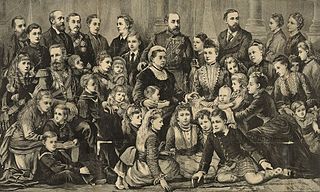
Queen Victoria, the British monarch from 1837 to 1901, and Prince Albert had 9 children, 42 grandchildren, and 87 great-grandchildren.
Baron Christian Louis de Massy is the son of Princess Antoinette of Monaco, Baroness de Massy, and her husband, international tennis champion Alexandre-Athenase Noghès. His grandfather, Antony Noghès, created the world-famous Monaco Grand Prix. He was one of the two page boys at the wedding of his uncle Rainier III with Grace Kelly.
References
http://europeandynasties.com/Descendants_of_ElizabethIIi_Windsor.htm