Related Research Articles
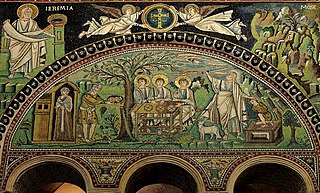
The Binding of Isaac, or simply "The Binding", is a story from Genesis 22 of the Hebrew Bible. In the biblical narrative, God tells Abraham to sacrifice his son, Isaac, on Moriah. As Abraham begins to comply, having bound Isaac to an altar, he is stopped by the Angel of the Lord; a ram appears and is slaughtered in Isaac's stead, as God commends Abraham's pious obedience.

Nora Ephron was an American journalist, writer, and filmmaker. She is best known for her romantic comedy films and was nominated three times for the Writers Guild of America Award and the Academy Award for Best Original Screenplay for Silkwood (1983), When Harry Met Sally... (1989), and Sleepless in Seattle (1993). She won the BAFTA Award for Best Original Screenplay for When Harry Met Sally..., which the Writers Guild of America ranked as the 40th greatest screenplay of all time.

Bilhah is a woman mentioned in the Book of Genesis. Genesis 29:29 describes her as Laban's handmaid, who was given to Rachel to be her handmaid on Rachel's marriage to Jacob. When Rachel failed to have children, Rachel gave Bilhah to Jacob like a wife to bear him children. Bilhah gave birth to two sons, whom Rachel claimed as her own and named Dan and Naphtali. Genesis 35:22 expressly calls Bilhah Jacob's concubine, a pilegesh. When Leah saw that she had stopped having children, she took her servant Zilpah and gave her to Jacob like a wife to bear him children as well.
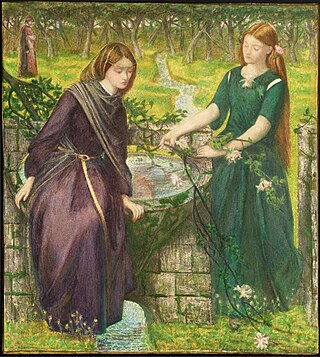
Leah appears in the Hebrew Bible as one of the two wives of the Biblical patriarch Jacob. Leah was Jacob's first wife, and the older sister of his second wife Rachel. She is the mother of Jacob's first son Reuben. She has three more sons, namely Simeon, Levi and Judah, but does not bear another son until Rachel offers her a night with Jacob in exchange for some mandrake root. Leah gives birth to two more sons after this, Issachar and Zebulun, and to Jacob's only daughter, Dinah.
In the Book of Genesis, Zilpah was Leah's handmaid, presumed slave, whom Leah gave to Jacob like a wife to bear him children. Zilpah gave birth to two sons, whom Leah claimed as her own and named Gad and Asher.
Shmendrik, oder di komishe Chaseneh is an 1877 comedy by Abraham Goldfaden, one of the earliest and most enduring pieces in Yiddish theater. The title role of Shmendrik was originally written for the young Sigmund Mogulesko, and derived from a character Mogulesko did when auditioning for Goldfaden earlier that year. The role was first played by Jacob/Yankel Katzman with great reviews. The role was later famously played by actress Molly Picon.
Moishe Finkel was a prominent figure in the early years of Yiddish theater. He was business partner first of Abraham Goldfaden and later of Sigmund Mogulesko and, for a time, was married to prima donna Annetta Schwartz. Together, they dominated Yiddish theatre in Bucharest in the early 1880s and in New York City in the late 1880s and into the 1890s, with a repertoire based mainly in the works of Joseph Lateiner and Moses Horowitz.
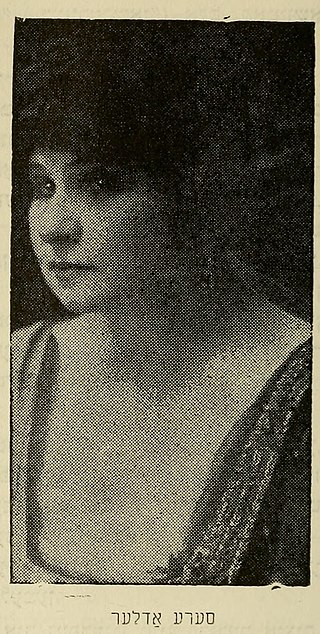
Sara Adler was a Russian-born Jewish actress in Yiddish theater who made her career mainly in the United States.
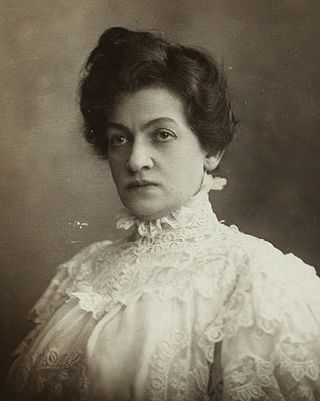
Keni Liptzin was a star in the early years of Yiddish theater, probably the greatest female dramatic star of the first great era of Yiddish theater in New York City.
Mirele Efros was an 1898 Yiddish play by Jacob Gordin. Some have called it "the Jewish Queen Lear".
Dinah Shtettin was an English-born Yiddish theater actress. She was the second wife of Jacob Adler, with whom she had a daughter, Celia in 1889; the couple divorced shortly thereafter. Despite acrimony between them, Shtettin went on to perform with Adler's troupe on the American Yiddish stage.

The New Testament provides two accounts of the genealogy of Jesus, one in the Gospel of Matthew and another in the Gospel of Luke. Matthew starts with Abraham, while Luke begins with Adam. The lists are identical between Abraham and David, but differ radically from that point. Matthew has twenty-seven generations from David to Joseph, whereas Luke has forty-two, with almost no overlap between the names on the two lists. Notably, the two accounts also disagree on who Joseph's father was: Matthew says he was Jacob, while Luke says he was Heli.
Jacob Milgrom was a prominent American Jewish Bible scholar and Conservative rabbi. Milgrom's major contribution to biblical research was in the field of cult and worship. Although he accepted the documentary hypothesis, contrary to the classical bible critics, he traced a direct line of development from the Priestly Code (P), to the Holiness Code (H), to the cultic innovations of Ezekiel, to the cultic writings of the Dead Sea sect and finally to Jewish law (halacha) of the Mishnah and Talmud. Best known for his comprehensive Torah commentaries and work on the Dead Sea Scrolls, he also published extensively on the Book of Ezekiel.
Isaac ben Abba Mari was a Provençal rabbi who hailed from Marseilles. He is often simply referred to as "Ba'al ha-Ittur," after his Magnum opus, Ittur Soferim.
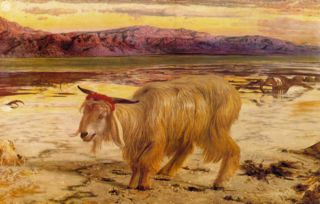
Acharei Mot is the 29th weekly Torah portion in the annual Jewish cycle of Torah reading. It is the sixth weekly portion in the Book of Leviticus, containing Leviticus 16:1–18:30. It is named after the fifth and sixth Hebrew words of the parashah, its first distinctive words.

Simeon was the second of the six sons of Jacob and Leah, and the founder of the Israelite Tribe of Simeon, according to the Book of Genesis. However, some Biblical scholars view this as postdiction, an eponymous metaphor providing an etiology of the connectedness of the tribe to others in the Israelite confederation. With Leah as a matriarch, Biblical scholars regard the tribe as having been believed by the text's authors to have been part of the original Israelite confederation. However, the tribe is absent from the parts of the Bible which textual scholars regard as the oldest. Some scholars think that Simeon was not originally regarded as a distinct tribe.

Chukat, HuQath, Hukath, or Chukkas is the 39th weekly Torah portion in the annual Jewish cycle of Torah reading and the sixth in the Book of Numbers. The parashah sets out the laws of corpse contamination and purification with the water of lustration prepared with the Red Cow. It also reports the deaths of Miriam and Aaron, the failure of Moses at the Waters of Meribah, and the conquest of Arad, the Amorites, and Bashan. The parashah comprises Numbers 19:1–22:1. The parashah is the shortest weekly Torah portion in the Book of Numbers, and is made up of 4,670 Hebrew letters, 1,245 Hebrew words, 87 verses, and 159 lines in a Torah Scroll.
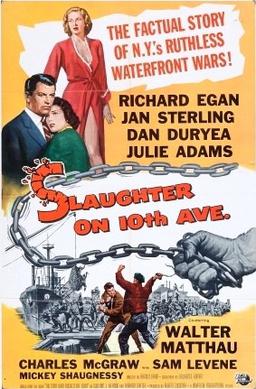
Slaughter on Tenth Avenue is a 1957 American film noir crime film directed by Arnold Laven and starring Richard Egan, Jan Sterling, Dan Duryea, Julie Adams.
The prohibition against slaughtering an animal and its offspring on the same day is a negative commandment in Judaism which forbids the slaughter of a kosher four-legged animal and its offspring on the same day.
The 1951 Fresno State Bulldogs football team represented Fresno State College—now known as California State University, Fresno—as an independent during the 1951 college football season. Led by Duke Jacobs in his second and final season as head coach, the Bulldogs compiled a record of 5–5. Fresno State played home games at Ratcliffe Stadium on the campus of Fresno City College in Fresno, California.
References
- Adler, Jacob, A Life on the Stage: A Memoir, translated and with commentary by Lulla Rosenfeld, Knopf, New York, 1999, ISBN 0-679-41351-0. 258 (commentary)
 | This article on a play from the 1890s is a stub. You can help Wikipedia by expanding it. |
 | This Yiddish language-related article is a stub. You can help Wikipedia by expanding it. |