In music, sharp, dièse, or diesis means, "higher in pitch". More specifically, in musical notation, sharp means "higher in pitch by one semitone ". Sharp is the opposite of flat, which is a lowering of pitch.

In classical music from Western culture, a diesis is either an accidental, or a very small musical interval, usually defined as the difference between an octave and three justly tuned major thirds, equal to 128:125 or about 41.06 cents. In 12-tone equal temperament three major thirds in a row equal an octave, but three justly-tuned major thirds fall quite a bit narrow of an octave, and the diesis describes the amount by which they are short. For instance, an octave (2:1) spans from C to C', and three justly tuned major thirds (5:4) span from C to B♯. The difference between C-C' (2:1) and C-B♯ (125:64) is the diesis (128:125). Notice that this coincides with the interval between B♯ and C', also called a diminished second.

A semitone, also called a half step or a half tone, is the smallest musical interval commonly used in Western tonal music, and it is considered the most dissonant when sounded harmonically. It is defined as the interval between two adjacent notes in a 12-tone scale. For example, C is adjacent to C♯; the interval between them is a semitone.

In classical music, a third is a musical interval encompassing three staff positions, and the major third is a third spanning four semitones. Along with the minor third, the major third is one of two commonly occurring thirds. It is qualified as major because it is the larger of the two: the major third spans four semitones, the minor third three. For example, the interval from C to E is a major third, as the note E lies four semitones above C, and there are three staff positions from C to E. Diminished and augmented thirds span the same number of staff positions, but consist of a different number of semitones.
The intervals from the tonic (keynote) in an upward direction to the second, to the third, to the sixth, and to the seventh scale degrees of a major scale are called major.

In music, an interval cycle is a collection of pitch classes created from a sequence of the same interval class. In other words, a collection of pitches by starting with a certain note and going up by a certain interval until the original note is reached. In other words, interval cycles "unfold a single recurrent interval in a series that closes with a return to the initial pitch class". See: wikt:cycle.
The word limma or leimma can refer to several different musical intervals, whose only common property is their small size.
Harmonice Mundi is a book by Johannes Kepler. In the work, written entirely in Latin, Kepler discusses harmony and congruence in geometrical forms and physical phenomena. The final section of the work relates his discovery of the so-called "third law of planetary motion".

In music theory, a comma is a very small interval, the difference resulting from tuning one note two different ways. Strictly speaking, there are only two kinds of comma, the syntonic comma, "the difference between a just major 3rd and four just perfect 5ths less two octaves", and the Pythagorean comma, "the difference between twelve 5ths and seven octaves". The word comma used without qualification refers to the syntonic comma, which can be defined, for instance, as the difference between an F♯ tuned using the D-based Pythagorean tuning system, and another F♯ tuned using the D-based quarter-comma meantone tuning system. Intervals separated by the ratio 81:80 are considered the same note because the 12-note Western chromatic scale does not distinguish Pythagorean intervals from 5-limit intervals in its notation. Other intervals are considered commas because of the enharmonic equivalences of a tuning system. For example, in 53TET, B♭ and A♯ are both approximated by the same interval although they are a septimal kleisma apart.

A septimal comma is a small musical interval in just intonation that contains the number seven in its prime factorization. There is more than one such interval, so the term septimal comma is ambiguous, but it most commonly refers to the interval 64/63.

In modern Western tonal music theory, a diminished second is the interval produced by narrowing a minor second by one chromatic semitone. It is enharmonically equivalent to a perfect unison. Thus, it is the interval between notes on two adjacent staff positions, or having adjacent note letters, altered in such a way that they have no pitch difference in twelve-tone equal temperament. An example is the interval from a B to the C♭ immediately above; another is the interval from a B♯ to the C immediately above.
Diesis was a British Thoroughbred racehorse and sire. An outstanding two-year-old in 1982, he failed to live up to expectations at three, but went on to become an extremely successful breeding stallion, based in the United States.
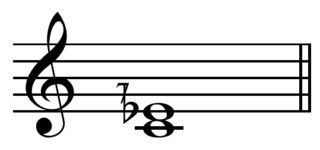
In music and tuning, the ragisma is an interval with the ratio of 4375:4374, ≈0.396 cents. It is usually defined as the difference between the septimal minor third (7:6) and two Bohlen–Pierce small semitones. It is also the difference between minor Bohlen–Pierce diesis (245:243) and septimal semicomma (126:125), as well as the difference between the septimal third tone (28:27) and the greater diesis (648:625).
In music, a breedsma is an interval between pitches with the ratio of 2401:2400, which is the difference between the septimal diesis (49:48, also known as Slendro diesis) and the septimal sixth-tone (50:49, also known as jubilisma). It is about 0.72 cents (Play (help·info)).

In music, septimal diesis is an interval with the ratio of 49:48 play (help·info), which is the difference between the septimal whole tone and the septimal minor third. It is about 35.7 cents wide, which is narrower than a quarter-tone but wider than the septimal comma. It may also be the ratio 36:35, or 48.77 cents. Play (help·info)
In music, 41 equal temperament, abbreviated 41-TET, 41-EDO, or 41-ET, is the tempered scale derived by dividing the octave into 41 equally sized steps. Play (help·info) Each step represents a frequency ratio of 21/41, or 29.27 cents, an interval close in size to the septimal comma. 41-ET can be seen as a tuning of the schismatic, magic and miracle temperaments. It is the second smallest equal temperament, after 29-ET, whose perfect fifth is closer to just intonation than that of 12-ET. In other words, is a better approximation to the ratio than either or .

In classical music from Western culture, an augmented seventh is an interval produced by widening a major seventh by a chromatic semitone. For instance, the interval from C to B is a major seventh, eleven semitones wide, and both the intervals from C♭ to B, and from C to B♯ are augmented sevenths, spanning twelve semitones. Being augmented, it is classified as a dissonant interval. However, it is enharmonically equivalent to the perfect octave.

A septimal 1/3-tone is an interval with the ratio of 28:27, which is the difference between the perfect fourth and the supermajor third. It is about 62.96 cents wide. The septimal 1/3-tone can be viewed either as a musical interval in its own right, or as a comma; if it is tempered out in a given tuning system, the distinction between these two intervals is lost. The septimal 1/3-tone may be derived from the harmonic series as the interval between the twenty-seventh and twenty-eighth harmonics. It may be considered a diesis.

Five-limit tuning, 5-limit tuning, or 5-prime-limit tuning (not to be confused with 5-odd-limit tuning), is any system for tuning a musical instrument that obtains the frequency of each note by multiplying the frequency of a given reference note (the base note) by products of integer powers of 2, 3, or 5 (prime numbers limited to 5 or lower), such as 2−3·31·51 = 15/8.
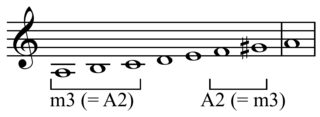
An incomposite interval is a concept in the Ancient Greek theory of music concerning melodic musical intervals between neighbouring notes in a tetrachord or scale which, for that reason, do not encompass smaller intervals. Aristoxenus defines melodically incomposite intervals in the following context:
Let us assume that given a systēma, whether pyknon or non-pyknon, no interval less than the remainder of the first concord can be placed next above it, and no interval less than a tone next below it. Let us also assume that each of the notes which are melodically successive in each genus will either form with the fourth note in order from it the concord of a fourth, or will form with the fifth note from it in order the concord of a fifth, or both, and that any note of which none of these things is true is unmelodic relative to those with which it forms no concord. Let us further assume that given that there are four intervals in the fifth, of which two are usually equal and two unequal, the unequal ones are placed next to the equal ones in the opposite order above and below. Let us assume that notes standing at the same concordant interval from successive notes are in succession with one another. Let us assume that in each genus an interval is melodically incomposite if the voice, in singing a melody, cannot divide it into intervals.
In music, 58 equal temperament divides the octave into 58 equal parts of approximately 20.69 cents each. It is notable as the simplest equal division of the octave to faithfully represent the 17-limit, and the first that distinguishes between all the elements of the 11-limit tonality diamond. The next-smallest equal temperament to do both these things is 72 equal temperament.
