
Dietrich I was the first Count of Cleves. He reigned from 1092 through 1119. He was succeeded by his son Arnold I, Count of Cleves. [1]
Dietrich I was the first Count of Cleves. He reigned from 1092 through 1119. He was succeeded by his son Arnold I, Count of Cleves. [1]

Berg was a state—originally a county, later a duchy—in the Rhineland of Germany. Its capital was Düsseldorf. It existed as a distinct political entity from the early 12th to the 19th centuries.

The County of Mark was a county and state of the Holy Roman Empire in the Lower Rhenish–Westphalian Circle. It lay on both sides of the Ruhr River along the Volme and Lenne rivers.
Engelbert of Cleves, Count of Nevers was the younger son of John I, Duke of Cleves and Elizabeth of Nevers, only surviving child of John II, Count of Nevers.
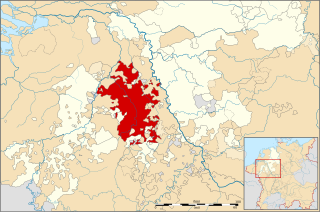
The Duchy of Jülich comprised a state within the Holy Roman Empire from the 11th to the 18th centuries. The duchy lay west of the Rhine river and was bordered by the Electorate of Cologne to the east and the Duchy of Limburg to the west. It had territories on both sides of the river Rur, around its capital Jülich – the former Roman Iuliacum – in the lower Rhineland. The duchy amalgamated with the County of Berg beyond the Rhine in 1423, and from then on also became known as Jülich-Berg. Later it became part of the United Duchies of Jülich-Cleves-Berg.

The Duchy of Cleves was a State of the Holy Roman Empire which emerged from the medieval Hettergau. It was situated in the northern Rhineland on both sides of the Lower Rhine, around its capital Cleves and the towns of Wesel, Kalkar, Xanten, Emmerich, Rees and Duisburg bordering the lands of the Prince-Bishopric of Münster in the east and the Duchy of Brabant in the west. Its history is closely related to that of its southern neighbours: the Duchies of Jülich and Berg, as well as Guelders and the Westphalian county of Mark. The Duchy was archaically known as Cleveland in English.

This is a list of the counts of Eu, a French county in the Middle Ages.

William of Jülich-Cleves-Berge was a Duke of Jülich-Cleves-Berg (1539–1592). William was born in and died in Düsseldorf. He was the only son of John III, Duke of Jülich-Cleves-Berg, and Maria, Duchess of Jülich-Berg. William took over rule of his father's estates upon his death in 1539. Despite his mother having lived until 1543, William also became the Duke of Berg and Jülich and the Count of Ravensberg.
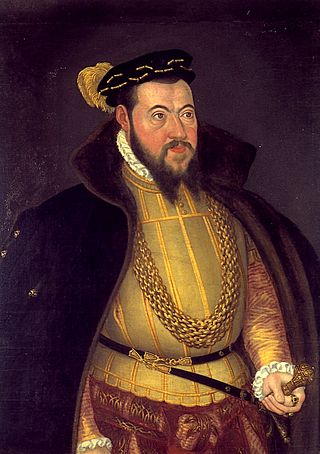
Count Palatine Wolfgang of Zweibrücken was member of the Wittelsbach family of the Counts Palatine and Duke of Zweibrücken from 1532. With the support of his regent, his uncle Rupert, Wolfgang introduced the Reformation to Zweibrücken in 1537.

John I of Zweibrücken was Count Palatine and Duke of Zweibrücken during 1569–1604.

Johann Wilhelm of Jülich-Cleves-Berg was the last Duke of Jülich-Cleves-Berg.
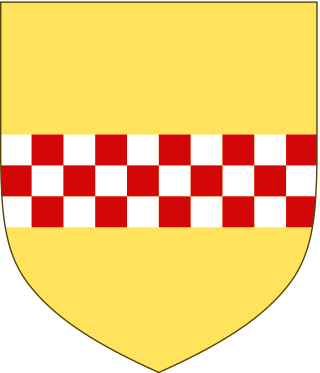
The House of La Marck was a noble family, which from about 1200 appeared as the counts of Mark.

Adolph I of Cleves was the second Count of Cleves and the fourth Count of Mark.
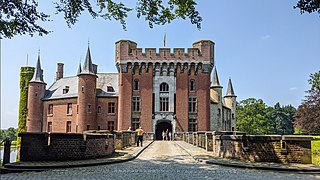
Wijnendale Castle is a historic residence in Wijnendale, West Flanders in Belgium which was once a medieval castle. The present buildings largely date to a nineteenth century restoration, though parts of the north wing still date to the fifteenth century. One wing is currently inhabited by the present owners of the castle, while another is open to the public as a museum.

John I, Duke of Cleves, Count of Mark. Jean de Belliqueux (warlike), was Duke of Cleves and Count of Mark.
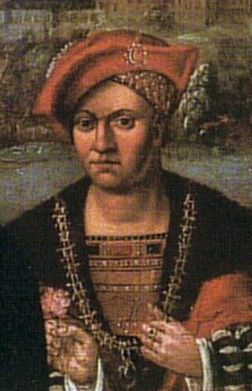
John II, "The Babymaker", Duke of Cleves, Count of Mark, was a son of John I, Duke of Cleves and Elizabeth of Nevers. He ruled Cleves from 1481 to his death in 1521. He was called "The Babymaker" as he had fathered sixty-three illegitimate children prior to his marriage with Mathilde of Hesse in 1489.

Adolph III of the Marck was the Prince-Bishop of Münster from 1357 to 1363, the Archbishop-Elector of Cologne in 1363, the Count of Cleves from 1368 to 1394, and the Count of Mark from 1391 to 1393.

Dietrich VII (1256–1305) was Count of Cleves from 1275 through 1305. He was the son of Dietrich VI, Count of Cleves and his wife Aleidis von Heinsberg. Dietrich adopted the strategy used in Holland, in the county of Cleves, methodically reclaiming territory with dikes and settling new residents.
Adolph II of the Marck was Count of the Marck.
Eberhard I was a German nobleman. He was Count of the Mark from 1277 until his death. He was the son of Engelbert I, Count of the Mark and Kunigunde of Blieskastel, daughter of Count Henry I of Blieskastel.
Margaret of Cleves, also spelled Margaretha or Margarethe was the wife of Count Adolf II of the Marck and mother of Adolf III of the Marck. She was a daughter of Count Dietrich VIII of Cleves and Margaret of Guelders, who was a daughter of Reginald I of Guelders.
| International | |
|---|---|
| National | |
| People | |
