
Maribo is a town in Lolland Municipality in Region Sjælland on the island of Lolland in south Denmark. It was the municipal seat of the former Maribo Municipality, until 1 January 2007, and then it became the seat of the current Lolland Municipality.

Sakskøbing, previously spelled Sakskjøbing, is a town on the island of Lolland in south Denmark. It has a population of 4,556. Until 1 January 2007 it was the seat of the former Sakskøbing Municipality, and is now situated in Guldborgsund Municipality in Region Sjælland.

A crown prince or hereditary prince is the heir apparent to the throne in a royal or imperial monarchy. The female form of the title, crown princess, is held by a woman who is heir apparent or is married to the heir apparent.

Eric IV, also known as Eric Ploughpenny or Eric Plowpenny, was King of Denmark from 1241 until his death in 1250. His reign was marked by conflict and civil wars against his brothers.

Christopher II was King of Denmark from 1320 to 1326 and again from 1329 until his death. He was a younger son of Eric V. His name is connected with national disaster, as his rule ended in a near-total dissolution of the Danish state.

The Duchy of Estonia, also known as Danish Estonia, was a direct dominion of the King of Denmark from 1219 until 1346 when it was sold to the Teutonic Order and became part of the Ordensstaat.
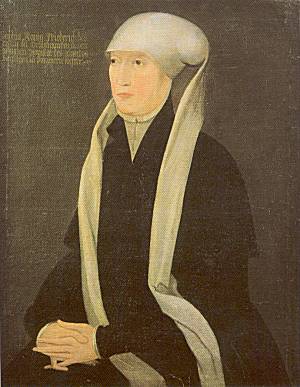
Sophie of Pomerania (1498–1568) was Queen of Denmark and Norway as the spouse of Frederick I. She is known for her independent rule over her fiefs Lolland and Falster, the castles in Kiel and Plön, and several villages in Holstein as queen.
This lists those feudal magnates who have held Halland (Hallandia) as fief, or its southern or northern part, as a substantive title.
Canute or Knud Valdemarsen was an illegitimate son of King Valdemar II of Denmark, who became Duke of Revelia, Blekinge and Lolland.

Lolland is the fourth largest island of Denmark, with an area of 1,243 km2 (480 sq mi). Located in the Kattegat, Belts and Sund area, it is part of Region Sjælland. As of 1 January 2022, it has 57,618 inhabitants. Lolland is closely connected to the island of Falster to its east. The locality of Sundby forms a cross-island urban area with Nykøbing Falster, the largest conurbation partially on Lolland. The most populated settlement on Lolland proper is Nakskov.
The first duke of Estonia was appointed in 1220 by King Valdemar II of Denmark after the Danish conquest of Estonia during the Livonian crusade. The title was resumed by the kings of Denmark since 1269. During the 1266-82 reign of the queen dowager Margaret Sambiria, the title lady of Estonia was used.

Olaf Rude was a Danish painter. He was a professor at the Royal Danish Academy of Art from 1953 to 1956. He is remembered in particular for his paintings of oak trees at Skejten on Lolland, two of which can be seen at Christiansborg.

Euphemia of Pomerania was Queen of Denmark as the spouse of King Christopher II. She was the daughter of Bogislaw IV, Duke of Pomerania, and his second spouse, Margarete of Rügen.

The House of Estridsen was a dynasty that provided the kings of Denmark from 1047 to 1412. The dynasty is named after its ancestor Estrid Svendsdatter. The dynasty is sometimes called the Ulfinger, after Estrid's husband, Ulf Jarl. The dynasty also provided three medieval rulers of Sweden and one of Norway. Their family coat of arms became the coat of arms of Denmark and thereby influenced the coat of arms of Tallinn and the coat of arms of Estonia.
Events from the year 1702 in Denmark.

Christopher, Duke of Lolland, was the son of King Valdemar IV of Denmark and his wife, Helvig of Schleswig. Christopher was appointed duke in 1359 and also was selected to succeed as king.
Otto of Denmark was a Danish prince who was also Duke of Lolland and Estonia.
Insular Danish are the traditional Danish dialects spoken on the islands of Zealand, Langeland, Funen, Falster, Lolland, and Møn. They are recorded in the Dictionary of Danish Insular Dialects (Ømålsordbogen) which has been collected since the 1920s, and published in biannual volumes since 1992. There are significant differences between the different insular varieties, but they also share a number of features. A major difference is between Modern Danish and the traditional insular dialects are that some of them lack the stød but kept the tonal accent. Also, they kept three noun genders.
Events from the 14th century in Denmark.
Events from the 1310s in Denmark.
