Laxatives, purgatives, or aperients are substances that loosen stools and increase bowel movements. They are used to treat and prevent constipation.
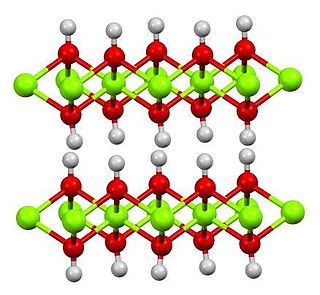
Magnesium hydroxide is the inorganic compound with the chemical formula Mg(OH)2. It occurs in nature as the mineral brucite. It is a white solid with low solubility in water (Ksp = 5.61×10⁻¹²). Magnesium hydroxide is a common component of antacids, such as milk of magnesia, as well as laxatives.

Phenolphthalein is a chemical compound with the formula C20H14O4 and is often written as "HIn" or "phph" in shorthand notation. Phenolphthalein is often used as an indicator in acid–base titrations. For this application, it turns colorless in acidic solutions and pink in basic solutions. It belongs to class of dyes known as phthalein dyes.

Cisapride is a gastroprokinetic agent, a drug that increases motility in the upper gastrointestinal tract. It acts directly as a serotonin 5-HT4 receptor agonist and indirectly as a parasympathomimetic. Stimulation of the serotonin receptors increases acetylcholine release in the enteric nervous system. It has been sold under the trade names Prepulsid (Janssen-Ortho) and Propulsid (in the United States). It was discovered by Janssen Pharmaceutica in 1980. In many countries, it has been either withdrawn from the market or had its indications limited due to incidences of serious cardiac side-effects.

Lactitol is a sugar alcohol used as a replacement bulk sweetener for low calorie foods with approximately 40% of the sweetness of sugar. It is also used medically as a laxative. Lactitol is produced by two manufacturers, Danisco and Purac Biochem.

A fecal impaction is a solid, immobile bulk of feces that can develop in the rectum as a result of chronic constipation. A related term is fecal loading which refers to a large volume of stool in the rectum of any consistency.

Maltitol is a sugar alcohol used as a sugar substitute. It has 75–90% of the sweetness of sucrose and nearly identical properties, except for browning. It is used to replace table sugar because it is half as caloric, does not promote tooth decay, and has a somewhat lesser effect on blood glucose. In chemical terms, maltitol is known as 4-O-α-glucopyranosyl-D-sorbitol. It is used in commercial products under trade names such as Lesys, Maltisweet and SweetPearl.
Fletcher's Castoria, now known as Fletcher's Laxative, is an oral syrup containing a stimulant laxative and ingredients to soothe the stomach. It is a product of The Mentholatum Company, Inc.

Prune juice is a fruit juice derived from prunes that have been rehydrated. It is a mass-produced product that is often produced using a hot extraction method, and juice concentrate is typically produced using a low-temperature extraction method. It is used by some as a dietary supplement to act as a laxative and to alleviate constipation. It is also sometimes used as a flavor enhancer in tobacco products.
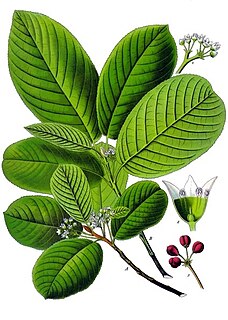
Rhamnus purshiana is a species of buckthorn native to western North America from southern British Columbia south to central California, and eastward to northwestern Montana.

Carter's Little Liver Pills were formulated as a patent medicine by Samuel J. Carter of Erie, Pennsylvania, in 1868. The active ingredient was changed when it was renamed in 1959 to be the laxative bisacodyl.

Magnesium citrate is a magnesium preparation in salt form with citric acid in a 1:1 ratio. The name "magnesium citrate" is ambiguous and sometimes may refer to other salts such as trimagnesium citrate which has a magnesium:citrate ratio of 3:2.

Dantron (INN), also known as chrysazin or 1,8-dihydroxyanthraquinone, is an organic substance, formally derived from anthraquinone by the replacement of two hydrogen atoms by hydroxyl groups (–OH). It is used in some countries as a stimulant laxative.

Senna alexandrina is an ornamental plant in the genus Senna. It is used in herbalism. It grows natively in lower Egypt, especially in the Nubian region, and near Khartoum (Sudan), where it is cultivated commercially. It is also grown elsewhere, notably in India and Somalia.

Sodium picosulfate is a contact stimulant laxative used as a treatment for constipation or to prepare the large bowel before colonoscopy or surgery. It is sold under the trade names Sodipic Picofast, Laxoberal, Laxoberon, Purg-Odan, Picolax, Guttalax, Namilax, Pico-Salax, PicoPrep, and Prepopik, among others.
Liquid paraffin, also known as paraffinum liquidum, is a very highly refined mineral oil used in cosmetics and for medical purposes. This is a UK definition and the term may have different uses in other countries. The cosmetic or medicinal liquid paraffin should not be confused with the paraffin used as a fuel.

Oxyphenisatine is a laxative. It is closely related to bisacodyl, sodium picosulfate, and phenolphthalein. Long-term use is associated with liver damage, and as a result, it was withdrawn in most countries in the early 1970s. The acetate derivative oxyphenisatine acetate was also once used as a laxative.

Docusate, also known as docusate salts or dioctyl sulfosuccinate, is a laxative of the stool softener type used to treat constipation. It is considered a good choice in children who have hard feces. For constipation that occurs as a side effect of opiate use, it may be used alone or with a stimulant laxative. It may be taken orally as a capsule or rectally as either an enema or a suppository. It may be taken by mouth or used rectally. By mouth a bowel movement often occurs in 1 to 3 days, while rectal use may be effective within 20 minutes.