
The National Liberation Front (Greek: Εθνικό Απελευθερωτικό Μέτωπο, Ethnikó Apeleftherotikó Métopo was an alliance of various political parties and organizations which fought to liberate Greece from Axis Occupation. It was the main movement of the Greek Resistance during the occupation of Greece. Its main driving force was the Communist Party of Greece, but its membership throughout the occupation included several other leftist and republican groups. ΕΑΜ became the first true mass social movement in modern Greek history. Its military wing, the Greek People's Liberation Army, quickly grew into the largest armed guerrilla force in the country, and the only one with nationwide presence. At the same time, from late 1943 onwards, the political enmity between ΕΑΜ and rival resistance groups from the centre and right evolved into a virtual civil war, while its relationship with the British and the British-backed Greek government in exile was characterized by mutual mistrust, leading EAM to establish its own government, the Political Committee of National Liberation, in the areas it had liberated in spring 1944. Tensions were resolved provisionally in the Lebanon Conference in May 1944, when EAM agreed to enter the Greek government in exile under Georgios Papandreou. The organization reached its peak after liberation in late 1944, when it controlled most of the country, before suffering a catastrophic military defeat against the British and the government forces in the Dekemvriana clashes. This marked the beginning of its gradual decline, the disarmament of ELAS, and the open persecution of its members during the "White Terror", leading eventually to the outbreak of the Greek Civil War.
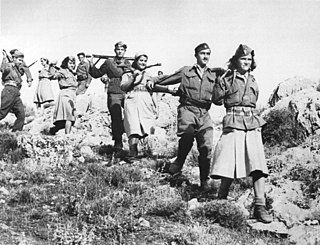
The Greek People's Liberation Army (Greek: Ελληνικός Λαϊκός Απελευθερωτικός Στρατός, Ellinikós Laïkós Apeleftherotikós Stratós was the military arm of the left-wing National Liberation Front during the period of the Greek resistance until February 1945, when, following the Dekemvriana clashes and the Varkiza Agreement, it was disarmed and disbanded. ELAS was the largest and most significant of the military organizations of the Greek resistance.
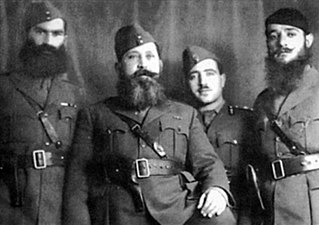
The Greek resistance, involved armed and unarmed groups from across the political spectrum that resisted the Axis occupation of Greece in the period 1941–1944, during World War II. The largest group was the Communist-dominated EAM-ELAS. The Greek Resistance is considered one of the strongest resistance movements in Nazi-occupied Europe, with partisans, known as andartes, controlling much of the countryside prior to the German withdrawal from Greece in late 1944.
The National Republican Greek League was one of the major resistance groups formed during the Axis occupation of Greece during World War II.

The occupation of Greece by the Axis Powers began in April 1941 after Nazi Germany invaded the Kingdom of Greece to assist its ally, Fascist Italy, which had been at war with Allied Greece since October 1940. Following the conquest of Crete, all of Greece was occupied by June 1941. The occupation of the mainland lasted until Germany and its ally Bulgaria were forced to withdraw under Allied pressure in early October 1944. However, German garrisons remained in control of Crete and some other Aegean islands until after the end of World War II in Europe, surrendering these islands in May and June 1945.

Anna Vissi is the name of a self-titled album by Greek singer Anna Vissi. It is the first album with lifelong collaborator and companion Nikos Karvelas, who is credited under the alias "Nikos Leonardos". It was released in Greece and Cyprus in 1981 by EMI Greece. The album includes both original songs as well as several Greek covers of international hits. The album reached gold status.

The Political Committee of National Liberation, commonly known as the "Mountain Government", was a Communist Party-dominated government established in Greece in 1944 in opposition to both the collaborationist German-controlled government at Athens and to the royal government-in-exile in Cairo. It was integrated with the Greek government-in-exile in a national unity government at the Lebanon conference in May 1944.
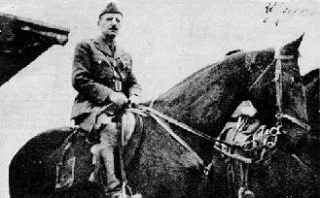
Stefanos Sarafis was an officer of the Hellenic Army and Major General in EAM-ELAS), who played an important role during the Greek Resistance.

Athanasios Klaras, better known by the nom de guerreAris Velouchiotis, was a Greek journalist, politician, member of the Communist Party of Greece, the most prominent leader and chief instigator of the Greek People's Liberation Army (ELAS) and the military branch of the National Liberation Front (EAM), which was the major resistance organization in occupied Greece from 1942 to 1945.

The Dekemvriana refers to a series of clashes fought during World War II in Athens from 3 December 1944 to 11 January 1945. The conflict was the culmination of months of tension between the communist EAM, some parts of its military wing, the ELAS stationed in Athens, the KKE and the OPLA from one side and from the other side, the Greek Government, some parts of the Hellenic Royal Army, the Hellenic Gendarmerie, the Cities Police, the far-right Organization X, among others and also the British Army.

This Is My Live is the name of the second live album by Greek singer Sakis Rouvas, released on 12 December 2007 in Greece and Cyprus by Minos EMI. The album was recorded on 9 September 2007 at Rouvas' sold-out show at Lycabetus Theatre with an audience of 7,000. The concert was the final stop on the musician's Benefit Tour for the Greek fire victims of 2007. The combined effort of the tour and other appearances by Rouvas raised over €1,000,000 in fundraiser, becoming one of the greatest sources of aid and relief. The majority of the proceeds of this concert went to fire victims in Greece, particularly those of the 2007 Greek forest fires, however, another intention was to promote blood donation which was running short in Athens. As a result, thousands of pints of blood were collected.
White Terror is the name of several episodes of mass violence in history, carried out by conservative or nationalist groups against anarchists, communists, socialists, liberals, revolutionaries, or other opponents. It is sometimes contrasted with, and is the opposite of, a red terror. It may refer to:

The Greek Civil War took place from 1946 to 1949. It was mainly fought against the established Kingdom of Greece, which was supported by the United Kingdom and the United States and won in the end. The losing opposition held a self-proclaimed people's republic, the Provisional Democratic Government of Greece, which was governed by the Communist Party of Greece (KKE) and its military branch, the Democratic Army of Greece (DSE). The rebels were supported by Yugoslavia and the Soviet Union.
The National Bands Agreement was an agreement concluded on 5 July 1943 at the village of Liaskovo, between the British military mission to occupied Greece and the three main Greek Resistance organizations, EAM-ELAS, EDES and EKKA. Its aim was to coordinate the actions of the Resistance movement in Greece, including the establishment of a joint headquarters under the aegis of the British GHQ Middle East.
The Feneos Executions is the name given to a series of killings committed by the Greek People's Liberation Army (ELAS) resistance group, and especially by its secret police OPLA, in the Feneos area of Corinthia, Greece, during the first stages of the Greek Civil War, while the country was still occupied by the Axis Powers.
The Battle of Fardykambos, also known as the Battle of Bougazi, was fought between the National Liberation Front (EAM-ELAS) of the Greek Resistance against the Italian troops during the Axis Occupation of Greece. The battle was notable for the large-scale and spontaneous participation of the local populace, and of officers from other groups and organizations, including right-wing rivals to ELAS.
The Panhellenic Liberation Organization, was a Greek resistance organization against the Axis occupation of Greece. It was founded in 1941 by a group of Greek army officers, under the name Defenders of Northern Greece, employing methods of non violent resistance. In 1943, YVE was renamed as the Panhellenic Liberation Organization (PAO), shifting its focus towards armed struggle. In the August of the same year it came into conflict with Greek People's Liberation Army (ELAS), a communist-led resistance organization. PAO was defeated in the ensuing civil war and its remnants turned towards collaboration with the Germans.
The Battle of Meligalas took place at Meligalas in Messenia in southwestern Greece, on 13–15 September 1944, between the Greek Resistance forces of the Greek People's Liberation Army (ELAS) and the collaborationist Security Battalions.
Red Terror is a term used by some historians to describe incidents of violence against civilians, by EAM from approximately 1942 or 1943 until the end of the Greek Civil War in 1949. In the countryside, operations were conducted by the ELAS; in cities, by the Organization for the Protection of the People's Struggle (OPLA).
