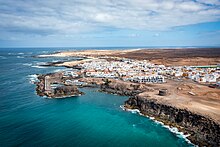
The Canary Islands, also known informally as the Canaries, are a Spanish region, autonomous community and archipelago in the Atlantic Ocean. At their closest point to the African mainland, they are 100 kilometres west of Morocco. They are the southernmost of the autonomous communities of Spain. The islands have a population of 2.2 million people and are the most populous special territory of the European Union.

Fuerteventura is one of the Canary Islands, in the Atlantic Ocean, geographically part of Macaronesia, and politically part of Spain. It is located 97 km (60 mi) away from the coast of North Africa. The island was declared a biosphere reserve by UNESCO in 2009.
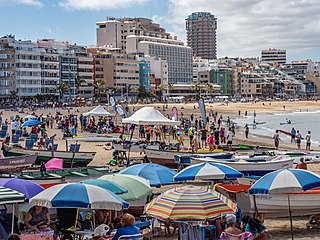
Las Palmas, officially Las Palmas de Gran Canaria, is a Spanish city and capital of Gran Canaria, in the Canary Islands, in the Atlantic Ocean.

Gran Canaria, also Grand Canary Island, is the third-largest and second-most-populous island of the Canary Islands, an archipelago off the Atlantic coast of Northwest Africa and is part of Spain. As of 2023 the island had a population of 862,893 that constitutes approximately 40% of the population of the archipelago. Las Palmas de Gran Canaria, the capital of the island, is the biggest city of the Canary Islands and the ninth of Spain.
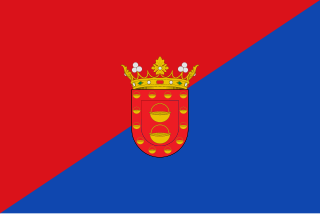
Lanzarote is a Spanish island, the easternmost of the Canary Islands in the Atlantic Ocean, 125 kilometres off the north coast of Africa and 1,000 kilometres from the Iberian Peninsula. Covering 845.94 square kilometres, Lanzarote is the fourth-largest of the islands in the archipelago. With 163,230 inhabitants at the beginning of 2024, it is the third most populous Canary Island, after Tenerife and Gran Canaria. Located in the centre-west of the island is Timanfaya National Park, one of its main attractions. The island was declared a biosphere reserve by UNESCO in 1993. The island's capital is Arrecife, which lies on the eastern coastline. It is the smaller main island of the Province of Las Palmas.

Arrecife is the capital city and a municipality of Lanzarote in the Canary Islands. It was made the island's capital in 1852. The city owes its name to the rock reef which covers its local beach. It also gives its name to the nearby Arrecife Airport. The population of the municipality was 64,645 in 2020. Its area is 22.72 square kilometres (8.77 sq mi).

Puerto del Carmen is the main tourist town on the island of Lanzarote, Canary Islands, Spain. It is part of the municipality of Tías. Most of Lanzarote's over 1 million visitors per year choose this town as their destination. As a result, almost all of the town's economy revolves around tourism.

Puerto del Rosario is a town and a municipality in the eastern part of the island of Fuerteventura in the Las Palmas province in the Canary Islands. It has been the capital of Fuerteventura since 1860. The town's population is 29,160 (2013), the administrative district's population is 36,744 and its area is 289.95 km².

La Oliva is a town and a municipality in the northern part of the island of Fuerteventura in the Province of Las Palmas, Canary Islands, Spain. The population is 29,174 (2023), and the area is 356.13 km2. The municipality includes the Lobos Island to the northeast, just off Corralejo.

Betancuria is a small town and a municipality in the western part of the island of Fuerteventura in the Province of Las Palmas, Canary Islands, Spain. The population is 811 (2013), and the area is 103.64 km2 (40 sq mi). It is situated in a mountainous region, 4 km (2 mi) west of Antigua and 21 km (13 mi) southwest of the island capital Puerto del Rosario. By population it is the smallest municipality in Fuerteventura as well as all of the Canary Islands. Betancuria is named after Jean de Béthencourt, who founded the town in 1404 with Gadifer de La Salle. It was the original capital of the Kingdom of the Canary Islands, and later capital of Fuerteventura.

The Tostón Lighthouse or El Cotillo Lighthouse is an active lighthouse on the Canary island of Fuerteventura. The lighthouse is situated on the northwestern coast of the island near to the village of El Cotillo, in the municipality of La Oliva. In conjunction with the lights at Pechiguera and Punta Martiño, it marks the narrow La Bocayna strait that separates Fuerteventura from the adjacent island of Lanzarote.

Punta La Entallada or La Entallada Lighthouse is an active lighthouse on the Canary island of Fuerteventura. It is located on the east coast, near the village of Las Playitas in Tuineje.

The Morro Jable Lighthouse is an active lighthouse on the Canary island of Fuerteventura. The lighthouse is situated at the edge of the beach near the town and resort of Morro Jable.
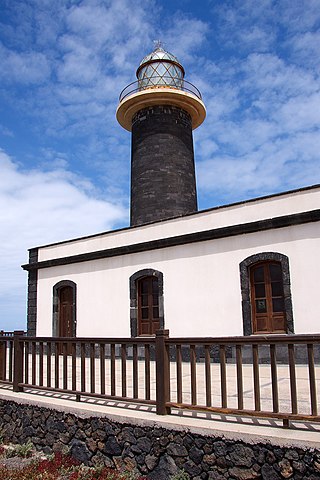
The Punta Jandía Lighthouse is an active lighthouse on the Canary island of Fuerteventura. The name derives from its location on the Punta de Jandía, at the end of the much larger Jandía peninsula, which forms the south west part of the island.

The Punta Martiño Lighthouse is an active lighthouse on the Canary island of Lobos, near Fuerteventura in the municipality of La Oliva.

The Puerto del Rosario Lighthouse also known as the Punta Gaviota Lighthouse is a modern active lighthouse on the Canary island of Fuerteventura. It is located in an industrial area at the north-eastern end of the town of Puerto del Rosario, the capital and major port of the island in the Province of Las Palmas.

Defense tower “Torre del Tostón” is located in the coastal town of el Cotillo, which forms part of the municipality of la Oliva, Fuerteventura, Spain. This defense tower was recognized as historic-artistic monument in 1949. Nowadays, famous local artists use Torre del Tostón as exhibition room, and it's one of the island's main tourist destinations, including as viewpoint.

Castillo de San Buenaventura is a defense tower located in Caleta de Fuste, a small town on the island of Fuerteventura, Canary Islands, Spain. It is also known as "Castillo de Caleta de Fuste", and the tower was recognized as historic-artistic monument in 1949.
As in the rest of Spain, the majority religion in the Canary Islands is the Catholic Church. The Catholic religion has been the majority since the Conquest of the Canary Islands in the fifteenth century. This religion would largely replace the Canarian aboriginal religion through the prohibition of the latter and syncretism. According to a survey conducted in 2019, Canary Islands is the fifth autonomous community in Spain with the highest percentage of people who declare themselves to be Catholics after the Region of Murcia, Extremadura, Galicia, Aragon, and Castile and León. 76.7% of the population is Catholic.

The Playa de Las Canteras is the main urban beach of the city of Las Palmas de Gran Canaria, one of the most important beaches of the Canary Islands.