Mérida or Merida may refer to:
Xanthus or Xanthos may refer to:

Shivta, originally Sobata or Subeita, is an ancient city in the Negev Desert of Israel located 43 kilometers southwest of Beersheba. Shivta was declared a UNESCO World Heritage Site in June 2005, as part of the Incense Route and the Desert Cities of the Negev, together with Haluza/Elusa, Avdat and Mamshit/Mampsis.
Tripoli or Tripolis may refer to:
Pyrgos or Pyrgus may refer to:
Arta, ARTA, or Artà may refer to:
Larissa is the capital and largest city of Thessaly, Greece
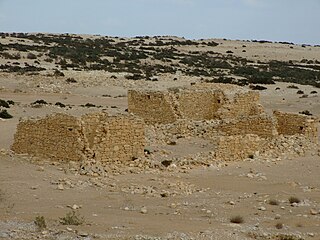
The ancient city of Halasa or Chellous, Elusa (Ελουϲα) in the Byzantine period, was a city in the Negev near present-day Kibbutz Mash'abei Sadeh that was once part of the Nabataean Incense Route. It lay on the route from Petra to Gaza. Today it is known as Haluza, and during periods of Arab habitation it was known as al-Khalūṣ and Al-Khalasa.

Novempopulania was one of the provinces created by Diocletian out of Gallia Aquitania, which was also called Aquitania Tertia.

Al-Khalasa, was a Palestinian village, located 23 kilometers southwest of the town of Beersheba. The village stood at the site of an ancient town from the Nabatean, Roman, Byzantine, and the beginning of the Early Muslim period. The ancient city, founded by the Nabateans, is known from Greek and Roman sources as "Halasa" or "Chellous", and later as "Elusa", one of the Byzantine administrative centers in the Negev Desert. Still important in the century of the Muslim conquest, it was deserted not long after. The site was repopulated by Bedouin in the early twentieth century, after western archaeologists took an interest in it. In October 1948, it was captured by Israel during the 1948 Arab-Israeli War. The population of al-Khalasa is unknown, but all of the inhabitants were Muslims, from the al-Azizma tribe.

The Elusates were an Aquitani tribe dwelling in the modern Gers department, around present-day Eauze, France during the Iron Age and the Roman period.

Eauze is a commune in the Gers department in southwestern France.

The former Roman Catholic Metropolitan Archdiocese of Eauze, in Aquitaine, south-west France, existed from circa 300 to 879.
Elusa inventa is a species of moth of the family Noctuidae. It was described by Emilio Berio in 1977, and is known from China.
The administration of Judaea as a province of Rome from 6 to 135 was carried out primarily by a series of Roman Prefects, Procurators, and Legates. These administrators coincided with the ostensible rule by Hasmonean and Herodian rulers of Judea. The Roman administrators were as follows:
Corcyra is Latin for Corfu, a Greek island in the Ionian Sea.

Elusa is the Aquitani-Roman city of the Elusates in Caesar's southwestern Gaul, the present-day town of Eauze in the Gers département. The city's name comes from the name of the Aquitanian (proto-Basque) Elusates people. It evolved into Elsa in the 10th century, then Euso in Gascon and, finally, Éauze in French.
This page is based on this
Wikipedia article Text is available under the
CC BY-SA 4.0 license; additional terms may apply.
Images, videos and audio are available under their respective licenses.
