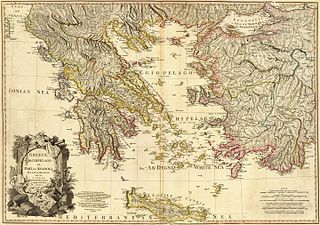
Aegean civilization is a general term for the Bronze Age civilizations of Greece around the Aegean Sea. There are three distinct but communicating and interacting geographic regions covered by this term: Crete, the Cyclades and the Greek mainland. Crete is associated with the Minoan civilization from the Early Bronze Age. The Cycladic civilization converges with the mainland during the Early Helladic ("Minyan") period and with Crete in the Middle Minoan period. From c. 1450 BC, the Greek Mycenaean civilization spreads to Crete, probably by military conquest. The earlier Aegean farming populations of Neolithic Greece brought agriculture westward into Europe before 5000 BC.
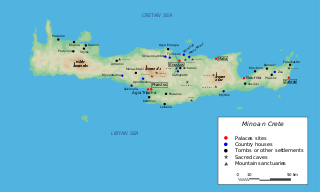
The Minoan civilization was a Bronze Age culture which was centered on the island of Crete. Known for its monumental architecture and energetic art, it is often regarded as the first civilization in Europe. The ruins of the Minoan palaces at Knossos and Phaistos are popular tourist attractions.
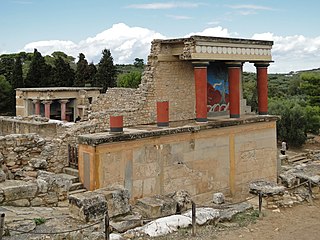
Knossos is a Bronze Age archaeological site in Crete. The site was a major centre of the Minoan civilization and is known for its association with the Greek myth of Theseus and the minotaur. It is located on the outskirts of Heraklion, and remains a popular tourist destination. Knossos is considered by many to be the oldest city in Europe.

Tiryns is a Mycenaean archaeological site in Argolis in the Peloponnese, and the location from which the mythical hero Heracles was said to have performed his Twelve Labours. It lies 20 km (12 mi) south of Mycenae.

The Carians were the ancient inhabitants of Caria in southwest Anatolia, who spoke the Carian language.
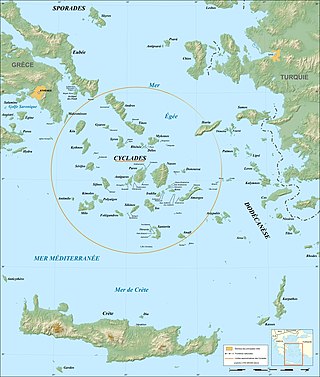
Cycladic culture was a Bronze Age culture found throughout the islands of the Cyclades in the Aegean Sea. In chronological terms, it is a relative dating system for artifacts which is roughly contemporary to Helladic chronology and Minoan chronology (Crete) during the same period of time.

Mycenaean Greece was the last phase of the Bronze Age in ancient Greece, spanning the period from approximately 1750 to 1050 BC. It represents the first advanced and distinctively Greek civilization in mainland Greece with its palatial states, urban organization, works of art, and writing system. The Mycenaeans were mainland Greek peoples who were likely stimulated by their contact with insular Minoan Crete and other Mediterranean cultures to develop a more sophisticated sociopolitical culture of their own. The most prominent site was Mycenae, after which the culture of this era is named. Other centers of power that emerged included Pylos, Tiryns, and Midea in the Peloponnese, Orchomenos, Thebes, and Athens in Central Greece, and Iolcos in Thessaly. Mycenaean settlements also appeared in Epirus, Macedonia, on islands in the Aegean Sea, on the south-west coast of Asia Minor, and on Cyprus, while Mycenaean-influenced settlements appeared in the Levant and Italy.

Aigeira is a town and a former municipality in northeastern Achaea, West Greece, Greece. Since the 2011 local government reform it has been a municipal unit of the Aigialeia municipality, with an area of 103.646 km2. The municipal unit stretches from the Gulf of Corinth, where the town of Aigeira is located, to the mountains in the south. The town of Aigeira is 26 km (16 mi) southeast of Aigio, 55 km (34 mi) northwest of Corinth and 55 km (34 mi) east of Patras.
Helladic chronology is a relative dating system used in archaeology and art history. It complements the Minoan chronology scheme devised by Sir Arthur Evans for the categorisation of Bronze Age artefacts from the Minoan civilization within a historical framework. Whereas Minoan chronology is specific to Crete, the cultural and geographical scope of Helladic chronology is confined to mainland Greece during the same timespan. Similarly, a Cycladic chronology system is used for artifacts found in the Aegean islands. Archaeological evidence has shown that, broadly, civilisation developed concurrently across the whole region and so the three schemes complement each other chronologically. They are grouped together as "Aegean" in terms such as Aegean art and, rather more controversially, Aegean civilization.

The Minoan civilization produced a wide variety of richly decorated Minoan pottery. Its restless sequence of quirky maturing artistic styles reveals something of Minoan patrons' pleasure in novelty while they assist archaeologists in assigning relative dates to the strata of their sites. Pots that contained oils and ointments, exported from 18th century BC Crete, have been found at sites through the Aegean islands and mainland Greece, in Cyprus, along coastal Syria and in Egypt, showing the wide trading contacts of the Minoans.
Hagia Triada, is a Minoan archaeological site in Crete. The site includes the remains of an extensive settlement noted for its monumental NeoPalatial and PostPalatial period buildings especially the large Royal Villa. It is located in the Mesara Plain about three kilometers from the larger Palace of Phaistos, with which it appears to have had close political and economic ties. It is also nearby the Minoan harbor site of Kommos. Excavations at Hagia Triada have provided crucial evidence concerning Minoan everyday life.

Mochlos is a small, uninhabited island in the Gulf of Mirabello in eastern Crete, and the archaeological site of an ancient Minoan settlement. There is evidence that Mochlos was not an island in Minoan times, but was attached to the mainland and acted as an eastern harbor.
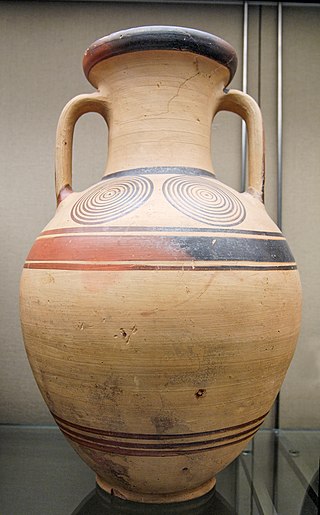
The Protogeometric style is a style of Ancient Greek pottery led by Athens and produced, in Attica and Central Greece, between roughly 1025 and 900 BCE, during the Greek Dark Ages. It was succeeded by the Early Geometric period.

Minoan chronology is a framework of dates used to divide the history of the Minoan civilization. Two systems of relative chronology are used for the Minoans. One is based on sequences of pottery styles, while the other is based on the architectural phases of the Minoan palaces. These systems are often used alongside one another.

Minyan ware is a broad archaeological term describing varieties of a particular style of Aegean burnished pottery associated with the Middle Helladic period. The term was coined in the 19th century by German archaeologist Heinrich Schliemann after discovering the pottery in Orchomenos, Greece. Excavations conducted during the 1960s confirmed that Minyan ware evolved from the burnished pottery developed by the Tiryns culture of the Early Helladic III period.

Minoan art is the art produced by the Bronze Age Aegean Minoan civilization from about 3000 to 1100 BC, though the most extensive and finest survivals come from approximately 2300 to 1400 BC. It forms part of the wider grouping of Aegean art, and in later periods came for a time to have a dominant influence over Cycladic art. Since wood and textiles have decomposed, the best-preserved surviving examples of Minoan art are its pottery, palace architecture, small sculptures in various materials, jewellery, metal vessels, and intricately-carved seals.

Phylakopi, located at the northern coast of the island of Milos, is one of the most important Bronze Age settlements in the Aegean and especially in the Cyclades. The importance of Phylakopi is in its continuity throughout the Bronze Age and because of this, it is the type-site for the investigation of several chronological periods of the Aegean Bronze Age.
The Middle Bronze Age Migrations are postulated waves of migration during the Middle Bronze Age. This proposal was advanced in the mid-20th century by scholars such as Mellaart, who argued for a connection between the spread of the Indo-European languages and archaeologically attested destructions and cultural changes around the 20th century BC. However, more recent research has disfavored the notion of Indo-European invasions, interpreting the evidence as favoring a more gradual process of assimilation.

Neolithic Greece is an archaeological term used to refer to the Neolithic phase of Greek history beginning with the spread of farming to Greece in 7000–6500 BC, and ending around 3200 BC. During this period, many developments occurred such as the establishment and expansion of a mixed farming and stock-rearing economy, architectural innovations, as well as elaborate art and tool manufacturing. Neolithic Greece is part of the Prehistory of Southeastern Europe.
The archaeology of Greece includes artificial remains, geographical landscapes, architectural remains, and biofacts. The history of Greece as a country and region is believed to have begun roughly 1–2 million years ago when Homo erectus first colonized Europe. From the first colonization, Greek history follows a sequential pattern of development alike to the rest of Europe. Neolithic, Bronze, Iron and Classical Greece are highlights of the Greek archaeological record, with an array of archaeological finds relevant to these periods.

