Related Research Articles
The History of the Northern Dynasties is one of the official Chinese historical works in the Twenty-Four Histories canon. The text contains 100 volumes and covers the period from 386 to 618, the histories of Northern Wei, Western Wei, Eastern Wei, Northern Zhou, Northern Qi, and Sui dynasty. Like the History of the Southern Dynasties, the book was started by Li Dashi and compiled from texts of the Book of Wei and Book of Zhou. Following his death, Li Yanshou (李延寿), son of Li Dashi, completed the work on the book between 643 and 659. Unlike most of the rest of the Twenty-Four Histories, this work was not commissioned by the state.
The History of the Southern Dynasties is one of the official Chinese historical works in the Twenty-Four Histories canon. It contain 80 volumes and covers the period from 420 to 589, the histories of the Liu Song, Southern Qi, Liang, and Chen dynasties in southern China during the Northern and Southern dynasties period. Like the History of the Northern Dynasties, the book was started by Li Dashi. Following his death, Li Yanshou (李延壽), his son, completed the work on the book between 643 and 659. As a historian, Li Yanshou also took part of some of the compilation during the early Tang dynasty. Unlike the many other contemporary historical texts, the book was not commissioned by the state.
The Northern Zhou dynasty of China had nine empresses consort in its history (although the first two used the alternative title of "Heavenly Princess", five of whom were the wives of emperors:
- Yuan Humo, the wife of Emperor Xiaomin.
- Empress Dugu, the wife of Emperor Ming.
- Empress Ashina, the wife of Emperor Wu.
- Yang Lihua, the wife of Emperor Xuan.
- Sima Lingji, the wife of Emperor Jing.
Gao Yan, courtesy name Renwei (仁威), posthumously honored as Emperor Gong'ai of Chu (楚恭哀帝), was an imperial prince of China's Northern Qi dynasty. He was a son of the Emperor Wucheng and Empress Hu, and was known as the Prince of Langye. In 571, during the reign of his older brother Gao Wei, he tried to seize power and killed Gao Wei's trusted official He Shikai and his allies. Gao Yan himself was killed after his army fled upon the arrival of the Jinyang army led by Hulü Guang. Some sources suggest he was killed by the powerful lady-in-waiting Lu Lingxuan, after a failed attempt to kill her.

Emperor Wu of Northern Zhou ( 周武帝), personal name Yuwen Yong (宇文邕), Xianbei name Miluotu (禰羅突), was an emperor of the Xianbei-led Northern Zhou dynasty of China. As was the case of the reigns of his brothers Emperor Xiaomin and Emperor Ming, the early part of his reign was dominated by his cousin Yuwen Hu, but in April 572 he ambushed Yuwen Hu and seized power personally. He thereafter ruled ably and built up the power of his military, destroying the rivaling Northern Qi dynasty in 577 and annexing its territory. His death the next year, however, ended his ambitions of uniting China, and under the reign of his erratic son Emperor Xuan, Northern Zhou itself soon deteriorated and was usurped by Yang Jian, who founded the Sui dynasty, in 581.
Emperor Wucheng of Northern Qi ( 齊武成帝) (537–569), personal name Gao Zhan, nickname Buluoji (步落稽), was an emperor of the Chinese Northern Qi dynasty. In traditional Chinese historiography, he was presented as a minimally competent ruler who devoted much of his time to feasting and pleasure-seeking, neglecting the affairs of the state. The state was governed with assistance from his adviser He Shikai and other appointed administrators. In 565, he passed the throne to his young son Gao Wei, taking the title Taishang Huang, but continued to make key decisions. He died in 569 at the age of 31, and the Northern Qi would fall in 577.
Empress Hu was an empress consort and empress dowager of the Chinese Northern Qi dynasty. Her husband was Emperor Wucheng. She was the empress dowager during the reign of her son Gao Wei. Hu was known to be debauched and promiscuous, having multiple love affairs even with eunuchs. Even after the Northern Qi was overthrown by the Northern Zhou, she continued to have affairs with the new emperors until she died in the Sui dynasty.
Gao Wei (高緯), often known in history as Houzhu of Northern Qi ( 齊後主), courtesy name Rengang (仁綱), sometimes referred to by his later Northern Zhou-created title of Duke of Wen (溫國公), was the penultimate emperor of the Northern Qi dynasty of China. During his reign, the Northern Qi's imperial administration was plunged into severe corruption and wastefulness, with the military suffering after Gao Wei killed the great general Hulü Guang in 572. Rival Emperor Wu of Northern Zhou launched a major attack in 576, and Northern Qi forces collapsed. Gao Wei, who formally passed the throne to his son Gao Heng, was captured while trying to flee to Chen dynasty, and later that year, the Northern Zhou emperor executed him and almost all members of his clan.
Empress Hulü was an empress of the Northern Qi dynasty of China. She was Gao Wei's first empress, and she was a daughter of the general Hulü Guang.
Empress Hu was an empress of the Chinese Northern Qi dynasty. She was Gao Wei's second empress.
Mu Sheli (穆舍利), originally named Mu Yeli (穆邪利), nickname Huanghua (黃花), was an empress of the Chinese Northern Qi dynasty. She was Gao Wei's last empress.

Hulü Guang, courtesy name Mingyue (明月), was an ethnic Tiele general of the Chinese Northern Qi dynasty. During the late years of the dynasty—the reigns of Emperor Wucheng and Gao Wei, traditionally viewed as a period of corruption and debauchery when the Northern Qi's once-powerful status was deteriorating—Hulü was viewed as the key pillar to the state and its army, maintaining the army's strength against the rivaling Northern Zhou and Chen dynasties. However, the powerful officials Zu Ting and Mu Tipo, had disagreements with him and accused him of plotting treason. In August 572, Gao Wei executed Hulü. The Emperor Wu of Northern Zhou was very glad about the news and declared a general pardon, and in 578, the Northern Qi fell to the Northern Zhou.
Zu Ting, courtesy name Xiaozheng (孝征), was an official of the Chinese Northern Qi dynasty (550–577). He was renowned for his literary and administrative talents.
Gao Heng, often known in historiography as the Youzhu of Northern Qi, was the last emperor of the Chinese Northern Qi dynasty. In 577, the Northern Qi was under a major attack by the rivaling Northern Zhou dynasty. Gao Heng's father Gao Wei, then emperor, wanted to try to deflect ill omens that portended a change in imperial status. He and therefore passed the throne to Gao Heng. Later that year, after they fled in face of Northern Zhou forces' arrival, they were captured and taken to the Northern Zhou capital Chang'an. There in winter 577, the Emperor Wu of Northern Zhou ordered them, as well as other members of the Gao clan, to commit suicide. Northern Qi territories were annexed by the Northern Zhou, marking the collapse of the Northern Qi dynasty. Gao Jie (高湝) succeeded to the Northern Qi throne thereafter, although this was only nominal due to the dynasty's de facto end. For several years Gao Wei's cousin Gao Shaoyi also claimed the imperial title in exile, under Tujue's protection.
Lu Lingxuan (陸令萱) was a lady in waiting in the palace of the Chinese Northern Qi dynasty. As she served as the wet nurse to the emperor Gao Wei, she became exceedingly powerful during his reign, at times eclipsing in importance his mother Empress Dowager Hu and was often criticized by historians for her corruption and treachery.
Mu Tipo (穆提婆), né Luo Tipo (駱提婆), was a Xianbei official of the Chinese Northern Qi dynasty. He was a close associate of the emperor Gao Wei, and during the latter part of Gao Wei's reign controlled the political scene along with his mother Lu Lingxuan, and the other favorites of Gao Wei, Han Zhangluan and Gao Anagong. In 577, in the midst of a major attack by rival Northern Zhou, Mu surrendered to Emperor Wu of Northern Zhou and was made a provincial governor, but after Northern Zhou destroyed Northern Qi and took over its territory, Emperor Wu falsely accused Mu of conspiring with Gao Wei, and killed Mu and forced Gao Wei and other members of the Gao clan to commit suicide.
Chen Yueyi, later Buddhist nun name Huaguang (華光), was a concubine of Emperor Xuan of the Northern Zhou dynasty of China.
The Dugu sisters were part-Xianbei, part-Han sisters of the Dugu clan who lived in the Western Wei (535–557), Northern Zhou (557–581) and Sui (581–618) dynasties of China. All were daughters of the Western Wei general Dugu Xin. The eldest sister became a Northern Zhou Empress, the seventh sister became a Sui dynasty Empress, and the fourth sister was posthumously honored as an Empress of the Tang dynasty (618–907). The seventh sister Dugu Qieluo, in particular, was one of the most influential women in ancient China history, owing to her closeness to her husband, the Emperor Wen of Sui, throughout their 45-year monogamous marriage, and because of the power she gained from her closeness to her husband. Some authors wrote that the three sisters "married emperors" or "married into imperial families". However, at the time of their marriages, none of their husbands were members of an imperial family (yet): each of the three sisters became an Empress or a posthumous Empress after a dynastic change. Out of the three dynasty changes, only the first—the usurpation of the Western Wei throne by the Yuwens—is considered a long time coming, in which the Dugus played no role. In both Yang Jian's and Li Yuan's rise to power, family ties to the ruling house were important.
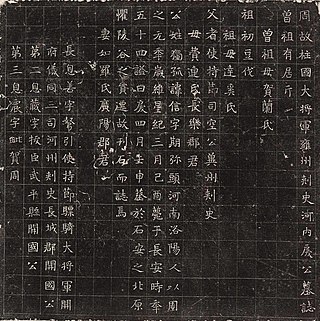
Dugu Xin, Xianbei name Qimitou (期彌頭), known as Dugu Ruyuan (獨孤如願) before 540, was a general and official during the chaotic Northern and Southern dynasties period of imperial China. In 534, Dugu Xin followed Emperor Xiaowu of Northern Wei to the west to join the warlord Yuwen Tai, and in the ensuing years led Western Wei forces against their nemesis, the Eastern Wei. Despite an early debacle, he captured the former Northern Wei capital Luoyang from Eastern Wei in 537. He rose to high ranks under Yuwen Tai, and his eldest daughter married Yuwen Tai's son Yuwen Yu. When the Northern Zhou dynasty replaced Western Wei, Dugu Xin was created Duke of Wei (衛國公), but was soon forced to commit suicide by the powerful regent Yuwen Hu.
References
- ↑ Rothschild, Norman Harry (2015). Emperor Wu Zhao and her pantheon of devis, divinities, and dynastic mothers. New York (N.Y.): Columbia University Press. p. 304. ISBN 9780231539180.
- ↑ Yanshou, Li (659). . 北史 (in Chinese) – via Wikisource.
- 1 2 Yanshou, Li (659). . 北史 (in Chinese) – via Wikisource.
- ↑ "Female Heads of Chinese Substates". guide2womenleaders.com.
 | This Chinese royalty–related article is a stub. You can help Wikipedia by expanding it. |