
The Global System for Mobile Communications (GSM) is a standard developed by the European Telecommunications Standards Institute (ETSI) to describe the protocols for second-generation (2G) digital cellular networks used by mobile devices such as mobile phones and tablets. GSM is also a trade mark owned by the GSM Association. GSM may also refer to the Full Rate voice codec.

General Packet Radio Service (GPRS), also called 2.5G, is a packet oriented mobile data standard on the 2G cellular communication network's global system for mobile communications (GSM). GPRS was established by European Telecommunications Standards Institute (ETSI) in response to the earlier CDPD and i-mode packet-switched cellular technologies. It is now maintained by the 3rd Generation Partnership Project (3GPP).
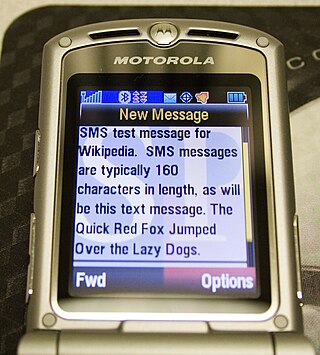
Short Message/Messaging Service, commonly abbreviated as SMS, is a text messaging service component of most telephone, Internet and mobile device systems. It uses standardized communication protocols that let mobile devices exchange short text messages. An intermediary service can facilitate a text-to-voice conversion to be sent to landlines.
The Universal Mobile Telecommunications System (UMTS) is a third generation mobile cellular system for networks based on the GSM standard. Developed and maintained by the 3GPP, UMTS is a component of the International Telecommunication Union IMT-2000 standard set and compares with the CDMA2000 standard set for networks based on the competing cdmaOne technology. UMTS uses wideband code-division multiple access (W-CDMA) radio access technology to offer greater spectral efficiency and bandwidth to mobile network operators.
The international mobile subscriber identity (IMSI) is a number that uniquely identifies every user of a cellular network. It is stored as a 64-bit field and is sent by the mobile device to the network. It is also used for acquiring other details of the mobile in the home location register (HLR) or as locally copied in the visitor location register. To prevent eavesdroppers from identifying and tracking the subscriber on the radio interface, the IMSI is sent as rarely as possible and a randomly-generated TMSI is sent instead.
Integrated Digital Enhanced Network (iDEN) is a mobile telecommunications technology, developed by Motorola, which provides its users the benefits of a trunked radio and a cellular telephone. It was called the first mobile social network by many technology industry analysts. iDEN places more users in a given spectral space, compared to analog cellular and two-way radio systems, by using speech compression and time-division multiple access (TDMA).

A SIM card is an integrated circuit (IC) intended to securely store an international mobile subscriber identity (IMSI) number and its related key, which are used to identify and authenticate subscribers on mobile telephony devices. Technically the actual physical card is known as a universal integrated circuit card (UICC); this smart card is usually made of PVC with embedded contacts and semiconductors, with the SIM as its primary component. In practice the term "SIM card" refers to the entire unit and not simply the IC.

Roaming is a wireless telecommunication term typically used with mobile devices, such as mobile phones. It refers to a mobile phone being used outside the range of its native network and connecting to another available cell network.

AT&T Mobility, LLC, also known as AT&T Wireless and marketed as simply AT&T, is an American telecommunications company. It is a wholly owned subsidiary of AT&T Inc. and provides wireless services in the United States. AT&T Mobility is the largest wireless carrier in the United States, with 229.1 million subscribers at the end of Q2 2023.
AT&T Wireless Services, formerly part of AT&T Corporation, was a wireless telephone carrier founded in 1987 in the United States, based in Redmond, Washington, and later traded on the New York Stock Exchange under the stock symbol "AWE", as a separate entity from its former parent.

A cell site, cell phone tower, cell base tower, or cellular base station is a cellular-enabled mobile device site where antennas and electronic communications equipment are placed to create a cell, or adjacent cells, in a cellular network. The raised structure typically supports antenna and one or more sets of transmitter/receivers transceivers, digital signal processors, control electronics, a GPS receiver for timing, primary and backup electrical power sources, and sheltering.
Mobility management is one of the major functions of a GSM or a UMTS network that allows mobile phones to work. The aim of mobility management is to track where the subscribers are, allowing calls, SMS and other mobile phone services to be delivered to them.

A cellular network or mobile network is a telecommunications network where the link to and from end nodes is wireless and the network is distributed over land areas called cells, each served by at least one fixed-location transceiver. These base stations provide the cell with the network coverage which can be used for transmission of voice, data, and other types of content. A cell typically uses a different set of frequencies from neighboring cells, to avoid interference and provide guaranteed service quality within each cell.

The Motorola StarTAC, first released on January 3, 1996, is often assumed to be the first ever clamshell (flip) mobile phone. Technically, however, NEC had been releasing flip phones on NTT Docomo's PDC Mova network long before 1996, namely the TZ-804 and TZ-1501, both respectively launched in 1991 and late 1994. Another early precursor of this form factor was the Grillo, which was designed in Italy by Richard Sapper and Marco Zanuso in 1965. The StarTAC is the successor of the MicroTAC, a semi-clamshell design first launched in 1989. Whereas the MicroTAC's flip folded down from below the keypad, the StarTAC folded up from above the display. In 2005, PC World named the StarTAC as the 6th Greatest Gadget of the Past 50 Years. The StarTAC was among the first mobile phones to gain widespread consumer adoption; approximately 60 million StarTACs were sold.
A cellular repeater is a type of bi-directional amplifier used to improve cell phone reception. A cellular repeater system commonly consists of a donor antenna that receives and transmits signal from nearby cell towers, coaxial cables, a signal amplifier, and an indoor rebroadcast antenna.
Wi-Fi calling refers to mobile phone voice calls and data that are made over IP networks using Wi-Fi, instead of the cell towers provided by cellular networks. Using this feature, compatible handsets are able to route regular cellular calls through a wireless LAN (Wi-Fi) network with broadband Internet, while seamlessly change connections between the two where necessary. This feature makes use of the Generic Access Network (GAN) protocol, also known as Unlicensed Mobile Access (UMA).
Phone cloning is the copying of identity from one cellular device to another.
Dual-mode mobiles refer to mobile phones that are compatible with more than one form of data transmission or network.
Cellemetry Data Services, abbreviated Cellemetry and stylized Cellemetrysm, was a cellular-telephony-based Internet of things network introduced commercially in 1996. Cellemetry was designed to operate over the existing cellular network, allowing it to be rapidly deployed.

