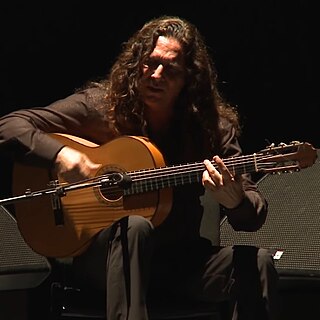
José Fernández Torres, known as Tomatito, is a Spanish roma flamenco guitarist. Having started his career accompanying famed flamenco singer Camarón de la Isla, he has made a number of collaborative albums and six solo albums, two of which have won Latin Grammy Awards.

José Monje Cruz, better known by his stage name Camarón de la Isla, was a Spanish Romani flamenco singer. Considered one of the all-time greatest flamenco singers, he was noted for his collaborations with Paco de Lucía and Tomatito, and the three of them were of major importance to the revival of flamenco in the second half of the 20th century.
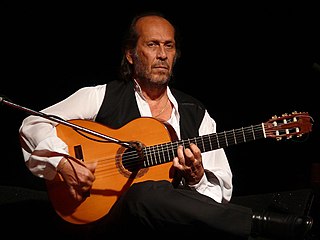
Francisco Gustavo Sánchez Gómez, known as Paco de Lucía, was a Spanish virtuoso flamenco guitarist, composer, and record producer. A leading proponent of the new flamenco style, he was one of the first flamenco guitarists to branch into classical and jazz. Richard Chapman and Eric Clapton, authors of Guitar: Music, History, Players, describe de Lucía as a "titanic figure in the world of flamenco guitar", and Dennis Koster, author of Guitar Atlas, Flamenco, has referred to de Lucía as "one of history's greatest guitarists".
Rumba flamenca, also known as flamenco rumba or simply rumba, is a palo (style) of flamenco music developed in Andalusia, Spain. It is known as one of the cantes de ida y vuelta, music which diverged in the new world, then returned to Spain in a new form. The genre originated in the 19th century in Andalusia, southern Spain, where Cuban music first reached the country.

Carles Benavent is a flamenco and jazz bassist.

Entre dos aguas is the first compilation album by the Spanish guitarist and composer Paco de Lucía.

Greenpeace, Salvemos al Mediterráneo is a compilation album by various singers with benefits to the non-governmental organization Greenpeace. It was released in 1986. It was edited only in Spain in LP format. The only unpublished song was the one by Mecano.
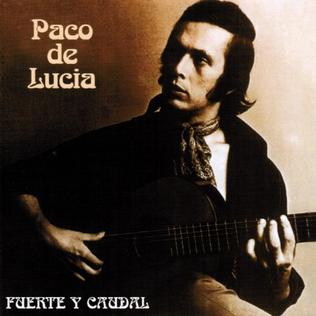
Fuente y caudal is the ninth studio album by the Spanish composer and guitarist Paco de Lucía. All pieces are credited Paco de Lucía and José Torregrosa.

Dos guitarras flamencas en stereo is the first of three collaborative albums between Paco de Lucía & Ricardo Modrego.

Dos guitarras flamencas en América Latina is the second of four collaboration albums by Paco de Lucía and Ramón de Algeciras.

Integral is a limited edition, 26-CD box set of the works of renowned flamenco guitarist Paco de Lucía. All works have been remastered from the original source tapes.

Javier Limón is a record producer, singer and songwriter born and raised in Madrid, Spain. Limón has worked with several artists, mainly from Spain, since he incorporates elements of flamenco rhythm to his work. Besides his work as producer has also dabbled as an interpreter and has released three studio albums, Limón, Son de Limón and Mujeres de Agua. Since 2003, Limón has done recordings in Israel, Bogotá, Bristol, Paris, Bahía Blanca, Buenos Aires, New York City and Morocco. In 2004, Limón was awarded the Latin Grammy Award for Producer of the Year for his work on Lágrimas Negras by Diego El Cigala and Bebo Valdés, Cositas Buenas by Paco de Lucía, El Cantante by Andrés Calamaro, El Pequeño Reloj by Enrique Morente, Niño Josele by Niño Josele and Tributo Flamenco A Don Juan Valderrama by Various Artists. Javier Limón serves as the Artistic Director of the Berklee College of Music's Mediterranean Music Institute, which operates in Valencia, Spain as well as Boston, Massachusetts.
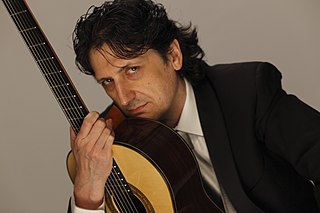
Juan Manuel Cañizares is a Spanish flamenco guitarist and composer. He is a winner of the "Premio Nacional de Música" (1982) and "Premio de la Música" (2008) awards.
Cepa Andaluza is a 1972 composition by virtuoso Spanish flamenco guitarist Paco de Lucia. It featured on his 1973 album, Fuente y caudal. A Bulería, it is generally played in C phrygian, with a capo on the third fret, based on the C 7 flat 9 chord. It has been played by Grisha Goryachev.

The discography of Spanish flamenco guitarist Paco de Lucía:
Ramón Sánchez Gómez, better known by his stage name Ramón de Algeciras, was a Spanish flamenco guitarist, composer and lyricist. He was the most prolific collaborator of Paco de Lucía, his younger brother, recording with him on most of his albums from the 1960s to 1980s and performing with him throughout much of his life as a rhythm guitarist, including the Paco de Lucía Sextet, formed in 1981, which also included his other brother Pepe de Lucía.
Castillo de Arena is a 1977 album, the last in a series of nine albums featuring flamenco guitarist Paco de Lucía and singer Camarón de la Isla. Paco de Lucia's brother Ramón de Algeciras also contributes guitar to the proceedings. The lyrics were written by Antonio Sánchez, with the exception of the bulerías "Samara" which was penned by both Sánchez and de la Isla.
Facelinopsis pacodelucia is a species of sea slug, an aeolid nudibranch, a marine gastropod mollusc in the family Facelinidae.

Paco de Lucía: La búsqueda is a Spanish documentary about the guitarist Paco de Lucía. It is directed by Francisco Sánchez Varela and portrayed by Paco de Lucía, who died before the production, Camarón de la Isla and Rubén Blades.

Entre dos aguas is an instrumental flamenco rumba created by the Spanish guitarist Paco de Lucía, included as the first single on the album Fuente y caudal 1973. It was recorded with two guitars, with a bass and a bongo, instead of the traditional palmas played on the rumbas.
