
A vineyard is a plantation of grape-bearing vines, grown mainly for winemaking, but also raisins, table grapes, and non-alcoholic grape juice. The science, practice and study of vineyard production is known as viticulture. Vineyards are often characterised by their terroir, a French term loosely translating as "a sense of place" that refers to the specific geographical and geological characteristics of grapevine plantations, which may be imparted to the wine itself.
Biodynamic agriculture is a form of alternative agriculture based on pseudo-scientific and esoteric concepts initially developed in 1924 by Rudolf Steiner (1861–1925). It was the first of the organic farming movements. It treats soil fertility, plant growth, and livestock care as ecologically interrelated tasks, emphasizing spiritual and mystical perspectives.
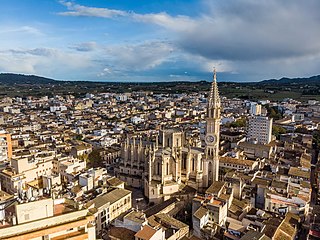
Manacor is a town and municipality on the island of Mallorca, part of the Spanish autonomous community of the Balearic Islands. It is the second-largest town in Mallorca, after the capital of Palma. The municipality features tourist attractions such as Porto Cristo, site of the famous Caves of Drach, and Cales de Mallorca. Manacor has one of the busiest street markets on the island, held every Monday morning. Manacor is famous for high-quality wood furniture manufacturing and artificial pearls.

The Valle de Guadalupe is an agricultural region in the Ensenada Municipality, Baja California, Mexico that produces an estimated 70 percent of Mexican wine. In recent years, it has become a popular tourist destination for wine and Baja Med cuisine.

New Zealand wine is produced in several of its distinct winegrowing regions. As an island country in the South Pacific Ocean, New Zealand has a largely maritime climate, although its elongated geography produces considerable regional variation from north to south. Like many other New World wines, New Zealand wine is usually produced and labelled as single varietal wines, or if blended, winemakers list the varietal components on the label. New Zealand is best known for its Marlborough Sauvignon Blanc, and more recently its dense, concentrated Pinot Noir from Marlborough, Martinborough and Central Otago.

Bierzo is a Spanish Denominación de Origen Protegida (DOP) for wines located in the northwest of the province of León and covers about 3,000 km2. It borders on the provinces of Ourense, Lugo and Asturias in the north and in the south on areas of La Montaña, la Cabrera and La Meseta, in Léon. The area consists of numerous small valleys in the mountainous part and of a wide, flat plain . The DO covers 23 municipalities including the largest town of the area, Ponferrada.

The Camden Park Estate incorporating the Belgenny Farm is a heritage-listed large working historical farm located at Elizabeth Macarthur Avenue, in the outer south-western Sydney suburb of Camden South, New South Wales, Australia. It was designed by Henry Kitchen in c. 1800, John Verge in c. 1835 and A. J. Onslow in c. 1888 and built from 1819 to 1840 by John Macarthur in c. 1800, James English and Sons in c. 1888 and John Sulman c. 1895. The property is owned by Belgenny Farm Trust and Camden Park Preservation Committee. It was added to the New South Wales State Heritage Register on 22 December 2006. Today, part of the original estate contains the Elizabeth Macarthur Agricultural Institute; having originally served as a commercial sheep station and horticultural farm for the Macarthur family since the early 1800s.
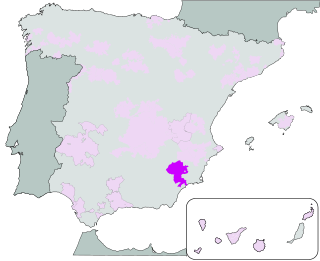
Bullas is a Spanish Denominación de Origen Protegida (DOP) for wines located in the region of Murcia (Spain) and covers the territories of eight different municipalities, including Caravaca de la Cruz, Moratalla and Bullas itself. The region is renowned for its young reds and rosés made from the Monastrell grape variety.

Mendocino County wine is an appellation that designates wine made from grapes grown mostly in Mendocino County, California. The region is part of the larger North Coast AVA and one of California's largest and most climatically diverse wine growing regions. Mendocino County is one of the northernmost commercial wine grape regions in the state with two distinct climate zones separated by the Mendocino Range. As of 2024, twelve American Viticultural Areas (AVA) have been designated within Mendocino County. Mendocino is one of the leading wine growing regions for organically produced wine grapes. Nearly 25% of the cultivation in Mendocino County is grown organically. In 2004, the residents of the county voted to become the first GMO-free county in the United States in an initiative that was supported by many of the county's largest wineries. The county's widespread focus on organic viticulture has inspired journalists to describe it as "California's organic wine Mecca".

Nahe is a region (Anbaugebiet) for quality wine in Germany, along the River Nahe in the state of Rhineland-Palatinate. On the region's 4,155 hectares of vineyards in 2008, white wine grapes dominate with 75% and Riesling is the most common variety with 27.2%. A characteristic of the Nahe region is that the soils are very varied owing to the region's volcanic origins.

Founded in 1870 by Jaime Torres, Bodegas Torres is a historical wine growing company located in Pacs, some 4 km from Vilafranca del Penedès, where the company has its head office. Torres is the family winery with the most extensive vineyards in the Denomination of Origin (DO) of Penedès and the largest winery in Spain.

Agriculture in Portugal is based on small to medium-sized family-owned dispersed units; however, the sector also includes larger-scale intensive farming export-oriented agrobusinesses backed by companies. The extent of cooperative organisation has been reaching a greater importance with globalization. Portugal produces a wide variety of products, including green vegetables, rice, corn, wheat, barley, olives, oilseeds, nuts, cherries, bilberry, table grapes and edible mushrooms. Forestry has also played an important economic role among the rural communities and industry. In 2013, the gross agricultural product accounted for 2.4% of the GDP. Portugal is the largest world producer of both cork and carob, as well as the third largest exporter of chestnut and the third largest European producer of pulp. Portugal is among the top ten largest olive oil producers in the world and is the fourth biggest exporter. The country is also one of the world's largest exporters of wine, being reputed for its fine wines. The land area of slightly more than 9.2 million hectares was classified as follows : 2,755 arable land and permanent crops, 530 permanent pasture, 3,640 forest and woodland, and 2,270 other land.
Precision viticulture is precision farming applied to optimize vineyard performance, in particular maximizing grape yield and quality while minimizing environmental impacts and risk. This is accomplished by measuring local variation in factors that influence grape yield and quality and applying appropriate viticulture management practices. Precision viticulture is based on the premise that high in-field variability for factors that affect vine growth and grape ripening warrants intensive management customized according to local conditions. Precision viticulture depends on new and emerging technologies such as global positioning systems (GPS), meteorologic and other environmental sensors, satellite and airborne remote sensing, and geographic information systems (GIS) to assess and respond to variability.
This glossary of viticultural terms list some of terms and definitions involved in growing grapes for use in winemaking.

S'illot is a small tourist town on the south east coast of the Balearic Island of Mallorca, Spain, divided between the council areas of Manacor and Sant Llorenç des Cardassar. The two districts are separated by the river Torrent de Ca n'Amer which is spanned by a large bridge in the town. A range of seaside leisure activities take place in the town. At the entrance to the town there is prehistoric settlement that is well preserved.
Veta la Palma is an estate (finca) in Andalusia, Spain. It is located on an island in the Guadalquivir river, 10 miles (16 km) inland from the Atlantic Ocean in Seville province of Spain. Prior to the break up of the estate in 2023 it consisted of 11,000 hectares, one of the biggest private properties in the province of Seville. It is recognised for its ecological importance, being included in Doñana Natural Park, the buffer zone of Doñana National Park. The two parks, national and natural, have been classified as a single natural landscape.
Araujo Estate Wines is a California winegrowing estate founded by Bart and Daphne Araujo. Located in Calistoga, California within both the Calistoga and Napa Valley AVAs, the estate produces a small portfolio of limited-production wines from the organically and Biodynamically farmed Eisele Vineyard.

Maule Valley is a wine-producing region in Chile's Central Valley and is a Denomination of Origin (DO) as defined by the Chilean Appellation system, the legally defined and protected geographical indication used to identify where the grapes for a wine were grown. The area is located 250 km (155 mi) south of Santiago, Chile’s capital city, and forms part of the Central Valley region. It is one of the largest winegrowing regions in Chile and is also one of the country's oldest and most diverse valleys.
Phil Coturri is an American viticulturalist. As a vineyard manager, Coturri has been recognized as pioneering organic and biodynamic farming in California. He is the chief executive officer of Enterprise Vineyard Management and co-owner of Winery Sixteen 600.
Regenerative cacao is defined as cacao that is produced on a farm that employs regenerative agriculture and agroforestry methods. It is most closely associated with the Ecuadorian chocolate company To’ak, the organic food supplier Navitas, the rainforest conservation organization TMA, and the social-agricultural enterprise Terra Genesis. Cacao is the raw material that is used to produce chocolate.


