The Bayer designations F Puppis and f Puppis are distinct and refer to two different stars in the constellation Puppis:
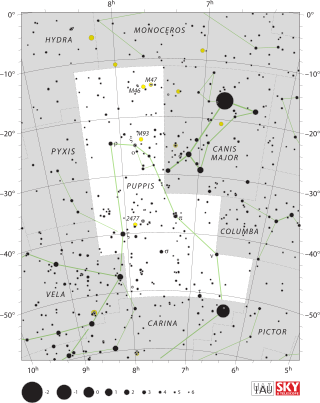
Puppis is a constellation in the southern sky. Puppis, the Latin translation of "poop deck", was originally part of an over-large constellation Argo Navis, which centuries after its initial description, was divided into three parts, the other two being Carina, and Vela. Puppis is the largest of the three constellations in square degrees. It is one of the 88 modern constellations recognized by the International Astronomical Union.
Pi Puppis, Latinized from π Puppis, also named Ahadi, is the second-brightest star in the southern constellation of Puppis. It has an apparent visual magnitude of 2.733, so it can be viewed with the naked eye at night. Parallax measurements yield an estimated distance of roughly 810 light-years from the Earth. This is a double star with a magnitude 6.86 companion at an angular separation of 0.72 arcsecond and a position angle of 148° from the brighter primary.
k Puppis is a Bayer designation given to an optical double star in the constellation Puppis, the two components being k1 Puppis and k2 Puppis.
Omicron Puppis (ο Puppis) is candidate binary star system in the southern constellation of Puppis. It is visible to the naked eye, having a combined apparent visual magnitude of +4.48. Based upon an annual parallax shift of 2.30 mas as seen from Earth, it is located roughly 1,400 light years from the Sun.
The Bayer designations a Puppis and A Puppis are distinct and refer to two different stars in the constellation Puppus:
The Bayer designations j Puppis and J Puppis are distinct. Due to technical limitations, both designations link here. For the star
The Bayer designations q Puppis and Q Puppis are distinct. Due to technical limitations, both designations link here. For the star
The Bayer designations p Puppis and P Puppis are distinct. Due to technical limitations, both designations link here. For the star
The Bayer designation L Puppis is shared by two stars in the constellation Puppis:
The Bayer designations h Puppis and H Puppis are distinct. They can refer to three stars in the constellation Puppis:
The Bayer designations c Puppis and C Puppis are distinct and refer to two different stars in the constellation Puppis:
The Bayer designations m Puppis and M Puppis are distinct. Due to technical limitations, both designations link here. For the star
The Bayer designations W Puppis and w Puppis are distinct and refer to two different stars in the constellation Puppis:
The Bayer designations D Puppis and d Puppis are distinct.
For D Puppis:
The Bayer designations T Puppis and t Puppis are distinct and refer to two different stars in the constellation Puppis:
The Bayer designations Y Puppis and y Puppis are distinct and refer to many different stars in the constellation Puppis:
For Y Puppis:
The Bayer designations X Puppis and x Puppis are distinct and refer to three different stars in the constellation Puppis:
The Bayer designations Z Puppis and z Puppis are distinct and refer to two different stars in the constellation Puppis:
The Bayer designations N Puppis and n Puppis are distinct and refer to three different stars in the constellation Puppis: