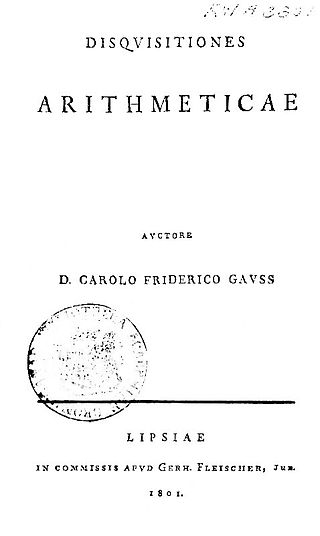
In mathematics, the fundamental theorem of arithmetic, also called the unique factorization theorem and prime factorization theorem, states that every integer greater than 1 can be represented uniquely as a product of prime numbers, up to the order of the factors. For example,
In number theory, integer factorization is the decomposition of a positive integer into a product of integers. Every positive integer greater than 1 is either the product of two or more integer factors, in which case it is called a composite number, or it is not, in which case it is called a prime number. For example, 15 is a composite number because 15 = 3 · 5, but 7 is a prime number because it cannot be decomposed in this way. If one of the factors is composite, it can in turn be written as a product of smaller factors, for example 60 = 3 · 20 = 3 · (5 · 4). Continuing this process until every factor is prime is called prime factorization; the result is always unique up to the order of the factors by the prime factorization theorem.

In mathematics, factorization (or factorisation, see English spelling differences) or factoring consists of writing a number or another mathematical object as a product of several factors, usually smaller or simpler objects of the same kind. For example, 3 × 5 is an integer factorization of 15, and (x – 2)(x + 2) is a polynomial factorization of x2 – 4.
Factor, a Latin word meaning "who/which acts", may refer to:
In mathematics, an irreducible polynomial is, roughly speaking, a polynomial that cannot be factored into the product of two non-constant polynomials. The property of irreducibility depends on the nature of the coefficients that are accepted for the possible factors, that is, the field to which the coefficients of the polynomial and its possible factors are supposed to belong. For example, the polynomial x2 − 2 is a polynomial with integer coefficients, but, as every integer is also a real number, it is also a polynomial with real coefficients. It is irreducible if it is considered as a polynomial with integer coefficients, but it factors as if it is considered as a polynomial with real coefficients. One says that the polynomial x2 − 2 is irreducible over the integers but not over the reals.
The RSA Factoring Challenge was a challenge put forward by RSA Laboratories on March 18, 1991 to encourage research into computational number theory and the practical difficulty of factoring large integers and cracking RSA keys used in cryptography. They published a list of semiprimes known as the RSA numbers, with a cash prize for the successful factorization of some of them. The smallest of them, a 100-decimal digit number called RSA-100 was factored by April 1, 1991. Many of the bigger numbers have still not been factored and are expected to remain unfactored for quite some time, however advances in quantum computers make this prediction uncertain due to Shor's algorithm.
In mathematics, the RSA numbers are a set of large semiprimes that were part of the RSA Factoring Challenge. The challenge was to find the prime factors of each number. It was created by RSA Laboratories in March 1991 to encourage research into computational number theory and the practical difficulty of factoring large integers. The challenge was ended in 2007.
The quadratic sieve algorithm (QS) is an integer factorization algorithm and, in practice, the second-fastest method known. It is still the fastest for integers under 100 decimal digits or so, and is considerably simpler than the number field sieve. It is a general-purpose factorization algorithm, meaning that its running time depends solely on the size of the integer to be factored, and not on special structure or properties. It was invented by Carl Pomerance in 1981 as an improvement to Schroeppel's linear sieve.
Fundamental may refer to:
Fermat's factorization method, named after Pierre de Fermat, is based on the representation of an odd integer as the difference of two squares:

In graph theory, a factor of a graph G is a spanning subgraph, i.e., a subgraph that has the same vertex set as G. A k-factor of a graph is a spanning k-regular subgraph, and a k-factorization partitions the edges of the graph into disjoint k-factors. A graph G is said to be k-factorable if it admits a k-factorization. In particular, a 1-factor is a perfect matching, and a 1-factorization of a k-regular graph is a proper edge coloring with k colors. A 2-factor is a collection of cycles that spans all vertices of the graph.
Non-negative matrix factorization, also non-negative matrix approximation is a group of algorithms in multivariate analysis and linear algebra where a matrix V is factorized into (usually) two matrices W and H, with the property that all three matrices have no negative elements. This non-negativity makes the resulting matrices easier to inspect. Also, in applications such as processing of audio spectrograms or muscular activity, non-negativity is inherent to the data being considered. Since the problem is not exactly solvable in general, it is commonly approximated numerically.
In mathematics, the splitting circle method is a numerical algorithm for the numerical factorization of a polynomial and, ultimately, for finding its complex roots. It was introduced by Arnold Schönhage in his 1982 paper The fundamental theorem of algebra in terms of computational complexity. A revised algorithm was presented by Victor Pan in 1998. An implementation was provided by Xavier Gourdon in 1996 for the Magma and PARI/GP computer algebra systems.
In mathematics and computer algebra, factorization of polynomials or polynomial factorization expresses a polynomial with coefficients in a given field or in the integers as the product of irreducible factors with coefficients in the same domain. Polynomial factorization is one of the fundamental components of computer algebra systems.
192 is the natural number following 191 and preceding 193.
Matrix factorization is a class of collaborative filtering algorithms used in recommender systems. Matrix factorization algorithms work by decomposing the user-item interaction matrix into the product of two lower dimensionality rectangular matrices. This family of methods became widely known during the Netflix prize challenge due to its effectiveness as reported by Simon Funk in his 2006 blog post, where he shared his findings with the research community. The prediction results can be improved by assigning different regularization weights to the latent factors based on items' popularity and users' activeness.
In computational number theory, Evdokimov's algorithm, named after Sergei Evdokimov, is the asymptotically fastest known algorithm for factorization of polynomials. It can factorize a one-variable polynomial of degree over an explicitly given finite field of cardinality . Assuming the generalized Riemann hypothesis the algorithm runs in deterministic time . This is an improvement of both Berlekamp's algorithm and Rónyai's algorithm in the sense that the first algorithm is polynomial for small characteristic of the field, whearas the second one is polynomial for small ; however, both of them are exponential if no restriction is made.
This page is based on this
Wikipedia article Text is available under the
CC BY-SA 4.0 license; additional terms may apply.
Images, videos and audio are available under their respective licenses.

