
The Eternaut is a science fiction Argentine comic created by Héctor Germán Oesterheld with artwork by Francisco Solano López. It was first published in Hora Cero Semanal between 1957 and 1959. Since its original release it has been hailed as a universal masterpiece of its genre, especially in South America.

Mexican literature is one of the most prolific and influential of Spanish-language literatures along with those of Spain and Argentina. Found among the names of its most important and internationally recognized literary figures are authors Octavio Paz, Alfonso Reyes, Carlos Fuentes, Sergio Pitol, José Emilio Pacheco, Rosario Castellanos, Fernando del Paso, Juan Rulfo, Amado Nervo, Sor Juana Inés de la Cruz, Ramón López Velarde, and Carlos de Sigüenza y Góngora, among others.

Alberto Breccia was an Uruguayan-born Argentine artist and cartoonist. A gifted penciller and inker, Breccia is one of the most celebrated and famous comics/historieta creators in the world, and specially prominent in Latin America and Europe. His son Enrique Breccia and daughter Patricia Breccia are also comic book artists.
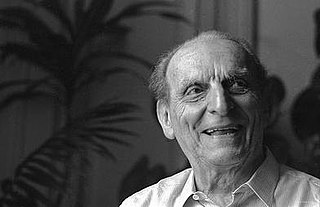
Norberto Bobbio was an Italian philosopher of law and political sciences and a historian of political thought. He also wrote regularly for the Turin-based daily La Stampa. Bobbio was a social liberal in the tradition of Piero Gobetti, Carlo Rosselli, Guido Calogero, and Aldo Capitini. He was also strongly influenced by Hans Kelsen and Vilfredo Pareto.

The Spain men's national basketball team represents Spain in international basketball competitions. They are managed by the Spanish Basketball Federation, the governing body for basketball in Spain. Spain is the current European champion.

Manuel Dorrego was an Argentine statesman and soldier. He was governor of Buenos Aires in 1820, and then again from 1827 to 1828.

Cinema of Argentina refers to the film industry based in Argentina. The Argentine cinema comprises the art of film and creative movies made within the nation of Argentina or by Argentine filmmakers abroad.
Amor libre is a 1969 Argentine romantic comedy film directed by Fernando Siro with a script by Norberto Aroldi.
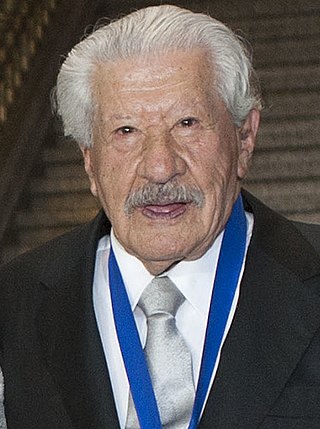
Ignacio López Tarso was a Mexican actor of stage, film and television. He acted in about 50 films and appeared in documentaries and in one short feature. In 1973 he was given the Ariel Award for Best Actor for Rosa Blanca, and the Ariel de Oro lifetime achievement award in 2007. He was honored multiple times at the TVyNovelas Awards. At the time of his death, he was one of the last surviving stars from the Golden Age of Mexican cinema.
Ángel Faretta is an Argentine writer, film and art scholar, poet, poetry translator, and narrator. Since 1977, he has published essays and analytical and critical articles on art, literature, and cinema in different media. His followers considerer him one of the insightful, influential, and consummate theoreticians of cinema in Argentina. Film critic and screenwriter Fernando Regueira wrote, "Faretta is the only thinker with his own theory of cinema--and a general aesthetics--in our country and, perhaps, in the whole Spanish-speaking world".

Luciano Cruz-Coke Carvallo is a Chilean actor, and was the Minister of Arts and Culture under the 35th President Sebastián Piñera.

Fernando Leal was one of the first painters to participate in the Mexican muralism movement starting in the 1920s. After seeing one of his paintings, Secretary of Education José Vasconcelos invited Leal to paint at the Escuela Nacional Preparatoria. The resulting work is Los danzantes de Chalma. Leal also painted a mural dedicated to Simón Bolívar at the Anfiteatro Bolivar, as well as religious murals such as those at the chapel dedicated to the Virgin of Guadalupe at the Basilica Villa in Tepeyac.

They're Watching Us is a 2002 Spanish-Italian thriller film directed by Norberto López Amado from a screenplay by Jorge Guerricaechevarría based on the novel Los otros by Javier García Sánchez. It stars Carmelo Gómez with Icíar Bollaín, Margarita Lozano and Francisco Algora.
Events in the year 1974 in Argentina.
Events in the year 1962 in Mexico.

This is a list of foreign ministers of Panama from 1945 to the present day.

Operación Masacre is a 1973 historical drama film co-written and directed by Jorge Cedrón and based on the nonfiction book of the same name by Rodolfo Walsh, who also wrote the script. It stars Norma Aleandro, Víctor Laplace, Ana María Picchio, Walter Vidarte and Julio Troxler. It was filmed clandestinely during the self-styled "Argentine Revolution" dictatorship (1966–1973), and finally released on September 27, 1973.
This article displays the rosters for the participating teams at the 1989 Tournament of the Americas played in Mexico City, Mexico from June 8 to June 18, 1989.

