
Floating Point is an album by John McLaughlin, released in 2008 through the record label Abstract Logix. The album reached number fourteen on Billboard's Top Jazz Albums chart.

In computing, floating-point arithmetic (FP) is arithmetic that represents subsets of real numbers using an integer with a fixed precision, called the significand, scaled by an integer exponent of a fixed base. Numbers of this form are called floating-point numbers. For example, 12.345 is a floating-point number in base ten with five digits of precision:

SPARC is a reduced instruction set computer (RISC) instruction set architecture originally developed by Sun Microsystems. Its design was strongly influenced by the experimental Berkeley RISC system developed in the early 1980s. First developed in 1986 and released in 1987, SPARC was one of the most successful early commercial RISC systems, and its success led to the introduction of similar RISC designs from many vendors through the 1980s and 1990s.
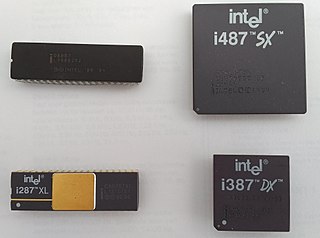
A floating-point unit is a part of a computer system specially designed to carry out operations on floating-point numbers. Typical operations are addition, subtraction, multiplication, division, and square root. Some FPUs can also perform various transcendental functions such as exponential or trigonometric calculations, but the accuracy can be low, so some systems prefer to compute these functions in software.
Double-precision floating-point format is a floating-point number format, usually occupying 64 bits in computer memory; it represents a wide dynamic range of numeric values by using a floating radix point.
Significance is a synonym for importance. It can also refer to:
The IEEE Standard for Floating-Point Arithmetic is a technical standard for floating-point arithmetic established in 1985 by the Institute of Electrical and Electronics Engineers (IEEE). The standard addressed many problems found in the diverse floating-point implementations that made them difficult to use reliably and portably. Many hardware floating-point units use the IEEE 754 standard.

Ladies and Gentlemen We Are Floating in Space is the third studio album by English space rock band Spiritualized, released on 16 June 1997. The album features guest appearances from the Balanescu Quartet, The London Community Gospel Choir and Dr. John.

In digital audio using pulse-code modulation (PCM), bit depth is the number of bits of information in each sample, and it directly corresponds to the resolution of each sample. Examples of bit depth include Compact Disc Digital Audio, which uses 16 bits per sample, and DVD-Audio and Blu-ray Disc, which can support up to 24 bits per sample.
Floating bridge may refer to:

Floating into the Night is the debut studio album by American singer Julee Cruise. It was released on September 12, 1989, by Warner Bros. Records, and features compositions and production by Angelo Badalamenti and film director David Lynch. Songs from the album were featured in Lynch's projects Blue Velvet (1986), Industrial Symphony No. 1 (1990), and Twin Peaks (1990–1991).
Floating World may refer to:
A characteristic is a distinguishing feature of a person or thing. It may refer to:
A floating dock may refer to a number of constructions found in ports and harbours
This page is based on this
Wikipedia article Text is available under the
CC BY-SA 4.0 license; additional terms may apply.
Images, videos and audio are available under their respective licenses.
