
The Los Angeles County Metropolitan Transportation Authority (LACMTA), branded as Metro, is the county agency that plans, operates, and coordinates funding for most of the public transportation system in Los Angeles County, California, the most populated county in the United States.

Los Angeles has a complex multimodal transportation infrastructure, which serves as a regional, national and international hub for passenger and freight traffic. The system includes the United States' largest port complex; an extensive freight and passenger rail infrastructure, including light rail lines and rapid transit lines; numerous airports and bus lines; vehicle for hire companies; and an extensive freeway and road system. People in Los Angeles rely on cars as the dominant mode of transportation, but since 1990 the Los Angeles County Metropolitan Transportation Authority has built over one hundred miles (160 km) of light and heavy rail serving more and more parts of Los Angeles and the greater area of Los Angeles County. As a result, Los Angeles was the last major city in the United States to get a permanent rail system installed.

The Los Angeles Metro Rail is an urban rail transit system serving Los Angeles County, California in the United States. It consists of six lines: four light rail lines and two rapid transit lines, serving a total of 101 stations. It connects with the Metro Busway bus rapid transit system, the Metrolink commuter rail system, as well as several Amtrak lines. Metro Rail is owned and operated by the Los Angeles County Metropolitan Transportation Authority (Metro).
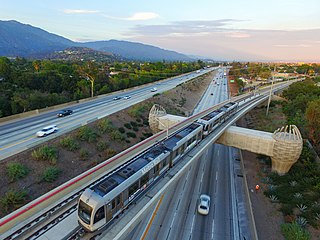
The A Line is a 48.5-mile (78.1 km) light rail line in Los Angeles County, California. The A Line runs east-west between Azusa and Pasadena, then north-south between Pasadena and Long Beach, via Downtown Los Angeles. The A Line is currently the longest light rail line in the world.

Slauson station is an elevated light rail station on the A Line of the Los Angeles Metro Rail system. The station is located within the historic right-of-way of the Pacific Electric Railway and elevated over the intersection of Slauson Avenue, after which the station is named, in the unincorporated Los Angeles County community of Florence.
Greater Los Angeles has a complex multimodal transportation infrastructure, which serves as a regional, national and international hub for passenger and freight traffic. The transportation system of Greater Los Angeles includes the United States' largest port complex, seven commuter rail lines, Amtrak service, a subway system within the city of Los Angeles, and numerous highways. Los Angeles is integrated into the Interstate Highway System by Interstate 5, Interstate 10, and Interstate 15, along with numerous auxiliary highways and state routes. Bus service is also included locally within the area by numerous local government agencies. Subways and light commuter rail lines are present within Los Angeles proper, allowing mass transportation within the city. Commuter railroads are run by Metrolink. Amtrak has numerous railroad lines that connect Los Angeles to the rest of the country.

Florence Avenue is a major east–west street in central Los Angeles County and South Los Angeles, in Southern California.

The West Santa Ana Branch is a rail right-of-way formerly used by the Pacific Electric's (PE) Santa Ana route in Los Angeles County and Orange County in Southern California. The Los Angeles County Metropolitan Transportation Authority (Metro) owns the segment of the right-of-way in Los Angeles County, and the Orange County Transportation Authority (OCTA) owns the segment in Orange County.

La Habra–Fullerton–Yorba Linda Line was a Pacific Electric interurban line which traveled between Los Angeles and Yorba Linda.

The Long Beach Line was a major interurban railway operated by the Pacific Electric Railway between Los Angeles and Long Beach, California via Florence, Watts, and Compton. Service began in 1902 and lasted until 1961, the last line of the system to be replaced by buses.
The OC Streetcar is a modern streetcar line currently under construction in Orange County, California, running through the cities of Santa Ana and Garden Grove. The electric-powered streetcar will be operated by the Orange County Transportation Authority (OCTA), and will serve ten stops in each direction along its 4.15-mile (6.68 km) route. With the exception of a short loop in downtown Santa Ana, the line will be double-tracked for its entire length. Most of the route follows the original path of the Pacific Electric Railway "Red Cars" that served Santa Ana in the early 20th century, before being abandoned in 1950. Construction on the streetcar broke ground on November 30, 2018. As of October 2023, the line's expected revenue service date has been pushed to August 2025, per OCTA staff, despite initial plans for a 2021 start.
The Southeast Gateway Line, formerly the West Santa Ana Branch Transit Corridor, is a planned light rail line, mostly following the Pacific Electric's historic West Santa Ana Branch, connecting Downtown Los Angeles to the city of Artesia, along with other cities in southeastern Los Angeles County.

The Eastside Transit Corridor is a light rail line extension that currently connects Downtown Los Angeles with East Los Angeles. However, the extension is planned to extend further southeast to connect with the Gateway Cities, continuing from a relocated Atlantic station southeast to a new Lambert station in Whittier.
Bellflower station is a planned light rail station in the Los Angeles Metro Rail system. It is part of the Southeast Gateway Line project. The segment of the corridor is expected to begin operations in 2035.
Paramount/Rosecrans station is a planned elevated light rail station in the Los Angeles Metro Rail system. It is located at the intersection of Paramount Boulevard and Rosecrans Avenue in Paramount, California and is part of the Southeast Gateway Line project. The segment of the corridor is expected to begin operations in 2035.
Pioneer station is a planned light rail station in the Los Angeles Metro Rail system. It will be the southern terminus of the Southeast Gateway Line project, located in Artesia at Pioneer Boulevard. The segment of the corridor is expected to begin operations in 2035. The route may later on be further expanded along the West Santa Ana right-of-way, but Metro has not yet announced any plans to do so.
Pacific/Randolph station is a planned light rail station in Huntington Park, California. It will operate as part of the Los Angeles Metro Rail system. It is part of the Southeast Gateway Line project. The segment of the corridor is expected to begin operations in 2035.
Firestone station is a planned elevated light rail station in the Los Angeles Metro Rail system. It is located near the intersection of Firestone Boulevard and Atlantic Avenue in South Gate, California and is part of the Southeast Gateway Line project. The segment of the corridor is expected to begin operations in 2035.
Gardendale station is a planned light rail station in the Los Angeles Metro Rail system. It is located near the intersection of Garfield Avenue and Gardendale Street in Downey, California and is part of the Southeast Gateway Line project. The segment of the corridor is expected to begin operations in 2035.
I-105/C Line station is a proposed infill light rail transfer station in the Los Angeles Metro Rail system. It is located near Century Boulevard above Interstate 105 in Paramount, California and is part of the Southeast Gateway Line project. A new infill station for a C Line transfer. The segment of the corridor is expected to begin operations in 2035.


