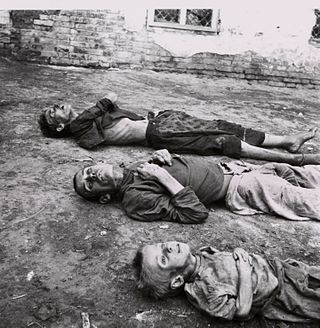
A famine is a widespread scarcity of food, caused by several factors including war, natural disasters, crop failure, widespread poverty, an economic catastrophe or government policies. This phenomenon is usually accompanied or followed by regional malnutrition, starvation, epidemic, and increased mortality. Every inhabited continent in the world has experienced a period of famine throughout history. During the 19th and 20th century, Southeast and South Asia, as well as Eastern and Central Europe, suffered the greatest number of fatalities. Deaths caused by famine declined sharply beginning in the 1970s, with numbers falling further since 2000. Since 2010, Africa has been the most affected continent in the world by famine.

The Dutch famine of 1944–1945, also known as the Hunger Winter, was a famine that took place in the German-occupied Netherlands, especially in the densely populated western provinces north of the great rivers, during the relatively harsh winter of 1944–1945, near the end of World War II.
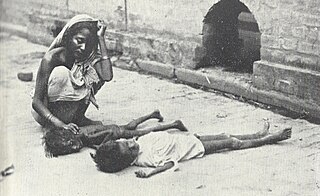
The Bengal famine of 1943 was a famine in the Bengal province of British India during World War II. An estimated 800,000 to 3.8 million Bengalis perished, out of a population of 60.3 million, from starvation, malaria and other diseases aggravated by malnutrition, population displacement, unsanitary conditions and lack of health care due to a combination of factors, including government policies, war-time disruption of food distribution, and high cyclones and floods. Millions were impoverished as the crisis overwhelmed large segments of the economy and catastrophically disrupted the social fabric. Eventually, families disintegrated; men sold their small farms and left home to look for work or to join the British Indian Army, and women and children became homeless migrants, often travelling to Calcutta or other large cities in search of organised relief. Some scholars characterise the famine as anthropogenic (man-made), asserting that wartime colonial policies exacerbated the crisis. Others argue that the famine was the result of natural causes.
Famine scales are the ways in which degrees of food security are measured, from situations in which an entire population has adequate food to full-scale famine. The word "famine" has highly emotive and political connotations and there has been extensive discussion among international relief agencies offering food aid as to its exact definition. For example, in 1998, although a full-scale famine had developed in southern Sudan, a disproportionate amount of donor food resources went to the Kosovo War. This ambiguity about whether or not a famine is occurring, and the lack of commonly agreed upon criteria by which to differentiate food insecurity has prompted renewed interest in offering precise definitions. As different levels of food insecurity demand different types of response, there have been various methods of famine measurement proposed to help agencies determine the appropriate response.
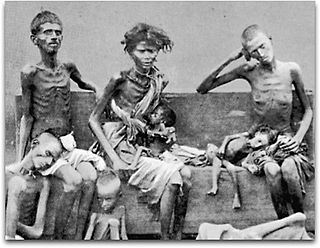
Famine had been a recurrent feature of life in the South Asian subcontinent countries of India and Bangladesh, most notoriously under British rule. Famines in India resulted in more than 30 million deaths over the course of the 18th, 19th, and early 20th centuries. Famines in British India were severe enough to have a substantial impact on the long-term population growth of the country in the 19th and early 20th centuries.
The Great Famine (Ireland) (1845–49) is sometimes referred to as the Irish Potato Famine or an Gorta Mór.
A subsistence crisis occurs when individuals or communities are unable to obtain the basic necessities for survival due to factors such as inflation, drought, war, or economic instability, which may be caused either naturally or by human actions. This threatens the food supplies and the survival prospects of large numbers of people. If it is extremely severe and many lives are lost, it is considered a famine. A subsistence crisis can be considered genuine if it is visible in demographic data.
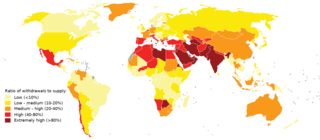
Water scarcity is the lack of fresh water resources to meet the standard water demand. There are two types of water scarcity: physical water scarcity and economic water scarcity. Physical water scarcity is where there is not enough water to meet all demands, including that needed for ecosystems to function. Arid areas for example Central and West Asia, and North Africa often suffer from physical water scarcity. On the other hand, economic water scarcity is the result of a lack of investment in infrastructure or technology to draw water from rivers, aquifers, or other water sources, or insufficient human capacity to meet the demand for water. Much of Sub-Saharan Africa has economic water scarcity.
Pacte de Famine was a conspiracy theory adopted by many living in France during the 18th century. The theory held that foods, especially grain, were purposely withheld from them, for the benefit of privileged interest groups. During this period French citizens obtained much of their nourishment from grain.

In economics, scarcity "refers to the basic fact of life that there exists only a finite amount of human and nonhuman resources which the best technical knowledge is capable of using to produce only limited maximum amounts of each economic good." If the conditions of scarcity didn't exist and an "infinite amount of every good could be produced or human wants fully satisfied ... there would be no economic goods, i.e. goods that are relatively scarce..." Scarcity is the limited availability of a commodity, which may be in demand in the market or by the commons. Scarcity also includes an individual's lack of resources to buy commodities. The opposite of scarcity is abundance. Scarcity plays a key role in economic theory, and it is essential for a "proper definition of economics itself".
"The best example is perhaps Walras' definition of social wealth, i.e., economic goods. 'By social wealth', says Walras, 'I mean all things, material or immaterial, that are scarce, that is to say, on the one hand, useful to us and, on the other hand, only available to us in limited quantity'."

The Indian famine of 1899–1900 began with the failure of the summer monsoons in 1899 over Western and Central India and, during the next year, affected an area of 476,000 square miles (1,230,000 km2) and a population of 59.5 million. The famine was acute in the Central Provinces and Berar, the Bombay Presidency, the minor province of Ajmer-Merwara, and the Hissar District of the Punjab; it also caused great distress in the princely states of the Rajputana Agency, the Central India Agency, Hyderabad and the Kathiawar Agency. In addition, small areas of the Bengal Presidency, the Madras Presidency and the North-Western Provinces were acutely afflicted by the famine.

In international politics, food power is the use of agriculture as a means of political control whereby one nation or group of nations offers or withholds commodities from another nation or group of nations in order to manipulate behavior. Its potential use as a weapon was recognised after OPEC’s earlier use of oil as a political weapon. Food has a major influence on political actions of a nation. In response to acts of food power, a nation usually acts in the interest of its citizens to provide food.
The Flour War refers to a wave of riots from April to May 1775, in the northern, eastern, and western parts of the Kingdom of France. It followed an increase in grain prices, and subsequently bread prices; bread was an important source of food among the populace. Contributing factors to the riots include poor weather and harvests, and the withholding by police of public grain supplies from the royal stores in 1773–1774. This large-scale revolt subsided following wheat price controls imposed by Turgot, Louis XVI's Controller-General of Finances, and the deploying of military troops.
The conventional explanation until 1951 for the cause of famines was the decline of food availability relative to the nutritional needs of the population. The assumption was that the central cause of all famines was a decline in food availability by reason of decline in food production or disruption of food distribution. However this does not explain why only a certain section of the population such as the agricultural laborer was affected by famines while others were insulated from them. On the other hand, inequalities in wealth or ability to exit food shortage areas sufficiently explain such phenomena.
The Great Famine was a period of mass starvation during the Axis occupation of Greece (1941–1944), during World War II. The local population suffered greatly during this period, while the Axis Powers initiated a policy of large-scale plunder. Requisitions, together with the Allied blockade, the ruined state of the country's infrastructure after the German invasion of Greece, and the emergence of a powerful and well-connected black market, resulted in the Great Famine, with the mortality rate reaching a peak during the winter of 1941–42.

GMO conspiracy theories are conspiracy theories related to the production and sale of genetically modified crops and genetically modified food. These conspiracy theories include claims that agribusinesses, especially Monsanto, have suppressed data showing that GMOs cause harm, deliberately cause food shortages to promote the use of GM food, or have co-opted government agencies such as the United States Food and Drug Administration or scientific societies such as the American Association for the Advancement of Science. Critics charge that GMO conspiracy theories are largely promulgated by those opposing the production and sale of GMOs, and instances of unsubstantiated conspiracy theories have lately occurred in the context of public health issues that are mostly unrelated to GMOs, including the 2015–16 Zika virus outbreak and concerns over food safety at Chipotle Mexican Grill.

The Persian famine of 1917–1919 was a period of widespread mass starvation and disease in Persia (Iran) under the rule of the Qajar dynasty during World War I. The famine took place in the territory of Iran, which despite declaring neutrality was occupied by the forces of British, Russian and Ottoman empires whose occupation contributed to the famine. So far, few historians have researched the famine, making it an understudied subject of modern history.
The Kanki famine, also spelled as Kangi famine, was a famine which affected Japan during the Kamakura period. The famine is considered to have begun in 1230 and lasted until 1231. It was named after the Kangi era (1229–1232), during the reign of Emperor Go-Horikawa. The shogun of Japan was Kujō Yoritsune. The famine was severe throughout Japan. It was caused by cold weather caused probably by volcanic eruptions, coupled later with a general breakdown of society.
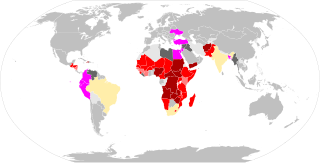
During the COVID-19 pandemic, food insecurity has intensified in many places – in the second quarter of 2020 there were multiple warnings of famine later in the year. In an early report, the Nongovernmental Organization (NGO) Oxfam-International talks about “economic devastation” while the lead-author of the UNU-WIDER report compared COVID-19 to a “poverty tsunami”. Others talk about “complete destitution”, “unprecedented crisis”, “natural disaster”, “threat of catastrophic global famine”. The decision of WHO on March 11, 2020 to qualify COVID as a pandemic, that is “an epidemic occurring worldwide, or over a very wide area, crossing international boundaries and usually affecting a large number of people” also contributed to building this global-scale disaster narrative.
Since the early 2020s, claims have been made on social media that there is a deliberate campaign by governments to create an artificial famine.
