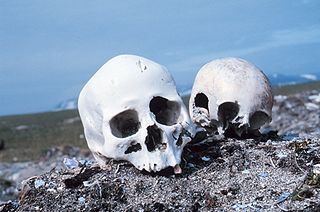
Forensic science, also known as criminalistics, is the application of science to criminal and civil laws, mainly—on the criminal side—during criminal investigation, as governed by the legal standards of admissible evidence and criminal procedure.
Forensic pathology is pathology that focuses on determining the cause of death by examining a corpse. A post mortem is performed by a medical examiner, usually during the investigation of criminal law cases and civil law cases in some jurisdictions. Coroners and medical examiners are also frequently asked to confirm the identity of a corpse. Also see forensic medicine.
A coroner is a government official who is empowered to conduct or order an inquest into the manner or cause of death, and to investigate or confirm the identity of an unknown person who has been found dead within the coroner's jurisdiction.
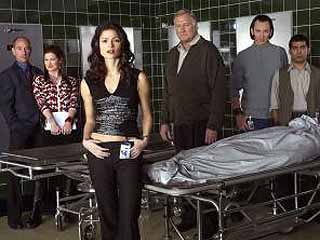
Crossing Jordan is an American crime drama television series created by Tim Kring, that aired on NBC from September 24, 2001, to May 16, 2007. It stars Jill Hennessy as Dr. Jordan Cavanaugh, a crime-solving forensic pathologist employed in the Massachusetts Office of the Chief Medical Examiner. In addition to Jordan, the show followed an ensemble cast composed of Jordan's co-workers and police detectives assigned to the various cases.
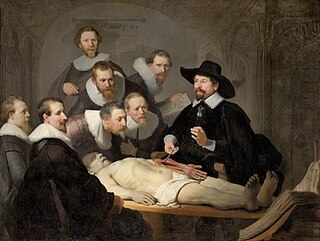
An autopsy is a surgical procedure that consists of a thorough examination of a corpse by dissection to determine the cause, mode, and manner of death or to evaluate any disease or injury that may be present for research or educational purposes.. Autopsies are usually performed by a specialized medical doctor called a pathologist. In most cases, a medical examiner or coroner can determine cause of death and only a small portion of deaths require an autopsy.
In forensic science, questioned document examination (QDE) is the examination of documents potentially disputed in a court of law. Its primary purpose is to provide evidence about a suspicious or questionable document using scientific processes and methods. Evidence might include alterations, the chain of possession, damage to the document, forgery, origin, authenticity, or other questions that come up when a document is challenged in court.

Computer forensics is a branch of digital forensic science pertaining to evidence found in computers and digital storage media. The goal of computer forensics is to examine digital media in a forensically sound manner with the aim of identifying, preserving, recovering, analyzing and presenting facts and opinions about the digital information.
Frederick Thomas Zugibe was the chief medical examiner of Rockland County, New York from 1969 to 2002. Zugibe was one of the United States' most prominent forensics experts, known for his research and books on forensic medicine as well as his crucifixion and Shroud of Turin studies.
A body farm is a research facility where decomposition can be studied in a variety of settings. They were invented by anthropologist Dr. William Bass in 1971 at the University of Tennessee in Knoxville, Tennessee where Dr. Bass was interested in studying the decomposition of a human corpse from the time of death to the time of decay. The aim is to gain a better understanding of the decomposition process, permitting the development of techniques for extracting information such as the timing and circumstances of death from human remains. Body farm research is of particular interest in forensic anthropology and related disciplines, and has applications in the fields of law enforcement and forensic science. By placing the bodies outside to face the elements, researchers are able to get a better understanding of the decomposition process.
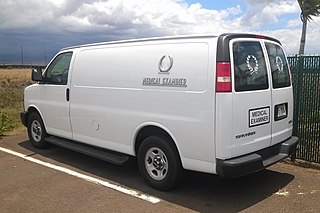
A medical examiner is an official trained in pathology that investigates deaths that occur under unusual or suspicious circumstances, to perform post-mortem examinations, and in some jurisdictions to initiate inquests.
A rape kit—also known as a sexual assault kit (SAK), a sexual assault forensic evidence (SAFE) kit, a sexual assault evidence collection kit (SAECK), a sexual offense evidence collection (SOEC) kit, or a physical evidence recovery kit (PERK)—is a package of items used by medical personnel for gathering and preserving physical evidence following an allegation of sexual assault. The evidence collected from the victim can aid the criminal rape investigation and the prosecution of a suspected assailant. DNA evidence can have tremendous utility for sexual assault investigations and prosecution by identifying offenders, revealing serial offenders through DNA matches across cases, and exonerating those who have been wrongly accused.
Michael M. Baden is an American physician and board-certified forensic pathologist known for his work investigating high-profile deaths and as the host of HBO's Autopsy. He is considered controversial, and has on a number of occasions been on the opposite side of many experts in his line of work. Baden was the chief medical examiner of the City of New York from 1978 to 1979. He was chairman of the House Select Committee on Assassinations' Forensic Pathology Panel that investigated the assassination of John F. Kennedy.
Jan Carla Garavaglia, better known as "Dr. G", served as the Chief Medical Examiner for Orange and Osceola counties in Orlando, Florida from 2004 until her retirement in May 2015. She starred in the hit series Dr. G: Medical Examiner on the Discovery Health Channel which first aired in July 2004 and ran until 2012. Repeats of the show are aired on the Discovery Life Channel and Justice Network. The show is ranked No. 1 for Discovery Health and is also broadcast in Australia, Europe, South America and South Africa. Garavaglia has appeared on The Oprah Winfrey Show, Larry King Live, The Rachael Ray Show, The Doctors and The Dr. Oz Show.
The Office of Chief Medical Examiner of the City of New York (OCME) is a department within the city government that investigates cases of persons who die within New York City from criminal violence; by casualty or by suicide; suddenly, when in apparent good health; when unattended by a physician; in a correctional facility; or in any suspicious or unusual manner. The OCME also investigates when an application is made pursuant to law for a permit to cremate the body of a deceased person.
The National Missing and Unidentified Persons System (NamUs) is a national clearinghouse and resource center for missing, unidentified, and unclaimed person cases throughout the United States. Funded and administered by the National Institute of Justice through a cooperative agreement with the University of North Texas Health Science Center's Center for Human Identification, all NamUs resources are provided to law enforcement, medical examiners, coroners, allied forensic professionals, and family members of missing persons.

Harris County Institute of Forensic Sciences (HCIFS), previously known as Harris County Medical Examiner's Office, is located in Houston, Texas. The institute is a part of the Texas Medical Center.
A Sexual Assault Nurse Examiner (SANE) is a qualification for forensic nurses who have received special training to conduct sexual assault evidentiary exams for rape victims. SANE nurses are specially trained in the medical, psychological, and forensic examination of a sexual assault victim. There are two different credentials available under the SANE designation: SANE-A for adult and adolescent examiners, and SANE-P, which is specifically for pediatric victims. Not all, but many SANE programs are coordinated by rape crisis centers in place of a hospital. Some programs are employed by law enforcement and conduct their exams at stand alone sites, not in an emergency department (ED). SANEs are on call 24-hours a day and may arrive at the hospital ED within an hour of a sexual assault victim’s arrival. Some programs will wait until the patient has had a medical screening exam (MSE) and subsequently have law enforcement bring a stable patient to the sexual assault response team (SART) site for their exam. If the patient is in critical condition and admitted to the hospital, the SANE can perform a 'mobile exam' and bring their exam supplies and camera to the hospital. In addition to the collection of forensic evidence, they also provide access to crisis intervention counseling, STI testing, drug testing if drug-facilitated rape is suspected, and emergency contraception. A SANE will also supply medical referrals for additional medical care or possible follow ups to document how they are healing.
Forensic nursing is defined as the application of the nursing process to public or legal proceedings, and the application of forensic health care in the scientific investigation of trauma and/or death related to abuse, violence, criminal activity, liability, and accidents.
In many legal jurisdictions, the manner of death is a determination, typically made by the coroner, medical examiner, police, or similar officials, and recorded as a vital statistic. Within the United States and the United Kingdom, a distinction is made between the cause of death, which is a specific disease or injury, versus manner of death, which is primarily a legal determination. Different categories are used in different jurisdictions, but manner of death determinations include everything from very broad categories like "natural" and "homicide" to specific manners like "traffic accident" or "attempted or self-induced abortion". In some cases an autopsy is performed, either due to general legal requirements, because the medical cause of death is uncertain, upon the request of family members or guardians, or because the circumstances of death were suspicious.
Barbara Sampson is a forensic pathologist in the United States who has served as the Chief Medical Examiner of New York City since February 2013. She is the first woman to lead the agency since it was created in 1918.
