The military defense of Puerto Rico is the responsibility of the United States as part of the Treaty of Paris. Locally, Puerto Rico has its own National Guard, the Puerto Rico National Guard, and its own state defense force, the Puerto Rico State Guard, which, by local law, is under the authority of the Puerto Rico National Guard. The commander-in-chief of both forces is the governor of Puerto Rico, currently Pedro Pierluisi, who delegates his authority to the Puerto Rico Adjutant General, currently Major General José J. Reyes. The Adjutant General, in turn, delegates the authority over the State Guard to another officer but retains the authority over the Puerto Rico National Guard as a whole. At the national level, the commander-in-chief is the President of the United States, currently Joe Biden.
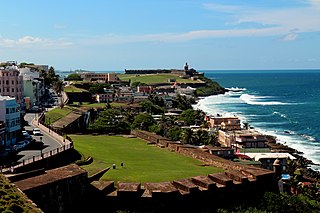
San Juan is the capital city and most populous municipality in the Commonwealth of Puerto Rico, an unincorporated territory of the United States. As of the 2020 census, it is the 57th-largest city under the jurisdiction of the United States, with a population of 342,259. San Juan was founded by Spanish colonists in 1521, who called it Ciudad de Puerto Rico.

Falmouth is a town in Cumberland County, Maine, United States. The population was 12,444 at the 2020 census. It is part of the Portland–South Portland–Biddeford, Maine metropolitan statistical area.

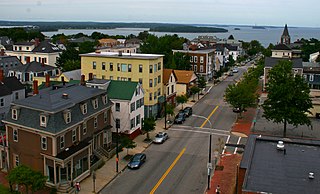
South Portland is a city in Cumberland County, Maine, United States, and is the fourth-largest city in the state, incorporated in 1898. At the 2020 census, the city population was 26,498. Known for its working waterfront, South Portland is situated on Portland Harbor and overlooks the skyline of Portland and the islands of Casco Bay. Due to South Portland's close proximity to air, marine, rail, and highway transportation options, the city has become a center for retail and industry in the region.

United States Army Garrison Fort Buchanan, is a United States Army installation in Puerto Rico. It is located in the metropolitan area of the capital, San Juan.

Charles Herbert Allen was an American politician and businessman. After serving in state and federal elected positions, he was appointed as the first United States-appointed civilian governor of Puerto Rico when the U.S. acquired it after the Spanish–American War. He previously had served as Assistant Secretary of the Navy under President William McKinley.

The United States Military Entrance Processing Command (USMEPCOM) is a Major Command of the U.S. Department of Defense, which primarily screens and processes enlisted personnel applicants into the United States Armed Forces.

Fort Gorges is a former United States military fort built on Hog Island Ledge in Casco Bay, Maine, United States. Built from 1858 to 1864, no battles were fought there and no troops were stationed there. Advancing military technology, including iron clad ships and long range guns, rendered the fort obsolete before it could be used. The fort is now a park, accessible only by boat. It was added to the National Register of Historic Places in 1973.
America's 11 Most Endangered Places or America's 11 Most Endangered Historic Places is a list of places in the United States that the National Trust for Historic Preservation considers the most endangered. It aims to inspire Americans to preserve examples of architectural and cultural heritage that could be "relegated to the dustbins of history" without intervention.
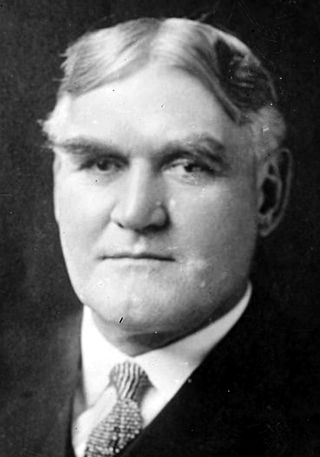
Martin Grove Brumbaugh was an American Republican politician who served as the 26th governor of Pennsylvania from 1915 until 1919. He is frequently referred to as M.G. Brumbaugh, as is common in the Brumbaugh family. He was president of Juniata College and the first education commissioner for Puerto Rico.
U.S. Customhouse or United States Custom House may refer to: (ordered by U.S. state or U.S. territory, and then by city)
This is an incomplete list of historic properties and districts at United States colleges and universities that are listed on the National Register of Historic Places (NRHP). This includes National Historic Landmarks (NHLs) and other National Register of Historic Places listings. It includes listings at current and former educational institutions.
Fort Brooke was a United States Army post established on 3 March 1943 under General Order Number 10 during World War II after the German U-boat attacks of 1942 on the Caribbean Basin in conjunction to Operation Z.

The Eastern Promenade is a historic promenade, 68.2-acre (27.6 ha) public park and recreation area in Portland, Maine. Construction of the Promenade began in 1836 and continued periodically until 1934. The 1.5-mile (2.4 km) park was designed by the Olmsted Brothers design firm and experienced its greatest expansion from the 1880s to the 1910s. The Promenade rings around the Munjoy Hill neighborhood and occupies the farthest eastern portion of Portland's peninsula. The Promenade is home to many historical sites, including a mass grave and the mast of USS Portland.

Fort Allen, officially Fort Allen Training Center, is a Puerto Rico National Guard military installation located on a 921-acre facility in Juana Díaz, Puerto Rico.

Battery Steele is a United States military fortification on Peaks Island, Portland, Maine in Casco Bay. Completed in 1942 as part of World War II, it is located on 14 acres (5.7 ha) on the oceanside area of the island, formerly part of the Peaks Island Military Reservation. It is named for Harry L. Steele, who was a Coast Artillery officer during World War I. It was armed with two 16-inch MkIIMI guns and, with a 12-inch gun battery at Fort Levett on Cushing Island, replaced all previous heavy guns in the Harbor Defenses of Portland. It was built to protect Casco Bay, particularly Portland harbor, from Kennebunk to Popham Beach in Phippsburg. According to Kim MacIsaac and historian Joel Eastman in An Island at War, “Battery Steele is not only the largest gun battery built on Peaks Island, but also an example of the largest battery ever built anywhere in the United States.” In 1995, after decades of non-use, the Peaks Island Land Preserve, a community land preservation group, formed to purchase the area and forever preserve it as a public space. On October 20, 2005, the property was listed on the National Register of Historic Places. Other coast defense structures on the island include fire control towers and the counterweight for a disappearing searchlight tower.

The Maine State Guard was the state defense force of the state of Maine during World War I, World War II, and the Vietnam War. As a state defense force, the State Guard served as a stateside replacement for the Maine National Guard when the National Guard was federalized. Like the National Guard, the State Guard was a reserve military force composed of members who held full-time civilian jobs and periodically met for drills, unless called into active service by the governor. However, unlike the National Guard, as a state defense force, the Maine State Guard was solely a state military force, which was immune from federalization and could not be deployed outside the State of Maine.
Fort Sumner was a coastal defense fortification on Munjoy Hill in Portland, Maine, United States. It was built in 1794 as part of the first system of coastal fortifications built by the United States. It was reportedly originally named Fort Allen after the nearby Revolutionary War battery that probably became part of Fort Sumner, but was renamed in 1797 after Increase Sumner, the incumbent Governor of Massachusetts, of which Maine was then a part. The location is now Fort Sumner Park, also called Standpipe Park, at 60 North Street.

The Harbor Defenses of Portland was a United States Army Coast Artillery Corps harbor defense command. It coordinated the coast defenses of Portland, Maine, the mouth of the Kennebec River, and surrounding areas from 1895 to 1950, beginning with the Endicott program. These included both coast artillery forts and underwater minefields. The command originated circa 1895 as the Portland Artillery District, was renamed Coast Defenses of Portland in 1913, and again renamed Harbor Defenses of Portland in 1925.