Related Research Articles
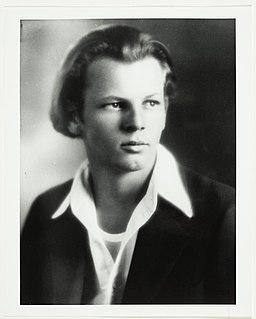
Paul Jackson Pollock was an American painter and a major figure in the abstract expressionist movement. He was widely noticed for his "drip technique" of pouring or splashing liquid household paint onto a horizontal surface, enabling him to view and paint his canvases from all angles. It was also called all-over painting and action painting, since he covered the entire canvas and used the force of his whole body to paint, often in a frenetic dancing style. This extreme form of abstraction divided the critics: some praised the immediacy of the creation, while others derided the random effects. In 2016, Pollock's painting titled Number 17A was reported to have fetched US$200 million in a private purchase.

Jan van Eyck was a painter active in Bruges who was one of the early innovators of what became known as Early Netherlandish painting, and one of the most significant representatives of Early Northern Renaissance art. According to Vasari and other art historians including Ernst Gombrich, he invented oil painting, though most now regard that claim as an oversimplification.

Giorgio Vasari was an Italian painter, architect, engineer, writer, and historian, best known for his Lives of the Most Excellent Painters, Sculptors, and Architects, considered the ideological foundation of art-historical writing, and the basis for biographies of several Renaissance artists, including Leonardo da Vinci. Vasari designed the Tomb of Michelangelo in the Basilica of Santa Croce, Florence that was completed in 1578. Based on Vasari's text in print about Giotto's new manner of painting as a rinascita (rebirth), author Jules Michelet in his Histoire de France (1835) suggested adoption of Vasari's concept, using the term Renaissance to distinguish the cultural change. The term was adopted thereafter in historiography and still is in use today.
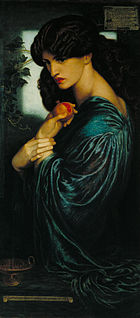
The Pre-Raphaelite Brotherhood was a group of English painters, poets, and art critics, founded in 1848 by William Holman Hunt, John Everett Millais, Dante Gabriel Rossetti, William Michael Rossetti, James Collinson, Frederic George Stephens and Thomas Woolner who formed a seven-member "Brotherhood" modelled in part on the Nazarene movement. The Brotherhood was only ever a loose association and their principles were shared by other artists of the time, including Ford Madox Brown, Arthur Hughes and Marie Spartali Stillman. Later followers of the principles of the Brotherhood included Edward Burne-Jones, William Morris and John William Waterhouse.

Jean-Baptiste-Camille Corot was a French landscape and portrait painter as well as a printmaker in etching. He is a pivotal figure in landscape painting and his vast output simultaneously referenced the Neo-Classical tradition and anticipated the plein-air innovations of Impressionism.
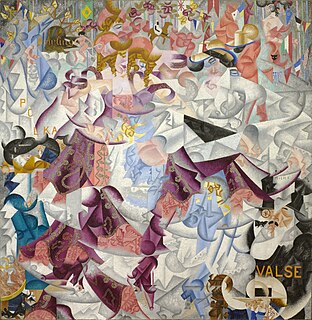
Futurism was an artistic and social movement that originated in Italy in the early 20th century and to a lesser extent in other countries. It emphasized dynamism, speed, technology, youth, violence, and objects such as the car, the airplane, and the industrial city. Its key figures included the Italians Filippo Tommaso Marinetti, Umberto Boccioni, Carlo Carrà, Fortunato Depero, Gino Severini, Giacomo Balla, and Luigi Russolo. Italian Futurism glorified modernity and according to its doctrine, aimed to liberate Italy from the weight of its past. Important Futurist works included Marinetti's 1909 Manifesto of Futurism, Boccioni's 1913 sculpture Unique Forms of Continuity in Space, Balla's 1913–1914 painting Abstract Speed + Sound, and Russolo's The Art of Noises (1913).
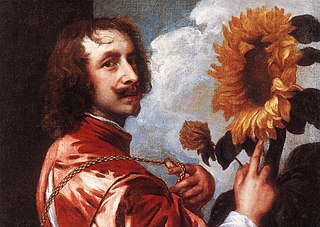
Sir Anthony van Dyck was a Flemish Baroque artist who became the leading court painter in England after success in the Southern Netherlands and Italy.

Pierre Bonnard was a French painter, illustrator and printmaker, known especially for the stylized decorative qualities of his paintings and his bold use of color. A founding member of the Post-Impressionist group of avant-garde painters Les Nabis, his early work was strongly influenced by the work of Paul Gauguin, as well as the prints of Hokusai and other Japanese artists. Bonnard was a leading figure in the transition from Impressionism to Modernism. He painted landscapes, urban scenes, portraits and intimate domestic scenes, where the backgrounds, colors and painting style usually took precedence over the subject.
Lee Hall is an English playwright, television writer, screenwriter, and lyricist. He is best known for writing the screenplay for the film Billy Elliot (2000) and the book and lyrics for its adaptation as a stage musical of the same name. In addition, he wrote the play The Pitmen Painters (2007), and the screenplay for the film Rocketman (2019).
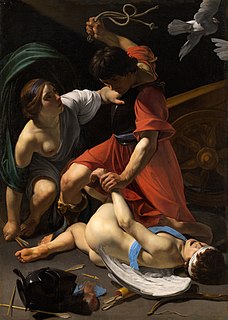
The Caravaggisti were stylistic followers of the late 16th-century Italian Baroque painter Caravaggio. His influence on the new Baroque style that eventually emerged from Mannerism was profound. Caravaggio never established a workshop as most other painters did, and thus had no school to spread his techniques. Nor did he ever set out his underlying philosophical approach to art, the psychological realism which can only be deduced from his surviving work. But it can be seen directly or indirectly in the work of Rubens, Jusepe de Ribera, Bernini, and Rembrandt. Famous while he lived, Caravaggio himself was forgotten almost immediately after his death. Many of his paintings were reascribed to his followers, such as The Taking of Christ, which was attributed to the Dutch painter Gerrit van Honthorst until 1990. It was only in the 20th century that his importance to the development of Western art was rediscovered. In the 1920s Roberto Longhi once more placed him in the European tradition: "Ribera, Vermeer, La Tour and Rembrandt could never have existed without him. And the art of Delacroix, Courbet and Manet would have been utterly different". The influential Bernard Berenson stated: "With the exception of Michelangelo, no other Italian painter exercised so great an influence."

Color field painting is a style of abstract painting that emerged in New York City during the 1940s and 1950s. It was inspired by European modernism and closely related to abstract expressionism, while many of its notable early proponents were among the pioneering abstract expressionists. Color field is characterized primarily by large fields of flat, solid color spread across or stained into the canvas creating areas of unbroken surface and a flat picture plane. The movement places less emphasis on gesture, brushstrokes and action in favor of an overall consistency of form and process. In color field painting "color is freed from objective context and becomes the subject in itself."

William Thomas Kinkade III was an American painter of popular realistic, pastoral, and idyllic subjects. He is notable for achieving success during his lifetime with the mass marketing of his work as printed reproductions and other licensed products by means of the Thomas Kinkade Company. According to Kinkade's company, one in every twenty American homes owned a copy of one of his paintings.
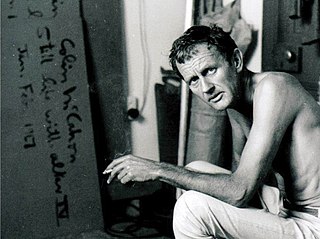
Colin John McCahon was a prominent New Zealand artist whose work over 45 years consisted of various styles, including landscape, figuration, abstraction, and the overlay of painted text. Along with Toss Woollaston and Rita Angus, McCahon is credited with introducing modernism to New Zealand in the mid-20th century. He is regarded as New Zealand's most important modern artist, particularly in his landscape work.

A court painter was an artist who painted for the members of a royal or princely family, sometimes on a fixed salary and on an exclusive basis where the artist was not supposed to undertake other work. Painters were the most common, but the court artist might also be a court sculptor. In Western Europe, the role began to emerge in the mid-13th century. By the Renaissance, portraits, mainly of the family, made up an increasingly large part of their commissions, and in the Early Modern period one person might be appointed solely to do portraits, and another for other work, such as decorating new buildings.

Rembrandt Harmenszoon van Rijn, usually simply known as Rembrandt, was a Dutch Golden Age painter, printmaker and draughtsman. An innovative and prolific master in three media, he is generally considered one of the greatest visual artists in the history of art and the most important in Dutch art history. Unlike most Dutch masters of the 17th century, Rembrandt's works depict a wide range of style and subject matter, from portraits and self-portraits to landscapes, genre scenes, allegorical and historical scenes, and biblical and mythological themes as well as animal studies. His contributions to art came in a period of great wealth and cultural achievement that historians call the Dutch Golden Age, when Dutch art, although in many ways antithetical to the Baroque style that dominated Europe, was extremely prolific and innovative and gave rise to important new genres. Like many artists of the Dutch Golden Age, such as Jan Vermeer of Delft, Rembrandt was also an avid art collector and dealer.

Giovanni Ambrogio de Predis was an Italian Renaissance painter, illuminator and designer of coins active in Milan. Ambrogio gained a reputation as a portraitist, including as a painter of miniatures, at the court of Ludovico Sforza.
Sunil Das was an Indian expressionist painter. He is known for the paintings in his Bull Series and his piece "Woman".

David S. Painter is an associate professor of international history at Georgetown University. He is a leading scholar of the Cold War and United States foreign policy during the 20th century, with particular emphasis on their relation to oil.

Wilhelm van Vile, better known as The Painter, is a fictional supervillain appearing in American comic books published by Marvel Comics. The character was created by plotter Stan Lee, writer Robert Bernstein and artist Jack Kirby. He first appeared in Strange Tales #108 (1963).
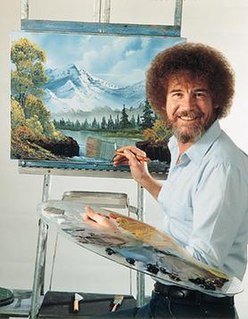
Robert Norman Ross was an American painter, art instructor, and television host. He was the creator and host of The Joy of Painting, an instructional television program that aired from 1983 to 1994 on PBS in the United States, CBC in Canada, and similar channels in Latin America, Europe and elsewhere. Ross subsequently became widely known via his posthumous internet presence.
References
- Bryan, Michael (1886). Robert Edmund Graves (ed.). Dictionary of Painters and Engravers, Biographical and Critical. Vol. I: A-K. London: George Bell and Sons. p. 207.
| General | |
|---|---|
| Art research institutes | |

 | This article about an Italian painter born in the 16th century is a stub. You can help Wikipedia by expanding it. |