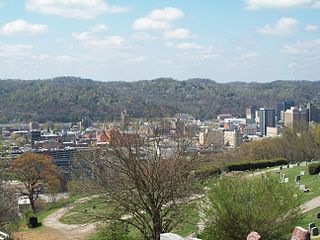
Charleston is an Amtrak station in Charleston, West Virginia, served by the Cardinal. The station was originally owned by the Chesapeake & Ohio Railway. In September 2010, the station was purchased by General Corporation, a commercial real estate company based in Charleston. The station is located on the south bank of the Kanawha River, opposite downtown Charleston which lies on the north bank. Much of the station's outdoor space is covered by the South Side Bridge which allows both vehicular and pedestrian traffic to access the downtown areas. A fine dining establishment, Laury's Restaurant, occupies much of the station's interior.
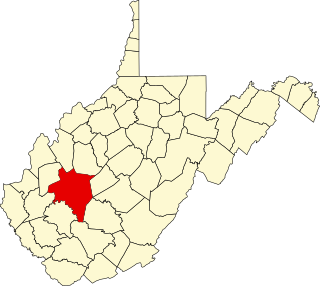
This is a list of the National Register of Historic Places listings in Kanawha County, West Virginia.

Bougemont is a historic home located at Charleston, West Virginia. It was the home of two prominent families in Charleston's business development. It was built about 1916 by Harrison Brooks Smith, an attorney, who served as president of Kanawha Banking and Trust and various companies in Kanawha County. Smith died in 1942, and in 1959, Horace Hamilton Smallridge, another leading Charleston businessman, purchased the property. Bougemont is symmetrically arranged with a 2 1⁄2-story central block and two single-story side wings. The entrance facade features a pedimented portico with Corinthian columns. Also on the property are a cottage, stable, and barn.

Bird Haven is a historic home located at Charleston, West Virginia. It was built about 1895, by Israel N. Johnson, who owned a tailor business and served as state ornithologist for West Virginia. This two-story bungalow-style cottage is of painted clapboards.

Cox-Morton House, also known as Home Hall, is a historic home located at Charleston, West Virginia. It was built in 1902, for Frank Cox, secretary of Republic Coal Co., the West Virginia Colliery Co., and the Carbon Coal Co. He was known in West Virginia as the "Great Wildcatter". His daughter Alice Boyd Cox married James Morton of the Morton Coal Co. It is an American Foursquare-style house. It features a ballustrated terrace around two sides of the house and a doric portico, added in the 1920s.

Cox-Parks House is a historic home located at Charleston, West Virginia. Emma Cox, the wife of Frank Cox, leader of several coal companies in the Kanawha Valley, had this home built for herself in about 1925 when she gave the old "Home Hill" to her daughter's family. It is an elaborate bungalow in the Prairie School-style. The exterior features clean white stucco and green tile and a double entrance and flanking double windows, housed by a recessed porch.

Crawford-Gardner House is a historic home located at Charleston, West Virginia. Ellis Thayer Crawford was the senior member of Crawford and Ashby, a real estate firm dealing in coal and timber lands. He and his wife built this home around 1904. It is an American Foursquare-style house that features an intricately patterned wood floor.

Dalgain, also known as the McCabe House, is a historic home located at Charleston, West Virginia. Robert E, McCabe, for whom the house was built in 1916, was a prominent Charleston attorney active in the city's business life. It is an American Foursquare-style house that features a white stucco exterior and green roof.

Danner-Fletcher House is a historic home located at Charleston, West Virginia. It was a farmhouse built for Capt. George Danner (1826-1897) in 1896 in the late Victorian style. It is older than most homes in South Hills and is the only house of this style in the area.

William S. Gilliland Log Cabin and Cemetery is a historic home and family cemetery located at Charleston, West Virginia. It was the home and graveyard of one of Charleston's oldest families, the Gillilands. They built the log cabins and lived there until selling it to the Neale family in 1868.

McAndrews-Gallaher House is a historic home located at Charleston, West Virginia. It was built in 1914 for Frank J. McReynolds, Workers' Compensation Commissioner for West Virginia. It is in the late Victorian farmhouse style.
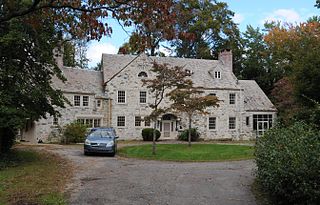
Stoneleigh, also known as the Charles E. Ward House or Ruffner Payne House, is a historic home located at Charleston, West Virginia. It was built in 1917 as the residence of Charles E. Ward, a leading West Virginia industrialist.

Thomas-McJunkin-Love House is a historic home located at Charleston, West Virginia. It was built for James R. Thomas, president of the Carbon Fuel Company, a coal mining business in the Kanawha Valley. Known originally as "The Maples," it was built for him and his family around 1921. It is in the English Tudor style and features half timbering in some of the gables and brick in others, but the exterior is predominantly in stucco.

Laidley-Summers-Quarrier House, also known as Glenwood, is a historic home located at Charleston, West Virginia. It is a two-story gable roofed dwelling in the Greek Revival style and built in 1852.

Edgewood Historic District is a national historic district located at Charleston, West Virginia. The district is set on the West Side of the city and was the first planned suburb in Charleston. The area developed in the early 20th century. The architectural styles of Edgewood are eclectic, ranging from Neo-Classicism to Neo-Colonial, from Craftsman to Bungaloid.

Grosscup Road Historic District is a national historic district located at Charleston, West Virginia. The district is a neighborhood of 22, 19th and early 20th century residences. They are architecturally and historically significant residences that were, and remain today, the residences of Charleston's prominent industrial, commercial, and political families.
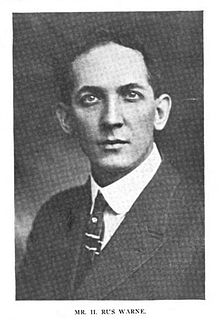
Harry Rus Warne was a Charleston, West Virginia-based architect.