
The Cyrillic script is a writing system used for various alphabets across Eurasia, particularly in Eastern Europe, the Caucasus, Central Asia, and North Asia. It is based on the Early Cyrillic alphabet developed during the 9th century AD at the Preslav Literary School in the First Bulgarian Empire. It is the basis of alphabets used in various languages, especially those of Orthodox Slavic origin, and non-Slavic languages influenced by Russian. As of 2011, around 250 million people in Eurasia use it as the official alphabet for their national languages, with Russia accounting for about half of them. With the accession of Bulgaria to the European Union on 1 January 2007, Cyrillic became the third official script of the European Union, following Latin and Greek.

A keyset or chorded keyboard is a computer input device that allows the user to enter characters or commands formed by pressing several keys together, like playing a "chord" on a piano. The large number of combinations available from a small number of keys allows text or commands to be entered with one hand, leaving the other hand free. A secondary advantage is that it can be built into a device that is too small to contain a normal-sized keyboard.
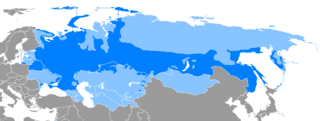
Russian is an East Slavic language, which is official in the Russian Federation, Belarus, Kazakhstan and Kyrgyzstan, as well as being widely used throughout Eastern Europe, the Baltic states, the Caucasus and Central Asia. It was the de facto language of the Soviet Union until its dissolution on 25 December 1991. Although, nowadays, nearly three decades after the breakup of the Soviet Union, Russian is used in official capacity or in public life in all the post-Soviet nation-states, as well as in Israel and Mongolia, the rise of state-specific varieties of this language tends to be strongly denied in Russia, in line with the Russian World ideology.

The Slavic languages are the Indo-European languages spoken by the Slavic peoples. They are thought to descend from a proto-language called Proto-Slavic, spoken during the Early Middle Ages, which in turn is thought to have descended from the earlier Proto-Balto-Slavic language, linking the Slavic languages to the Baltic languages in a Balto-Slavic group within the Indo-European family.

Belarusian is an official language of Belarus, along with Russian, and is also spoken in Russia, Poland and Ukraine.
Before Belarus gained independence from the Soviet Union in 1991, the language was only known in English as Byelorussian or Belorussian, transliterating the Russian name, белорусский язык Belorusskiy yazyk, or alternatively as White Ruthenian or White Russian. Following independence, it has acquired the additional name Belarusian.
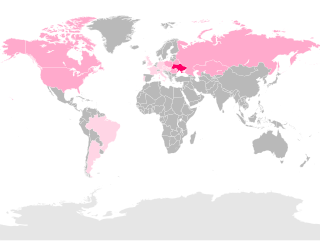
Ukrainian is an East Slavic language. It is the official state language of Ukraine, one of the three official languages in the unrecognized state of Transnistria, the other two being Romanian and Russian. Written Ukrainian uses a variant of the Cyrillic script.
The Tatars are a Turkic-speaking people living mainly in Russia and other Post-Soviet countries. The name Tatar first appears in written form on the Kul Tigin monument as 𐱃𐱃𐰺 (Ta-tar). Historically, the term Tatars was applied to anyone originating from the vast Northern and Central Asian landmass then known as the Tartary, which was dominated by various mostly Turco-Mongol semi-nomadic empires and kingdoms. More recently, however, the term refers more narrowly to people who speak one of the Turkic languages.
Russians are a nation and an East Slavic ethnic group native to European Russia in Eastern Europe. Outside Russia, notable minorities exist in other former Soviet states such as Belarus, Kazakhstan, Moldova, Ukraine and the Baltic states. A large Russian diaspora also exists all over the world, with notable numbers in the United States, Germany, Brazil, and Canada.

SMERSH was an umbrella organization for three independent counter-intelligence agencies in the Red Army formed in late 1942 or even earlier, but officially announced only on 14 April 1943. The name SMERSH was coined by Joseph Stalin. The main reason for its creation was to subvert the attempts by German forces to infiltrate the Red Army on the Eastern Front.

Sergey Vladilenovich Kiriyenko is a Russian politician. He serves as the First Deputy Chief of Staff of the Presidential Administration of Russia since 5 October 2016. Previously he served as the 30th Prime Minister of Russia from 23 March to 23 August 1998 under President Boris Yeltsin. Between 2005 and 2016 he was the head of Rosatom, the state nuclear energy corporation.
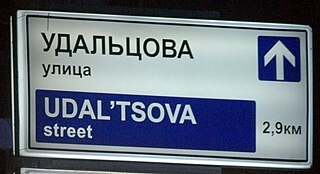
Romanization of Russian is the process of transliterating the Russian language from the Cyrillic script into the Latin script.
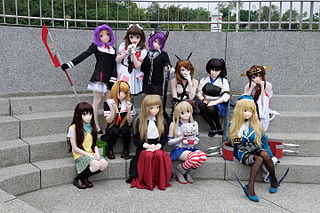
Animegao kigurumi, known colloquially as kigurumi, kigu or occasionally doller, is a type of cosplay which uses a masked character costume to portray anime or cartoon characters in the real world. The face of the performer is fully covered with a stylized mask, and the costume of the character is worn. Used in stage shows, the concept of animegao kigurumi was then adopted by cosplayers, who made custom masks of various characters. In Japan, most cosplayers refer to this style as, while performers are sometimes called "dollers". It is still a very minor part of the cosplay scene in Japan, though around 2005, it began attracting attention in other countries, including the United States, Canada, and European countries.

Of all the languages of Russia, Russian is the only official language at the national level. There are 35 different languages which are considered official languages in various regions of Russia, along with Russian. There are over 100 minority languages spoken in Russia today.
The State Defense Committee was an extraordinary organ of state power in the USSR during the German-Soviet War which held complete state power in the country.
The Russian financial crisis hit Russia on 17 August 1998. It resulted in the Russian government and the Russian Central Bank devaluing the ruble and defaulting on its debt. The crisis had severe impacts on the economies of many neighboring countries. Meanwhile, James Cook, the senior vice president of The U.S. Russia Investment Fund, suggested the crisis had the positive effect of teaching Russian banks to diversify their assets.
A flight-to-liquidity is a financial market phenomenon occurring when investors sell what they perceive to be less liquid or higher risk investments, and purchase more liquid investments instead, such as US Treasuries. Usually, flight-to-liquidity quickly results in panic leading to a crisis.
Chording means pushing several keys or buttons simultaneously to achieve a result.
In the Soviet Union of World War II, NKVD labor columns were militarized labor formations created from certain categories of population, both fully rightful Soviet citizens, as well as categories of limited civil rights. They were primarily from the people of ethnicities associated with the countries that fought against the Soviet Union. The vast majority of them were ethnic Germans. In later literature these formations were informally referred to as "labor army", in an analogy with Soviet Labor armies of 1920-1921, although this term was not used in official Soviet documents in reference to 1941-1946.
OFZs are coupon-bearing federal loan bonds issued by the Russian government. The Ministry of Finance auctions off OFZs to finance the federal budget, or less commonly, to bail out troubled banks. Given their role, they form an essential part of the Russian financial system.
