Alternate uses
The term GTC now often simply refers to any one-use code for an online game. Some other uses include upgraded subscription cards, new account codes, and even codes that can be redeemed for in-game money. Many popular online games offer this substitution for normal subscription methods; others, such as NCSoft, allow players to add this game time across all of the games for which they currently have an account. Sony Online Entertainment offers game time cards that will work for any one of their online games, which allows players to easily find game time cards for even their lesser-known games.
EVE Online, developed by CCP Games, has innovated the game time card world. By offering a secure transfer system for players to buy Eve GTCs with the in-game currency ISK, they have built a system that allows players who cannot afford subscriptions to instead use the in-game currency to buy their game time from others who cannot afford to spend much time generating in-game currency. [1]

CCP hf., doing business as CCP Games, is an Icelandic video game developer based in Reykjavík. Novator Partners and General Catalyst had previously collectively owned a majority stake in the company, and in September 2018, CCP was acquired by South Korean video game publisher Pearl Abyss. CCP Games is best known for developing Eve Online, which was released in 2003 and has since been maintained.
Massively multiplayer online role-playing games (MMORPGs) are a combination of role-playing video games and massively multiplayer online games in which a very large number of players interact with one another within a virtual world.
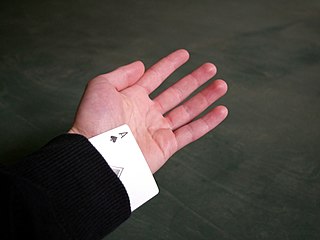
Cheating in poker is any behavior outside the rules that is intended to give an unfair advantage to one or more players.
A virtual economy is an emergent economy existing in a virtual world, usually exchanging virtual goods in the context of an Internet game. People enter these virtual economies for recreation and entertainment rather than necessity, which means that virtual economies lack the aspects of a real economy that are not considered to be "fun". However, some people do interact with virtual economies for "real" economic benefit.
Twinking is a type of behavior in role-playing video games which involves deceiving other players about one's playing abilities or achievements in the game. A player who engages in such behavior is known as a twink. The precise definition of twinking varies depending on the variety of role-playing game:

Eve Online is a space-based, persistent world massively multiplayer online role-playing game (MMORPG) developed and published by CCP Games. Players of Eve Online can participate in a number of in-game professions and activities, including mining, piracy, manufacturing, trading, exploration, and combat. The game contains a total of 7,800 star systems that can be visited by players.
A massively multiplayer online game is an online game with large numbers of players, typically from hundreds to thousands, on the same server. MMOs usually feature a huge, persistent open world, although some games differ. These games can be found for most network-capable platforms, including the personal computer, video game console, or smartphones and other mobile devices.
Player(s) versus player(s), better known as PvP, is a type of multiplayer interactive conflict within a game between two or more live participants. This is in contrast to games where players compete against computer-controlled opponents and/or players, which is referred to as player versus environment (PvE). The terms are most often used in games where both activities exist, particularly MMORPGs, MUDs, and other role-playing video games. PvP can be broadly used to describe any game, or aspect of a game, where players compete against each other. PvP is often controversial when used in role-playing games. In most cases, there are vast differences in abilities between experienced and novice players. PvP can even encourage experienced players to immediately attack and kill inexperienced players. PvP is sometimes called player killing.

Cheating in online games is defined as the action of pretending to comply with the rules of the game, while secretly subverting them to gain an unfair advantage over an opponent. Depending on the game, different activities constitute cheating and it is either a matter of game policy or consensus opinion as to whether a particular activity is considered to be cheating.

Magic: The Gathering Online is a video game adaptation of Magic: The Gathering, utilizing the concept of a virtual economy in order to preserve the collectible aspect of the card game. It is played through an Internet service operated by Wizards of the Coast, which went live on June 24, 2002. Users can play the game or trade cards with other users. It is only officially available for the Microsoft Windows operating system.

Alhambra is a 2003 tile-based German-style board game designed by Dirk Henn. It was originally published in Germany by Queen Games in a language-interdependent version; an English-specific version was released in North America by the now-defunct Überplay. The game is an Arabian-themed update, set during the construction of the Alhambra palace in 14th century Granada, of the 1998 stock trading board game Stimmt So!, which in turn was an update of the 1992 mafia influence board game Al Capone; the original version was subsequently released as Alhambra: The Card Game.
In role-playing games, an alternate character, often referred to in slang as alt, alt char, or less commonly multi, is a character in addition to one's "primary" or "Main" player character. Players are generally not secretive about their alternate characters, unless having multiple characters is illegal, or in a role-playing environment where alternate characters might be judged by the actions of the primary character. In games where multiple characters are illegal, enforcement of this restriction can be difficult, especially without specialized tools.

Perfect World, is a 3D adventure and fantasy MMORPG with traditional Chinese settings. Players can take on various roles depending on choice of race and choice of class within that race.
Multiboxing refers to playing as multiple separate characters concurrently in an MMORPG. This can either be achieved by using multiple separate machines to run the game or by running multiple separate instances of the game. Multiboxing might be considered a form of cheating. Multiboxing is considered to be difficult to do well without practice, as it involves adapting to problems in real-time.
Jack Change It is a simple card game of the Crazy Eights family that is popular among children. It is usually played by two to six players, although theoretically it can be played with up to ten. This game is a shedding-type card game, the purpose being for a player to be the first to discard all of their cards. Jack Change It appears to be the same game as Jacks, Twos and Eights.
Eve Online is a player-driven, persistent-world massively multiplayer online role-playing game (MMORPG) set in a science fiction space setting, developed and published by CCP Games. Characters pilot customizable ships through a galaxy of 7,800 star systems. Most star systems are connected to one or more other star systems by means of stargates. The star systems can contain moons, planets, stations, wormholes, asteroid belts and complexes.
Alternative payments refers to payment methods that are used as an alternative to credit card payments. Most alternative payment methods address a domestic economy or have been specifically developed for electronic commerce and the payment systems are generally supported and operated by local banks. Each alternative payment method has its own unique application and settlement process, language and currency support, and is subject to domestic rules and regulations.

CardMon Hero is an anime-inspired free-to-play massively multiplayer online role-playing game (MMORPG) developed by Redbana and published by HanbitSoft. The game is unique in that players are able to command their primary avatar along with various mercenaries summoned via magical cards. Also, unlike most MMORPGs players, are not given classes to choose from but instead weapons which can be changed at any time and depending on which weapon is equipped decides what cards can be used. The game was released worldwide into open beta on January 19, 2011 and a full release has yet to be announced.
GamePal is an online platform for players of massively multiplayer online (MMO) games to buy, sell and trade digital assets such as in-game currency, items, accounts, and power leveling services. The site is a neutral marketplace that supports player-to-player as well as direct selling for popular MMOs.

Wizard101 is a 2008 massively multiplayer online role-playing game (MMORPG) and free to play game created by KingsIsle Entertainment. In the game, players take on the role of students of Ravenwood School of Magical Arts in order to save the Spiral, the fictional galaxy in which the game is set, from various threats. Players battle enemies by casting spells using a turn-based combat system similar to collectible card games.

Magic: The Gathering Arena is a free-to-play digital collectible card game developed by Wizards of the Coast's internal development studio, Wizards Digital Games Studio. The game is a digital adaption of the Magic: The Gathering card game, allowing players to gain cards through booster packs, in-game achievements or microtransaction purchases, and build their own decks to challenge other players.
