
Trakai is a historic city and lake resort in Lithuania. It lies 28 kilometres west of Vilnius, the capital of Lithuania. Because of its proximity to Vilnius, Trakai is a popular tourist destination. Trakai is the administrative centre of Trakai district municipality. The town covers 497.1 square kilometres of area and, according to 2007 estimates, is inhabited by 5,357 people. A notable feature of Trakai is that the town was built and preserved by people of different nationalities. Historically, communities of Karaims, Tatars, Lithuanians, Russians, Jews and Poles lived here.

Gediminas' Tower is the remaining part of the Upper Castle in Vilnius, Lithuania.
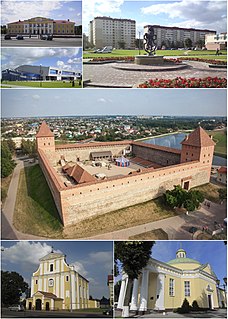
Lida is a city 160 km west of Minsk in western Belarus in Hrodna Voblast.

Demetrius of Liubar or Liubartas was Prince of Lutsk and Liubar (Volhynia) (1323–1383), Prince of Zhytomyr (1363–1374), Grand Prince of Volhynia (1340–1383), Grand Prince of Galicia and Volhynia (1340–1349).
Butigeidis was the Grand Duke of Lithuania from 1285 to 1291. He is the first known and undisputed member of the Gediminids.

Trakai District Municipality is one of 60 municipalities in Lithuania. It has significant Polish minority population in Lithuania, with about 30% of the population claiming Polish ethnicity.

Raudonė is a town on the Nemunas River in Tauragė County, Lithuania. The town is primarily known for its castle and a large park complex.

The Vilnius Castle Complex is a group of cultural, and historic structures on the left bank of the Neris River, near its confluence with the Vilnia River, in Vilnius, Lithuania. The buildings, which evolved between the 10th and 18th centuries, were one of Lithuania's major defensive structures.

Senieji Trakai Castle was a castle in Senieji Trakai, Lithuania.

Raudonė Castle is a residential castle of the 19th century in Raudonė, Lithuania. Today it is used as a public school.

Senieji Trakai is a historic Lithuanian village located 3 kilometres (1.9 mi) east of Trakai. According to the Lithuanian census of 2011, it has 1,396 inhabitants – Lithuanians, Poles and Russians. The Saint Petersburg – Warsaw Railway passes through Senieji Trakai.
The national symbols of Lithuania are used in Lithuania and abroad to represent the country and its people, history, culture, and nature. These symbols are seen in official capacities, such as flags, coats of arms, postage stamps, and currency, and in URLs. They appear less formally as recurring themes in literature, art and folk art, heraldry, monuments, clothing, personal decoration, and as the names of parks, bridges, streets, and clubs. The less formal manifestations may be classified as national emblems.
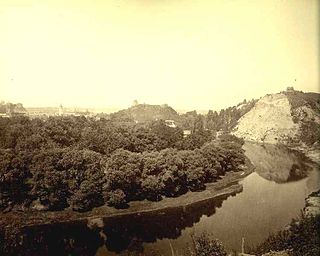
Kalnai Park is a 24.5-hectare (61-acre) park between the left bank of the Neris River and right bank of the Vilnia River in Vilnius, Lithuania. It lies within the Vilnius Old Town elderate near Gediminas Hill and Gediminas Tower, and is part of the State Cultural Reserve of Vilnius Castles, established in 1997. The park hosts various events, including concerts, political rallies, and sporting competitions. Its name reflects the presence of four prominent hills (kalnai): Crooked Hill, Table Hill, Bekes Hill, and the Hill of Gediminas's Grave.

Lida Castle was one of several citadels erected by Grand Duke Gediminas of Lithuania in the early 14th century to defend his lands against the expansion of the Teutonic Knights. Other links in this chain of defense included Hrodna, Navahrudak, Kreva, Medininkai, and Trakai. The modern town of Lida, Belarus grew up around this castle. Lida Castle is 141 metres (463 ft) above sea level.
Kreva Castle is the ruins of a major fortified residence of the Grand Dukes of Lithuania in the village of Kreva, Belarus. The village lies 220 metres (720 ft) above sea level.

Gediminas was Grand Duke of Lithuania from 1315 or 1316 until his death. He is credited with founding this political entity and expanding its territory which, at the time of his death, spanned the area ranging from the Baltic Sea to the Black Sea. Also seen as one of the most significant individuals in early Lithuanian history, he was responsible for both building Vilnius, the capital of Lithuania, and establishing a dynasty that later came to rule other European countries such as Poland, Hungary and Bohemia.

Vytenis was the Grand Duke of Lithuania from c. 1295 to c. 1316. He became the first of the Gediminid dynasty to rule for a considerable amount of time. In the early 14th century his reputation outshone that of Gediminas, who is regarded by modern historians as one of the greatest Lithuanian rulers. The rule of Vytenis was marked by constant warfare in an effort to consolidate the Grand Duchy of Lithuania with the Ruthenians, Masovians, and the Teutonic Order.

Gediminas Hill Lift — an inclined lift in Vilnius, Lithuania. Opened in 2003, it is used by visitors to reach the Vilnius Upper Castle and Gediminas Tower.
