George Lailey (1869–1958) was a craftsman from the United Kingdom, noted as the last professional practitioner of the traditional craft of bowl-turning using a pole lathe.
The United Kingdom (UK), officially the United Kingdom of Great Britain and Northern Ireland, informally as Britain, is a sovereign country lying off the north-western coast of the European mainland. The United Kingdom includes the island of Great Britain, the north-eastern part of the island of Ireland and many smaller islands. Northern Ireland is the only part of the United Kingdom that shares a land border with another sovereign state, the Republic of Ireland. Apart from this land border, the United Kingdom is surrounded by the Atlantic Ocean, with the North Sea to the east, the English Channel to the south and the Celtic Sea to the south-west, giving it the 12th-longest coastline in the world. The Irish Sea lies between Great Britain and Ireland. With an area of 242,500 square kilometres (93,600 sq mi), the United Kingdom is the 78th-largest sovereign state in the world. It is also the 22nd-most populous country, with an estimated 66.0 million inhabitants in 2017.
Woodturning is the craft of using the wood lathe with hand-held tools to cut a shape that is symmetrical around the axis of rotation. Like the potter's wheel, the wood lathe is a simple mechanism which can generate a variety of forms. The operator is known as a turner, and the skills needed to use the tools were traditionally known as turnery. In pre-industrial England, these skills were sufficiently difficult to be known as 'the misterie' of the turners guild. The skills to use the tools by hand, without a fixed point of contact with the wood, distinguish woodturning and the wood lathe from the machinists lathe, or metal-working lathe.
A pole lathe is a wood-turning lathe that uses a long pole as a return spring for a treadle. Pressing the treadle pulls on a cord that is wrapped around the piece of wood or billet being turned. The other end of the cord reaches up to the end of a long springy pole. As the action is reciprocating, the work rotates in one direction and then back the other way. Cutting is only carried out on the down stroke of the treadle, the spring of the pole only being sufficient to return the treadle to the raised position ready for the next down stroke. Modern reciprocating lathes often replace the springy pole with an elastic bungee cord.
Lailey lived in Miles Green, near the Berkshire village of Bucklebury Common, near Newbury. Both his grandfather, George William Lailey (1782–1871) [1] and his father William (1847–1912) were also bowl-turners, specialising in the production of bowls and plates from elm wood using a pole lathe. [2] George Lailey was particularly noted for his exceptional skill of turning bowls in a 'nest', one inside another. [3] After being mentioned in Henry Vollam Morton's popular 1927 book In Search of England, Lailey's work became increasingly desirable, and he began signing and dating his pieces.
Berkshire is one of the home counties in England. It was recognised by the Queen as the Royal County of Berkshire in 1957 because of the presence of Windsor Castle, and letters patent were issued in 1974. Berkshire is a county of historic origin, a ceremonial county and a non-metropolitan county without a county council. The county town is Reading.
Bucklebury is a village and civil parish in West Berkshire, England. The village is about 5 miles (8 km) north-east of Newbury and between 1 and 3 miles north of the A4 road. The parish has a population of 2,116, but the village is much smaller. Bucklebury Common, with an area of over 1 square kilometre (0.39 sq mi), is one of the largest commons in the ceremonial and historic county of Berkshire.
Newbury is a market town in Berkshire, England, which is home to the administrative headquarters of West Berkshire.
George Lailey was unmarried, had no children to pass his skills to, and was unable to find anyone who wanted to continue his business. By the time of his death in December 1958 he had for many years been the last practitioner of his craft, and his equipment and tools were given to the University of Reading's Museum of English Rural Life. [4]
The University of Reading is a public university located in Reading, Berkshire, England. It was founded in 1892 as University College, Reading, a University of Oxford extension college. The institution received the power to grant its own degrees in 1926 by Royal Charter from King George V and was the only university to receive such a charter between the two world wars. The university is usually categorised as a red brick university, reflecting its original foundation in the 19th century.
The Museum of English Rural Life, also known as the MERL, is a museum, library and archive dedicated to recording the changing face of farming and the countryside in England. It houses designated collections of national importance that span the full range of objects, archives, photographs, film and books. It is also the location of the University of Reading’s special collections archive, housing hundreds of collections of rare books, manuscripts, typescripts and other objects of importance.
Lailey's workshop, on Bucklebury Common, had the form of a Grubenhaus (a sunken-floored building of early mediaeval type), though it dated from the nineteenth century. [1] He did not install an electricity supply, though one was available.
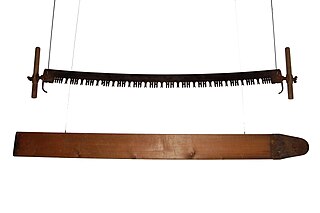
Lailey made a variety of items (including wooden ladles) but concentrated mainly on bowls, produced in a variety of sizes. For this, elm logs were seasoned for at least two years, sawn with a crosscut saw, and then trimmed using a side axe; the blanks were then roughly turned, stored for a further short period and finished on the lathe, applying a polish of beeswax and turmeric root. [5] Most of the specialist tools used would have been made by Lailey himself.
A ladle (dipper) is a type of spoon used for soup, stew, or other foods. Although designs vary, a typical ladle has a long handle terminating in a deep bowl, frequently with the bowl oriented at an angle to the handle to facilitate lifting liquid out of a pot or other vessel and conveying it to a bowl. Some ladles involve a point on the side of the basin to allow for finer stream when pouring the liquid; however, this can create difficulty for left handed users, as it is easier to pour towards one's self. Thus, many of these ladles feature such pinches on both sides.
A crosscut saw is any saw designed for cutting wood perpendicular to (across) the wood grain. Crosscut saws may be small or large, with small teeth close together for fine work like woodworking or large for coarse work like log bucking, and can be a hand tool or power tool.
Beeswax is a natural wax produced by honey bees of the genus Apis. The wax is formed into scales by eight wax-producing glands in the abdominal segments of worker bees, which discard it in or at the hive. The hive workers collect and use it to form cells for honey storage and larval and pupal protection within the beehive. Chemically, beeswax consists mainly of esters of fatty acids and various long-chain alcohols.
Lailey charged a relatively modest amount for his services, although he and his father had also supplied leading London stores, including Harrods, with their work around the turn of the twentieth century, when there was a fashion for craftsman-made items. [5] He told Morton that "Money's only storing up trouble, I think. I like making bowls better than I like making money." [6]
Harrods is a department store located on Brompton Road in Knightsbridge, London. It is owned by the state of Qatar via its sovereign wealth fund, the Qatar Investment Authority. The Harrods brand also applies to other enterprises undertaken by the Harrods group of companies including Harrods Estates, Harrods Aviation and Air Harrods, and to Harrods Buenos Aires, sold by Harrods in 1922 and closed as of 2011.
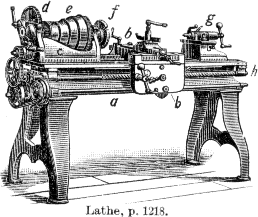
A lathe is a machine that rotates a workpiece about an axis of rotation to perform various operations such as cutting, sanding, knurling, drilling, deformation, facing, and turning, with tools that are applied to the workpiece to create an object with symmetry about that axis.
Anglo-Saxon architecture was a period in the history of architecture in England, and parts of Wales, from the mid-5th century until the Norman Conquest of 1066. Anglo-Saxon secular buildings in Britain were generally simple, constructed mainly using timber with thatch for roofing. No universally accepted example survives above ground.
Guilloché ,(or guilloche) is a decorative technique in which a very precise, intricate and repetitive pattern is mechanically engraved into an underlying material via engine turning, which uses a machine of the same name, also called a rose engine lathe. This mechanical technique improved on more time-consuming designs achieved by hand and allowed for greater delicacy, precision, and closeness of line, as well as greater speed.
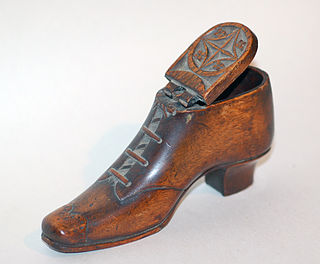
Treen, literally "of a tree" is a generic name for small handmade functional household objects made of wood. Treen is distinct from furniture, such as chairs, and cabinetry, as well as clocks and cupboards. Before the late 17th-century, when silver, pewter, and ceramics were introduced for tableware, most small household items, boxes and tableware were carved from wood. Today, treen is highly collectable for its beautiful patina and tactile appeal.
Thursley is a village and civil parish in southwest Surrey, west of the A3 between Milford and Hindhead. An associated hamlet is Bowlhead Green. To the east is Brook. In the south of the parish rises the Greensand Ridge, in this section reaching its escarpment near Punch Bowl Farm and the Devil's Punch Bowl, Hindhead.
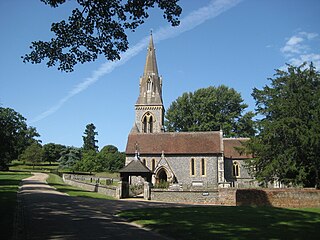
Englefield is a village and civil parish in the English county of Berkshire. The village is mostly within the bounds of the private walled estate of Englefield House. The village is in the district of West Berkshire, close to Reading.
A Windsor chair is a chair built with a solid wooden seat into which the chair-back and legs are round-tenoned, or pushed into drilled holes, in contrast to standard chairs, where the back legs and the uprights of the back are continuous. The seats of Windsor chairs were often carved into a shallow dish or saddle shape for comfort. Traditionally, the legs and uprights were usually turned on a pole lathe. The back and sometimes the arm pieces are formed from steam bent pieces of wood.
The American Craftsman style, or the American Arts and Crafts movement, is an American domestic architectural, interior design, landscape design, applied arts, and decorative arts style and lifestyle philosophy that began in the last years of the 19th century. As a comprehensive design and art movement, it remained popular into the 1930s. However, in decorative arts and architectural design, it has continued with numerous revivals and restoration projects through present times.
Segmented turning is turning on a lathe where the initial workpiece is composed of multiple glued-together parts. The process involves gluing up several pieces of wood to create patterns and visual effects in turned projects.
Bob Stocksdale was an American woodturner, known for his bowls formed from rare and exotic woods. He was raised on his family farm and enjoyed working with tools. His wife of more than 30 years, Kay Sekimachi, stated that, "His grandfather gave him a pocketknife, and he started to whittle. That's how it started."
Richard (Rich) Profit is an English mountaineer, sailor, a former British Army officer and polar adventurer. In 2007 he took part in the Polar Race with the mother and son pair Janice Meek and Daniel Byles, successfully walking and skiing 350 nautical miles from Resolute, Nunavut to the Magnetic North Pole in 20 days and 5 hours, helping to set two Guinness World Records. He is married with two sons.
The Moulthrop family are three generations of woodturners, starting with Ed Moulthrop, credited as the "father of modern woodturning". The family has been documented in the book Moulthrop: A Legacy in Wood.
Bodging is a traditional woodturning craft, using green (unseasoned) wood to make chair legs and other cylindrical parts of chairs. The work was done close to where a tree was felled. The itinerant craftsman who made the chair legs was known as a bodger or chair-bodger.
The History of the Anglo-Saxons is a three volume publication by English historian Sharon Turner written between 1799 and 1805. It covers the history of England up to the Norman conquest. Under the influence of Thomas Percy's Reliques of Ancient English Poetry he compiled the first edition of the History of the Anglo-Saxons between 1799 and 1805, and became one of the earliest scholars to document Anglo-Saxon historical manuscripts in the Cottonian collection at the British Museum. By 1852, the history had seen seven editions. 'Immensely popular', Turner's History 'had immediate and lasting effects, stimulating both Anglo-Saxon studies as an academic discipline and the ideology of England as an ancient Anglo-Saxon nation'. It was cited as an influence by Walter Scott in his preface to Ivanhoe and was a key step in inspiring John Mitchell Kemble's landmark 1937 edition of Beowulf.
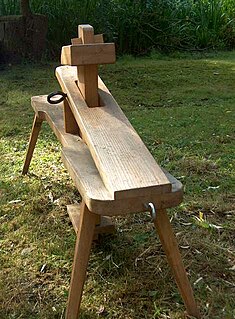
A shaving horse is a combination of vice and workbench, used for green woodworking. Typical usage of the shaving horse is to create a round profile along a square piece, such as for a chair leg or to prepare a workpiece for the pole lathe. They are used in crafts such as coopering and bowyery.
Barnaby Alexander Carder, known as Barn the Spoon, is a British artisan spoon carver, teacher, author and co-founder of Spoonfest, the annual international festival of spoon carving in Edale in Derbyshire, UK. He is also founder of the Green Wood Guild, a collective of green wood carvers who run carving workshops and owns a spoon shop and woodworking venue in Hackney in London's East End. Carder also teaches spoon carving, woodworking and bladesmithing.
The Benty Grange hanging bowl is a fragmentary Anglo-Saxon artefact from the 7th century AD. All that remains are two escutcheons; a third disintegrated soon after excavation, and no longer survives. The escutcheons were found in 1848, alongside the better-known Benty Grange helmet, by the antiquary Thomas Bateman in a tumulus at the Benty Grange farm in the English county of Derbyshire. They were undoubtedly buried as part of an entire hanging bowl, placed in what appears to have been the burial mound of a high-status warrior.