Lentulus, the name of a Roman patrician family of the Cornelian gens, derives from lentes (lentils), which its oldest members were fond of cultivating. The word Lentulitas was coined by Cicero to express the attributes of a pronounced aristocrat. The three first of the name were L. Cornelius Lentulus, Servius Cornelius Lentulus and L. Cornelius Lentulus Caudinus. Their connection with the later Lentuli is very obscure and difficult to establish. The following members of the family deserve mention:
Lucius Cornelius Lentulus was a consul of the Roman Republic in 199 BC with Publius Villius Tappulus as his colleague.

The gens Cornelia was one of the greatest patrician houses at ancient Rome. For more than seven hundred years, from the early decades of the Republic to the third century AD, the Cornelii produced more eminent statesmen and generals than any other gens. At least seventy-five consuls under the Republic were members of this family, beginning with Servius Cornelius Maluginensis in 485 BC. Together with the Aemilii, Claudii, Fabii, Manlii, and Valerii, the Cornelii were almost certainly numbered among the gentes maiores, the most important and powerful families of Rome, who for centuries dominated the Republican magistracies. All of the major branches of the Cornelian gens were patrician, but there were also plebeian Cornelii, at least some of whom were descended from freedmen.
Gnaeus Cornelius Lentulus Marcellinus was a Roman statesman and consul of 56 BC. He was married at least twice. His first wife is unknown but his second wife was probably Scribonia, at least twenty years his junior, who later became the second wife of Augustus.
Gnaeus Cornelius Lentulus Gaetulicus was a Roman senator and general. He was ordinary consul in the year 26 with Gaius Calvisius Sabinus as his colleague. Gaetulicus was involved in a plot against the emperor Caligula, and following its discovery he was executed.
Lucius Apronius was a Roman senator and suffect consul.
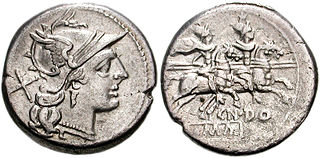
Gnaeus Domitius Ahenobarbus, son of the Gnaeus Domitius Ahenobarbus who had been consul in 192 BC, was chosen pontifex in 172 BC, when still a young man, and in 169 BC was sent with two others as commissioners into Macedonia. In 167 BC he was one of the ten commissioners for arranging the affairs of Macedonia in conjunction with Aemilius Paulus; and when the consuls of 162 BC abdicated on account of some fault in the auspices in their election, he and Cornelius Lentulus were chosen consuls in their stead.
The gens Apronia was a plebeian family at ancient Rome throughout the history of the Republic and into imperial times. The first member of the gens to achieve prominence was Gaius Apronius, tribune of the plebs in 449 BC. None of the Apronii obtained the consulship until the first century AD.
Gaius Calvisius Sabinus was a Roman Senator, who was consul in AD 26 as the colleague of Gnaeus Cornelius Lentulus Gaetulicus. During the reign of Caligula, he was accused of conspiring against the emperor, and took his own life rather than submit to a trial.
Cossus Cornelius Lentulus Gaetulicus was a Roman senator and general, who was consul in 1 BC with Lucius Calpurnius Piso the Augur as his colleague.
Lucius Cornelius Lentulus was a suffect consul in 38 BC, in the late Roman Republic.
Lucius Calpurnius Piso was a Roman senator who was appointed consul in 1 BC as the colleague of Cossus Cornelius Lentulus Gaetulicus. He was also an augur.
Publius Cornelius Lentulus Marcellinus was a Roman Senator who was elected Roman consul in 18 BC, with Gnaeus Cornelius Lentulus as his colleague. During his consulship, the Senate and the Roman assembly again conferred upon the Roman emperor Augustus his extraordinary promagisterial authority and his Tribunician power.
Cossus Cornelius Lentulus may refer to:
Cossus Cornelius Lentulus was a Roman senator who flourished during the Principate. He was the consul posterior as the colleague of the emperor Nero in AD 60.
Cossus Cornelius Lentulus was a Roman senator, who was active during the reign of Tiberius. He was consul in the year AD 25 as the colleague of Marcus Asinius Agrippa. Except for his consulship, the only office Lentulus might have held is governorship of Germania Superior, as Edmund Groag conjectured.
Gnaeus Cornelius Lentulus served as quaestor of the Roman Republic in 212 BC, curule aedile and consul in 201 BC. His brother Lucius Cornelius Lentulus was also consul in 199 BC. Gnaeus was possibly the son of L. Cornelius L. f. L. n. Lentulus Caudinus, curule aedile in 209 BC, though the presence of the praenomen Gnaeus, along with the absence of the agnomen Caudinus, are opposed to this connection.
Lucius Seius Tubero was a Roman senator, who flourished under the reign of Tiberius. He was suffect consul for February through July of the year 18, succeeding the emperor Tiberius, and as the colleague first of Germanicus, then of Livineius Regulus.
Gnaeus Cornelius Lentulus Gaetulicus was a Roman senator, who flourished under the reign of Nero. He was consul in the nundinium of November to December 55 with Titus Curtilius Mancia as his colleague. He is known entirely from inscriptions.
This page is based on this
Wikipedia article Text is available under the
CC BY-SA 4.0 license; additional terms may apply.
Images, videos and audio are available under their respective licenses.
