
The Sorrows of Young Werther is a 1774 epistolary novel by Johann Wolfgang Goethe, which appeared as a revised edition in 1787. It was one of the main novels in the Sturm und Drang period in German literature, and influenced the later Romantic movement. Goethe, aged 24 at the time, finished Werther in five and a half weeks of intensive writing in January to March 1774. It instantly placed him among the foremost international literary celebrities and was among the best known of his works.

The Goethe-Institut is a non-profit German cultural association operational worldwide with 159 institutes, promoting the study of the German language abroad and encouraging international cultural exchange and relations. Around 246,000 people take part in these German courses per year.

Goethe University is a university located in Frankfurt am Main, Germany. It was founded in 1914 as a citizens' university, which means it was founded and funded by the wealthy and active liberal citizenry of Frankfurt. The original name was Universität Frankfurt am Main. In 1932, the university's name was extended in honour of one of the most famous native sons of Frankfurt, the poet, philosopher and writer/dramatist Johann Wolfgang von Goethe. The university currently has around 45,000 students, distributed across four major campuses within the city.

Elective Affinities, also translated under the title Kindred by Choice, is the third novel by Johann Wolfgang von Goethe, published in 1809. Situated around the city of Weimar, the book relates the story of Eduard and Charlotte, an aristocratic couple enjoying an idyllic but somewhat mundane life on a secluded estate; although it is the second marriage for both, their relationship deteriorates after they invite Eduard's friend Captain Otto and Charlotte's orphaned niece, Ottilie, to live with them in their mansion. The invitation to Ottilie and the Captain is described as an "experiment", as it indeed is. The house and its surrounding gardens are described as "a chemical retort in which the human elements are brought together for the reader to observe the resulting reaction." As if in a chemical reaction, each of the spouses experiences a strong new attraction, which is reciprocated: Charlotte, who represents reason, to the sensible and energetic Captain Otto; the impulsive and passionate Eduard to the adolescent and charming Ottilie. The conflict between passion and reason leads to chaos and ultimately to a tragic end.

Emil Ludwig was a German-Swiss author, known for his biographies and study of historical "greats."

Charles Matthias Goethe was an American eugenicist, entrepreneur, land developer, philanthropist, conservationist, founder of the Eugenics Society of Northern California, and a native and lifelong resident of Sacramento, California.
German studies is the field of humanities that researches, documents and disseminates German language and literature in both its historic and present forms. Academic departments of German studies often include classes on German culture, German history, and German politics in addition to the language and literature component. Common German names for the field are Germanistik, Deutsche Philologie, and Deutsche Sprachwissenschaft und Literaturwissenschaft. In English, the terms Germanistics or Germanics are sometimes used, but the subject is more often referred to as German studies, German language and literature, or German philology.

Italian Journey is Johann Wolfgang von Goethe's report on his travels to Italy from 1786 to 1788 that was published in 1816 & 1817. The book is based on Goethe's diaries and is smoothed in style, lacks the spontaneity of his diary report and is augmented with the addition of afterthoughts and reminiscences.
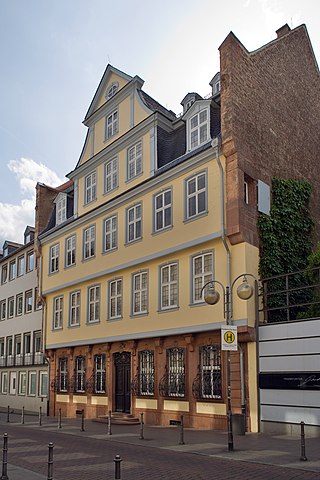
The Goethe House is a writer's house museum located in the Innenstadt district of Frankfurt, Germany. It is the birthplace and childhood home of German poet and playwright Johann Wolfgang von Goethe. It is also the place where Goethe wrote his famous works Götz von Berlichingen,The Sorrows of Young Werther, and the first drafts of Urfaust. The house has mostly been operated as a museum since its 1863 purchase by the Freies Deutsches Hochstift, displaying period furniture and paintings from Goethe's time in the house.
Deutsch or Deutsche may refer to:
Elizabeth Wolff Mayer was a German-born American translator and editor, closely associated with W. H. Auden, Benjamin Britten, Peter Pears, and other writers and musicians. After emigrating to the United States in the 1940s she used her homes in Long Island and New York City as salons for visiting artists.

In the siege of Mainz, from 14 April to 23 July 1793, a coalition of Prussia, Austria, and other German states led by the Holy Roman Empire besieged and captured Mainz from revolutionary French forces. The allies, especially the Prussians, first tried negotiations, but this failed, and the bombardment of the city began on the night of 17 June.
Ganymede most commonly refers to:

Johann Wolfgang von Goethe was a German poet, playwright, novelist, scientist, statesman, theatre director, and critic. His works include plays, poetry, literature, and aesthetic criticism, as well as treatises on botany, anatomy, and colour. He is widely regarded as the greatest and most influential writer in the German language, his work having a profound and wide-ranging influence on Western literary, political, and philosophical thought from the late 18th century to the present day.
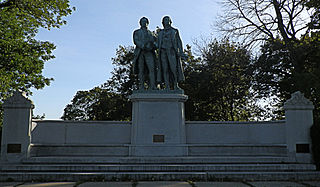
The Goethe–Schiller Monument is a public artwork by German artist Ernst Friedrich August Rietschel located in Washington Park, which is in Milwaukee, Wisconsin, United States. The bronze sculpture from 1908 depicts two men, Johann Wolfgang von Goethe and Friedrich von Schiller, one holding a laurel wreath and the other a scroll. The 12 foot artwork rests upon a 26 foot long granite base. The bronze sculpture is a recasting of the statue incorporated into the 1857 Goethe-Schiller Monument in Weimar, Germany.
The Consulate General of the Federal Republic of Germany in Chennai represents the interests of the German government in the Chennai and surrounding regions. The current Consul General is Karin Christina Maria Stoll incumbent since July 2018. She succeeds Achim Fabig.

The Goethe-Institut New York is an organization that is located at 30 Irving Place in Manhattan, New York City. The organization is part of the worldwide Goethe-Institut non-profit association. It fosters cultural cooperation and promotes German language learning by offering the public opportunities to interact with themes and questions relevant to German culture and society. The institute provides grants for translation in subject areas like democracy, current regional and global issues, the cultural dimension of European integration, recent German history or outstanding works of contemporary German literature.
Goethe Monument may refer to:
Goethe Memorial may refer to:
