
Look up golden calf in Wiktionary, the free dictionary.
The golden calf is an idol in the Bible and the Qur'an.
Contents
Golden calf may also refer to:
The golden calf is an idol in the Bible and the Qur'an.
Golden calf may also refer to:


The cinema of the Soviet Union includes films produced by the constituent republics of the Soviet Union reflecting elements of their pre-Soviet culture, language and history, albeit they were all regulated by the central government in Moscow. Most prolific in their republican films, after the Russian Soviet Federative Socialist Republic, were Armenia, Azerbaijan, Georgia, Ukraine, and, to a lesser degree, Lithuania, Belarus and Moldavia. At the same time, the nation's film industry, which was fully nationalized throughout most of the country's history, was guided by philosophies and laws propounded by the monopoly Soviet Communist Party which introduced a new view on the cinema, socialist realism, which was different from the one before or after the existence of the Soviet Union.
Golden Age refers to a mythological period of primeval human existence perceived as an ideal state when human beings were pure and free from suffering.

Mosfilm is a film studio which is among the largest and oldest in the Russian Federation and in Europe. Founded in 1924 in the USSR as a production unit of that nation's film monopoly, its output includes most of the more widely acclaimed Soviet-era films, ranging from works by Andrei Tarkovsky and Sergei Eisenstein, to Red Westerns, to the Akira Kurosawa co-production Dersu Uzala and War and Peace.
Seventeen or 17 may refer to:
The cinema of Russia, popularly known as Mollywood, refers to the film industry in Russia, engaged in production of motion pictures in Russian language. The popular term Mollywood is a portmanteau of "Moscow" and "Hollywood".

Anatoli Dmitriyevich Papanov was a Soviet and Russian actor, drama teacher, and theatre director at the Moscow Satire Theatre where he served for almost 40 years. A prominent character actor, Papanov is mostly remembered for his comedy roles in a duo with his friend Andrei Mironov, although he had many dramatic roles as well. As a voice actor, he contributed to over one hundred cartoons. He was named People's Artist of the USSR in 1973 and awarded the USSR State Prize posthumously.

Giuliano MontaldoOMRI was an Italian film director, screenwriter, and actor. He was known internationally for his biographical docudrama Sacco & Vanzetti (1971), which was nominated for the Palme d'Or, and the historical miniseries Marco Polo (1982), which won the Primetime Emmy Award for Outstanding Limited Series. He served as the 5th President of the Accademia del Cinema Italiano.
Golden Boy or The Golden Boy may refer to:

Francis de Miomandre was a French novelist and well-known translator from Spanish into French.

Zalman Afroimovich Khrapinovich, known by the pseudonym Zinovy Yefimovich Gerdt, was a Soviet and Russian actor. He was awarded the People's Artist of the USSR in 1990.
Pierre Yves Clouin is a video artist and filmmaker. He was born in Paris, where he lives and works. He studied architecture at the École Nationale Supérieure des Beaux-Arts in Paris. He has exhibited his paintings and photos in Paris.
Henning Carlsen was a Danish film director, screenwriter, and producer most noted for his documentaries and his contributions to the style of cinéma vérité. Carlsen's 1966 social-realistic drama Hunger (Sult) was nominated for the Palme d'Or and won the Bodil Award for Best Danish Film. Carlsen also won the Bodil Award the following year for the comedy People Meet and Sweet Music Fills the Heart. Acting as his own producer since 1960, Carlsen has directed more than 25 films, 19 for which he wrote the screenplay. In 2006, he received the Golden Swan Lifetime Achievement Award at the Copenhagen International Film Festival.

Georges Lecomte was a French novelist and playwright, who also wrote literary, historical and artistic studies.

Jan Hendrik (John) Kraaijkamp Sr. was a Dutch Golden Calf and Louis d'Or winning actor, comedian and singer. For years, he formed a comedy team with Rijk de Gooyer. One of The Netherlands' most popular comedians, praised for his perfect timing, he also played in more serious plays, including the title role in King Lear (1979) and in the Academy Award-winning WWII drama film The Assault (1986). From 1993 until 2003, he starred in the successful sitcom "Het Zonnetje in Huis" along his son John Kraaijkamp Jr.

Les Dix Commandements is a French-language musical comedy written by Élie Chouraqui and Pascal Obispo that premiered in Paris in October 2000.
Andrea Kleine is an American writer, choreographer, and performance artist. She is the author of the novel, Calf, a fictionalized account of the John Hinckley Jr. story published by Counterpoint/Soft Skull Press. Her second novel, Eden, was published by Houghton Mifflin Harcourt in 2018.

Calf’s head, or [la] tête de veau, [la] testina di vitèllo, [der] Kalbskopf and [de] kalfskop is a dish consisting of a calf's head, commonly found in French, Belgian, German, Swiss, and Italian cuisine.
Maria Kraakman is a Dutch actress. She has been awarded the Golden Calf for Best Actress at the Netherlands Film Festival in 2005 and 2018, and the Theo d'Or theatre award for best leading actress in 2010 as well as for the most impressive acting performance in a leading role in 2024.
The Golden Key may refer to:
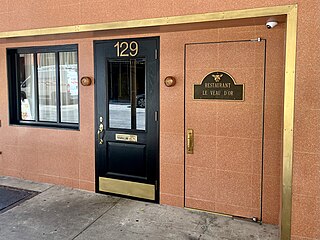
Le Veau d'Or is a restaurant on the Upper East Side of Manhattan, serving traditional French cuisine since 1937. As of 2015, it was considered the oldest French bistro in New York City.