
Rabbinic literature, in its broadest sense, can mean the entire spectrum of rabbinic writings throughout Jewish history. However, the term often refers specifically to literature from the Talmudic era, as opposed to medieval and modern rabbinic writing, and thus corresponds with the Hebrew term Sifrut Chazal. This more specific sense of "Rabbinic literature"—referring to the Talmudim, Midrash, and related writings, but hardly ever to later texts—is how the term is generally intended when used in contemporary academic writing. On the other hand, the terms meforshim and parshanim (commentaries/commentators) almost always refer to later, post-Talmudic writers of rabbinic glosses on Biblical and Talmudic texts.

Yosef Hayim was a leading Baghdadi hakham, authority on halakha, and Master Kabbalist. He is best known as author of the work on halakhaBen Ish Ḥai, a collection of the laws of everyday life interspersed with mystical insights and customs, addressed to the masses and arranged by the weekly Torah portion.
Aggadah refers to non-legalistic exegetical texts in the classical rabbinic literature of Judaism, particularly as recorded in the Talmud and Midrash. In general, Aggadah is a compendium of rabbinic texts that incorporates folklore, historical anecdotes, moral exhortations, and practical advice in various spheres, from business to medicine.

Ofer Bar-Yosef is an Israeli archaeologist and anthropologist whose main field of study is the Palaeolithic period.

Hagaon Rabbi Shmuel Auerbach was a Haredi rabbi in Jerusalem, Israel. Rav Auerbach led a large portion of more radical elements of the non-Hasidic Haredi community. His followers formed a political party known as the Jerusalem Faction. In 2013, as the Israeli government launched a campaign to draft Ultra Orthodox men into the IDF, the Jerusalem Faction adopted a controversial policy of demonstrations and incitement against efforts to draft Haredi men into military service.

Shlomo ha-Levi Alkabetz, also spelt Alqabitz, Alqabes; was a rabbi, kabbalist and poet perhaps best known for his composition of the song Lecha Dodi.

Porat Yosef Yeshiva is a Sephardic yeshiva in Jerusalem, with locations in both the Old City and the Geula neighborhood. The name Porat Yosef means "Joseph is a fruitful tree" after the biblical verse Genesis 49:22.
Enoch Zundel ben Joseph was a Russian Talmudist best known as author of a commentary on Midrash Rabbah. He died at Białystok, Poland in 1867.
Midrash HaGadol or The Great Midrash, written by Rabbi David Adani of Yemen, is a compilation of aggadic midrashim on the Pentateuch taken from the two Talmuds and earlier midrashim of Yemenite provenance. In addition, it borrows quotations from the Targums, Maimonides, and Kabbalistic writings, and in this aspect is unique among the various midrashic collections. This important work—the largest of the midrashic collections—came to popular attention only in the late 19th century through the efforts of Jacob Saphir, Solomon Schecter, and David Zvi Hoffmann. In addition to containing midrashic material that is not found elsewhere, such as part of the Mekhilta of Rabbi Shimon, Midrash HaGadol contains what are considered to be more correct versions of previously known Talmudic and Midrashic passages.
A number of midrashim exist which are smaller in size, and generally later in date, than those dealt with in the articles Midrash Haggadah and Midrash Halakah. Despite their late date, some of these works preserve material from the Apocrypha and Philo of Alexandria. These small works, were in turn used by later larger works, such as Sefer haYashar (midrash) and Zohar. Important editors and researchers of this material include Abraham ben Elijah of Vilna, Adolf Jellinek, and Solomon Aaron Wertheimer.
Midrash Vayisau is one of the smaller midrashim. This small midrash, "the heroic legend of the sons of Jacob," is based on Genesis 35:5 and 36:6, and recounts the story of the wars of Jacob and his sons against the kings of the Amorites and against Esau and his army.
Esther Rabbah is a midrash to the Book of Esther.
Midrash Abba Gorion is a late midrash to the Book of Esther, and may be considered one of the smaller midrashim. The name derives from that of the tanna Abba Gorion of Sidon, who is one of the authorities mentioned in this midrash.
Rav Nachman bar Yitzchak was a Babylonian rabbi, of the fourth and fifth generations of amoraim.
Adrian Nigel Goring-Morris is a British-born Archaeologist and a Professor at the Hebrew University of Jerusalem in Israel. He completed his PhD there in 1986 and is notable for his work and discoveries at one of the oldest ritual burial sites in the world; Kfar HaHoresh. The earliest levels of this site have been dated to 8000 BC and it is located in the northern Israel, not far from Nazareth.
Nikolsburg is the name of several Hasidic dynasties, named for rabbinic leaders of the town of Nikolsburg (Mikulov) in Moravia.
Abba Gorion of Sidon was a tanna in the second century CE. He handed down sayings from both Abba Saul and Rabban Gamaliel II. The quote from Gamaliel, was used in the introduction to a Midrash on the Book of Esther, for which reason the latter was called Midrash Abba Gorion.
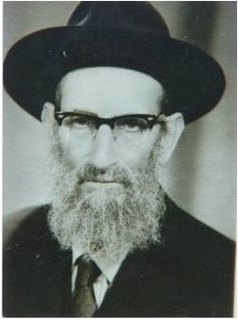
Amram Aburbeh, also spelled Abourabia and Aburabia, was the Chief Rabbi of the Sephardic congregation in Petah Tikva, Israel and author of Netivei Am, a collection of responsa, sermons, and Torah teachings.
Yom Tov Shel Rosh Hashana: 5666, or Samech Vov, is a compilation of the Chasidic treatises by Rabbi Sholom Dovber Schneersohn, the fifth Rebbe of Chabad, from the Hebrew year 5666 (1905–06). This series of Chassidic essays are considered a fundamental work of Chabad mysticism. The Samech Vov series is one of the single largest works of Chabad philosophy. The work is titled as Yom Tov Shel Rosh Hashana after the opening words of the first treatise. The work is also referred to as Hemshech Samech Vov.
Dira Betachtonim is a concept in Chabad philosophy describing the process of manifesting the presence of God within the world. Dirah Batachtonim is discussed primarily by the fifth Chabad Rebbe, Rabbi Sholom Dovber Schneersohn, in his Samech Vov series of Hasidic treatises. In the Samech Vov series, this idea is pronounced as the ultimate purpose of creation.


