
Yue or Yueh is one of the primary branches of Chinese spoken in southern China, particularly the provinces of Guangdong and Guangxi, collectively known as Liangguang.
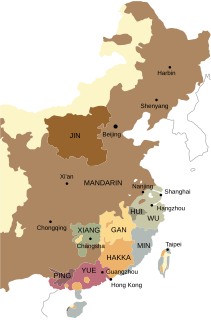
Chinese, also known as Sinitic, is a branch of the Sino-Tibetan language family consisting of hundreds of local language varieties, many of which are not mutually intelligible. The differences are similar to those within the Romance languages, with variation particularly strong in the more mountainous southeast. A widely quoted classification divides these varieties into seven groups: Mandarin, Wu, Min, Xiang, Gan, Hakka and Yue, though a more recent classification splits some of these to obtain ten groups, and some varieties remain unclassified.

Wu is a group of linguistically similar and historically related varieties of Chinese primarily spoken in the whole city of Shanghai, Zhejiang province and the southern half of Jiangsu province, as well as bordering areas.

The Battle of Changsha (1944) was an invasion of the Chinese province of Hunan by Japanese troops near the end of the Second Sino-Japanese War. As such, it encompasses three separate conflicts: an invasion of the city of Changsha and two invasions of Hengyang.
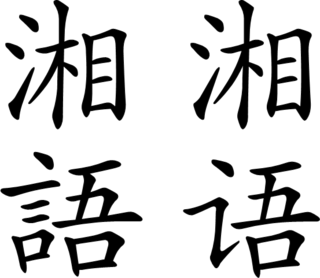
Xiang or Hsiang, also known as Hunanese, is a group of linguistically similar and historically related varieties of Chinese, spoken mainly in Hunan province but also in northern Guangxi and parts of neighboring Guizhou and Hubei provinces. Scholars divided Xiang into five subgroups, Chang-Yi, Lou-Shao, Hengzhou, Chen-Xu and Yong-Quan. Among those, Lou-shao, also known as Old Xiang, still exhibits the three-way distinction of Middle Chinese obstruents, preserving the voiced stops, fricatives, and affricates. Xiang has also been heavily influenced by Mandarin, which adjoins three of the four sides of the Xiang speaking territory, and Gan in Jiangxi Province, from where a large population immigrated to Hunan during the Ming Dynasty.

Pinghua is a group of related varieties of Chinese spoken mainly in parts of the Guangxi Zhuang Autonomous Region, with some speakers in Hunan province. Pinghua is a trade language in some areas of Guangxi, where it is spoken as a second language by speakers of Zhuang languages. Some speakers of Pinghua are officially classified as Zhuang, and many are genetically distinct from most other Han Chinese. The northern subgroup of Pinghua is centered on Guilin and the southern subgroup around Nanning. Southern Pinghua has several notable features such as having four distinct checked tones, and using various loanwords from the Zhuang languages, such as the final particle wei for imperative sentences.
Weitou dialect is a dialect of Yue Chinese. It forms part of the Guan-Bao branch of Yuehai, sometimes called Cantonese. It is spoken by older generations in Luohu and Futian Districts in Shenzhen, and by those in the New Territories, Hong Kong.
Shiqi dialect is a dialect of Yue Chinese. It is spoken by roughly 160,000 people in Zhongshan, Guangdong's Shiqi urban district. It differs slightly from Standard Cantonese, mainly in its pronunciation and lexicon.
Nanyue was an ancient kingdom that consisted of parts of the modern southern China and much of modern northern Vietnam
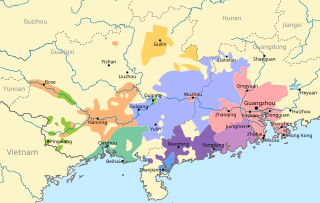
Yong–Xun, is a western branch of Yue Chinese spoken in some cities and towns in Guangxi province, including Nanning, Yongning, Guiping, Chongzuo, Ningmin, Hengzhou, Baise, etc. This branch originates from Guangfu Yue and is therefore close to Standard Cantonese. It also absorbed some phonemes and words from the local languages Pinghua and Zhuang.
Yuehai is the main branch of Yue Chinese, spoken in the Pearl River Delta of the province of Guangdong, as well as Hong Kong and Macau. It is commonly called Cantonese, though that name is more precisely applied to the Guangzhou dialect of Yuehai.
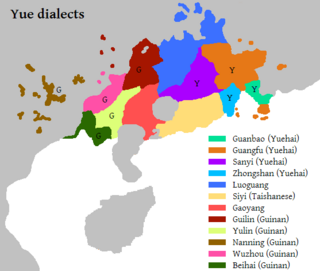
Luo–Guang (羅廣方言) is a northern branch of Yue Chinese spoken in Guangxi province.
Wu–Hua is a branch of Yue Chinese spoken in Guangdong province composed of two dialects:
The Yiyang-Loudi-Hengyang Expressway commonly abbreviated as Yilouheng Expressway, is an expressway in Hunan province, China that connects Yiyang, Loudi, and Hengyang. It is 222.632 km in length.
The Huizhou dialect is a Chinese dialect spoken in and around Huicheng District, the traditional urban centre of Huizhou, Guangdong. The locals also call the dialect Bendihua and distinguish it from the dialect spoken in Meixian and Danshui, Huiyang, which they call Hakka.


