
Greek is an independent branch of the Indo-European family of languages, native to Greece, Cyprus and other parts of the Eastern Mediterranean and the Black Sea. It has the longest documented history of any living Indo-European language, spanning more than 3000 years of written records. Its writing system has been the Greek alphabet for the major part of its history; other systems, such as Linear B and the Cypriot syllabary, were used previously. The alphabet arose from the Phoenician script and was in turn the basis of the Latin, Cyrillic, Armenian, Coptic, Gothic, and many other writing systems.
In linguistics, grammar is the set of structural rules governing the composition of clauses, phrases, and words in any given natural language. The term refers also to the study of such rules, and this field includes phonology, morphology, and syntax, often complemented by phonetics, semantics, and pragmatics.

Latin is a classical language belonging to the Italic branch of the Indo-European languages. The Latin alphabet is derived from the Etruscan and Greek alphabets and ultimately from the Phoenician alphabet.
The nominative case , subjective case, straight case or upright case is one of the grammatical cases of a noun or other part of speech, which generally marks the subject of a verb or the predicate noun or predicate adjective, as opposed to its object or other verb arguments. Generally, the noun "that is doing something" is in the nominative, and the nominative is often the form listed in dictionaries.
In linguistics, syntax is the set of rules, principles, and processes that govern the structure of sentences in a given language, usually including word order. The term syntax is also used to refer to the study of such principles and processes. The goal of many syntacticians is to discover the syntactic rules common to all languages.
The trivium is the lower division of the seven liberal arts and comprises grammar, logic, and rhetoric.
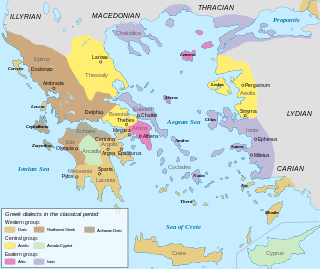
Attic Greek is the Greek dialect of the ancient city-state of Athens. Of the ancient dialects, it is the most similar to later Greek and is the standard form of the language that is studied in ancient Greek language courses. Attic Greek is sometimes included in the Ionic dialect. Together, Attic and Ionic are the primary influences on Modern Greek.
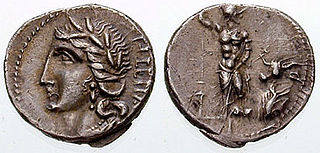
Oscan is an extinct Indo-European language of southern Italy. The language is also the namesake of the language group to which it belonged. As a member of the Italic languages, Oscan is therefore a sister language to Latin and Umbrian.

A grammar school is one of several different types of school in the history of education in the United Kingdom and other English-speaking countries, originally a school teaching Latin, but more recently an academically-oriented secondary school, differentiated in recent years from less academic secondary modern schools.
Aorist verb forms usually express perfective aspect and refer to past events, similar to a preterite. Ancient Greek grammar had the aorist form, and the grammars of other Indo-European languages and languages influenced by the Indo-European grammatical tradition, such as Middle Persian, Sanskrit, Armenian, the South Slavic languages, and Georgian, also have forms referred to as aorist.
Pontic Greek is a Greek dialect originally spoken in the Pontus area on the southern shores of the Black Sea, northeastern Anatolia, the Eastern Turkish/Caucasus province of Kars, southern Georgia and today mainly in northern Greece. Its speakers are referred to as Pontic Greeks or Pontian Greeks.

Demotic is the ancient Egyptian script derived from northern forms of hieratic used in the Nile Delta, and the stage of the Egyptian language written in this script, following Late Egyptian and preceding Coptic. The term was first used by the Greek historian Herodotus to distinguish it from hieratic and hieroglyphic scripts. By convention, the word "Demotic" is capitalized in order to distinguish it from demotic Greek.
Synizesis is a sound change (metaplasm) in which two originally syllabic vowels are pronounced as a single syllable without change in writing. In Latin and Greek, the reason was often to preserve meter, but similar changes can occur naturally.
Herbert Weir Smyth was an American classical scholar. His comprehensive grammar of Ancient Greek has become a standard reference on the subject in English, comparable to that of William Watson Goodwin, whom he succeeded as Eliott Professor of Greek Literature at Harvard University.
The Art of Grammar is a treatise on Greek grammar, attributed to Dionysius Thrax, who wrote in the 2nd century BC. It is the first work on grammar in Greek, and also the first concerning a Western language; it sought mainly to help speakers of Koine Greek understand the language of Homer and other great poets of the past.
Jewish Koine Greek, or Jewish Hellenistic Greek, is the variety of Koine Greek or "common Attic" found in a number of Alexandrian dialect texts of Hellenistic Judaism, most notably in the Septuagint translation of the Hebrew Bible and associated literature, as well as in Greek Jewish texts from Palestine. The term is largely equivalent with Greek of the Septuagint as a cultural and literary rather than a linguistic category. The minor syntax and vocabulary variations in the Koine Greek of Jewish authors are not as linguistically distinctive as the later language Yevanic, or Judeo-Greek, spoken by the Romaniotes Jews in Greece.
