
A tea bag or teabag is a small, porous, sealed bag or packet, typically containing tea leaves or the leaves of other herbs, which is immersed in water to steep and make an infusion. Originally used only for tea, they are now made with other tisanes as well.

A lifting bag is an item of diving equipment consisting of a robust and air-tight bag with straps, which is used to lift heavy objects underwater by means of the bag's buoyancy. The heavy object can either be moved horizontally underwater by the diver or sent unaccompanied to the surface.

A handbag, commonly known as a purse in North American English, is a handled medium-to-large bag used to carry personal items. It has also been called a pocketbook in parts of the U.S.

In use by consumers worldwide since the 1960s, shopping bags made from various kinds of plastic, are variously called plastic shopping bags, carrier bags, or plastic grocery bags. They a sometimes refereed to as single-use bags—referring to carrying items from a store to a home—although, it is rare for bags to be worn out after single use, and in the past some retailers incentivised customers to reuse 'single use' bags by offering loyalty points to those doing so. Even after they are no longer used for shopping, reuse of these bags for storage or trash is common, and modern plastic shopping bags are increasingly recyclable or compostable - at the Co-op for example. In recent decades, numerous countries have introduced legislation restricting the provision of plastic bags, in a bid to reduce littering and plastic pollution.
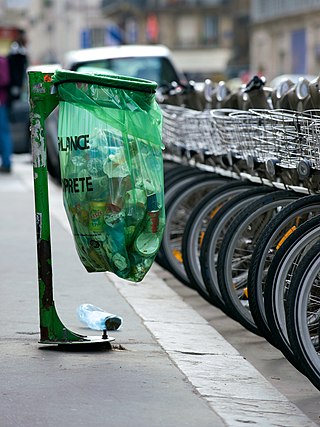
A plastic bag, poly bag, or pouch is a type of container made of thin, flexible, plastic film, nonwoven fabric, or plastic textile. Plastic bags are used for containing and transporting goods such as foods, produce, powders, ice, magazines, chemicals, and waste. It is a common form of packaging.
A bin bag, rubbish bag, garbage bag, bin liner, trash bag or refuse sack is a disposable receptable for solid waste. These bags are useful to line the insides of waste containers to prevent the insides of the container from becoming coated in waste material. Most bags today are made out of plastic, and are typically black, white, or green in color.

A sickness bag is a small bag commonly provided to passengers on board airplanes and boats to collect and contain vomit in the event of motion sickness.
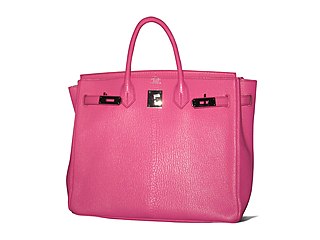
The Birkin bag is a tote bag introduced in 1984 by French luxury goods maker Hermès. Birkin bags are handmade from leather and are named after the English-French actress and singer Jane Birkin.

An It bag is a high-priced designer handbag that has become a popular best-seller. The phenomenon arose in the fashion industry and was named in the 1990s and 2000s. Examples of handbag brands that have been considered "It bags" are Chanel, Hermès and Fendi.

A zipper storage bag,slider storage bag,zipper bag,zip lock bag, or zippie is an inexpensive flexible rectangular storage bag, usually transparent, made of polyethylene or similar plastic, that can be sealed and opened many times, either by a slider, which works in a similar way to a zip fastener, or by pinching together the two sides of a mechanical sealing mechanism with one's fingers. The bags are made in many sizes; a typical small size is 1.5 by 2.5 inches, and a typical large size is 9 by 12 inches. Material thickness (gauge) varies; smaller bags are typically 40 to 45 μm.
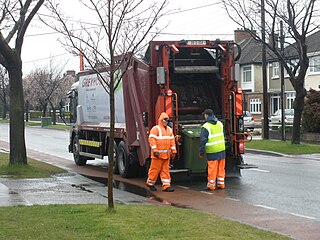
Rates of household recycling in Ireland have increased dramatically since the late 1990s. The Irish Environmental Protection Agency (EPA) is the agency with overall responsibility for environmental protection in Ireland and monitors rates of recycling in Ireland along with other measures of environmental conditions in Ireland. The EPA, along with Repak, the principal organisation for packaging recycling in Ireland, report on recycling rates each year. In 2012 Ireland’s municipal solid waste (MSW) recycling rate was 34%, while the rate of packaging recycling reached 79%. The amount of municipal waste generated per person per year in Ireland has fallen significantly in recent years. This figure remains above the European Union annual municipal waste average of 503 kg per person, however. Each local council in Ireland has considerable control over recycling, so recycling practices vary to some extent across the country. Most waste that is not recycled is disposed of in landfill sites.

Golf equipment encompasses the various items that are used to play the sport of golf. Types of equipment include the golf ball, golf clubs, and devices that aid in the sport.

A milk bag is a flexible plastic pouch used to package milk and is used in some areas instead of a hardened milk jug, or as an alternative to it. Usually one of the corners is cut off to allow for pouring, and the bag is stored in a pitcher.

A diaper bag or nappy bag is a storage bag with many pocket-like spaces that is big enough to carry everything needed by someone taking care of a baby while taking a typical short outing.

A reusable shopping bag, sometimes called a bag for life in the UK, is a type of shopping bag which can be reused many times, in contrast to single-use paper or plastic shopping bags. It is often a tote bag made from fabric such as canvas, natural fibres such as jute, woven synthetic fibers, or a thick plastic that is more durable than disposable plastic bags, allowing multiple use. Other shoppers may use a string bag or a wheeled trolley bag. They are often sold in supermarkets and apparel shops.
A plastic bag ban or charge is a law that restricts the use of lightweight plastic bags at retail establishments. In the early 21st century, there has been a global trend towards the phase-out of lightweight plastic bags. Single-use plastic shopping bags, commonly made from low-density polyethylene (LDPE) plastic, have traditionally been given for free to customers by stores when purchasing goods: the bags have long been considered a convenient, cheap, and hygienic way of transporting items. Problems associated with plastic bags include use of non-renewable resources, difficulties during disposal, and environmental impacts. Concurrently with the reduction in lightweight plastic bags, shops have introduced reusable shopping bags.

A bag is a common tool in the form of a non-rigid container, typically made of cloth, leather, bamboo, paper, or plastic. The use of bags predates recorded history, with the earliest bags being lengths of animal skin, cotton, or woven plant fibers, folded up at the edges and secured in that shape with strings of the same material. Bags can be used to carry items such as personal belongings, groceries, and other objects. They come in various shapes and sizes, often equipped with handles or straps for easier carrying.

Red-white-blue bag or laundry bag is a carriage bag made out of nylon canvas in colors of red, white and blue. It originated in Hong Kong in the 1960s and has become a representative of Hong Kong culture. Because the nylon canvas is known of its light, firmness and durable usage, it is commonly used as hand carry luggage and transport between Mainland China and Hong Kong.

A security bag is a heavy duty bag used to contain high-value products, documents or legally sensitive items. Envelopes with security features are called security envelopes as well as security bags. Cash for deposit in a bank is often placed in a special deposit bag with security features. When they are used to contain items related to a crime, special evidence bags are used. Authentication of signatures and chain of custody are often required.
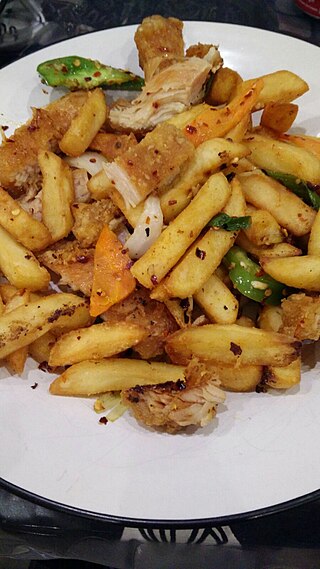
A spice bag is a fast food dish, popular in most of Ireland and inspired by Chinese cuisine. The dish is most commonly sold in Chinese takeaways in Ireland, and Irish-themed restaurants elsewhere. Typically, a spice bag consists of deep-fried salt and chilli chips, salt and chilli chicken, red and green peppers, sliced chili peppers, fried onions and a variety of spices. A vegetarian or vegan option is often available, in which deep fried tofu takes the place of the shredded chicken. It is sometimes accompanied by a tub of curry sauce.

