
An echinoderm is any member of the phylum Echinodermata. The adults are recognisable by their radial symmetry, and include starfish, brittle stars, sea urchins, sand dollars, and sea cucumbers, as well as the sea lilies or "stone lilies". Adult echinoderms are found on the sea bed at every ocean depth, from the intertidal zone to the abyssal zone. The phylum contains about 7,000 living species, making it the second-largest grouping of deuterostomes, after the chordates. Echinoderms are the largest entirely marine phylum. The first definitive echinoderms appeared near the start of the Cambrian.

Sea urchins are spiny, globular echinoderms in the class Echinoidea. About 950 species of sea urchin live on the seabed of every ocean and inhabit every depth zone — from the intertidal seashore down to 5,000 meters. The spherical, hard shells (tests) of sea urchins are round and spiny, ranging in diameter from 3 to 10 cm. Sea urchins move slowly, crawling with tube feet, and also propel themselves with their spines. Although algae are the primary diet, sea urchins also eat slow-moving (sessile) animals. Predators that eat sea urchins include a wide variety of fish, starfish, crabs, marine mammals. Sea urchins are also used as food especially in Japan.
Urchin or urcheon is the Middle English term for "hedgehog". It may refer to:
Sea potato may refer to :
There have been five ships of the Royal Navy to bear the name HMS Urchin after the Sea urchin:
Diadema is the term for diadem in most Romance languages, and in English may refer to:

The Marvelous Misadventures of Flapjack is an American animated television series created by Thurop Van Orman for Cartoon Network. It premiered in the United States on June 5, 2008. It stars Van Orman as the voice of Flapjack, a naive young boy who was raised by a whale named Bubbie and is mentored by a crusty old pirate named Captain K'nuckles. Together the trio spend their days in Stormalong Harbor, where most of the show takes place, whilst getting into mishaps on the search for the elusive Candied Island.
Bald sea urchin disease is a bacterial disease known to affect several species of sea urchins in the Mediterranean Sea, North Atlantic and along the California coastline. Research suggests two pathogens are responsible for the disease, Listonella anguillarum and Aeromonas salmonicida.
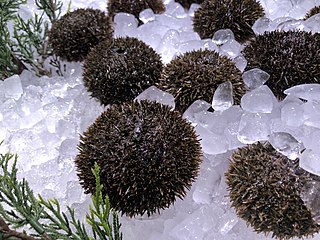
Hemicentrotus pulcherrimus is a species of sea urchin, the only one in the monotypic genus Hemicentrotus. It was first described by the American engineer and marine zoologist Alexander Agassiz in 1864 as Psammechinus pulcherrimus. Its range extends along the coasts of Korea and China, and in Japan from Kyūshū to Ishikari Bay. An edible species, it is harvested from Kyūshū to Fukui, in the Sea of Japan.

Toxopneustes pileolus, commonly known as the flower urchin, is a widespread and commonly encountered species of sea urchin from the Indo-West Pacific. It is considered highly dangerous, as it is capable of delivering extremely painful and medically significant stings when touched. It inhabits coral reefs, seagrass beds, and rocky or sandy environments at depths of up to 90 m (295 ft). It feeds on algae, bryozoans, and organic detritus.
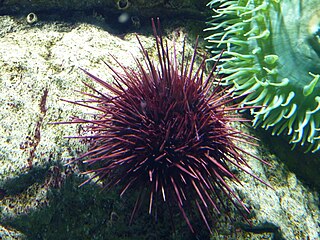
The Parechinidae are a family of sea urchins in the class Echinoidea.

Psammechinus miliaris is a species of sea urchin in the family Parechinidae. It is sometimes known as the green sea urchin or shore sea urchin. It is found in shallow areas of the eastern Atlantic Ocean and the North Sea.
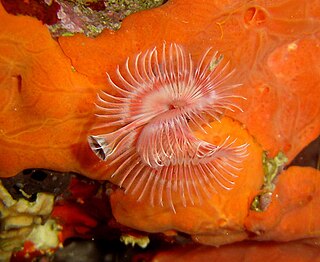
Serpula vermicularis, known by common names including the calcareous tubeworm, fan worm, plume worm or red tube worm, is a species of segmented marine polychaete worm in the family Serpulidae. It is the type species of the genus Serpula and was first described by Carl Linnaeus in his 1767 12th edition of Systema Naturae. It lives in a tube into which it can retract.

Psammechinus microtuberculatus, also known as the green sea urchin, in the family Parechinidae.
A sea urchin is a spiny marine echinoderm.

Marthasterias is a genus of starfish in the family Asteriidae. It is monotypic and the only species in the genus is Marthasterias glacialis, commonly known as the spiny starfish. It is native to the eastern Atlantic Ocean.
Fire urchin may refer to one of several sea urchins including:
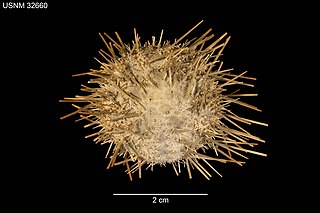
Lytechinus pictus, commonly known as the painted urchin, is a sea urchin in the family Toxopneustidae. It occurs on shallow reefs in the tropical and subtropical eastern Pacific Ocean, off the coasts of California, Central America and South America as far south as Ecuador.

Parechinus angulosus, the Cape urchin, is a sea urchin in the family Parechinidae endemic to southern Africa.
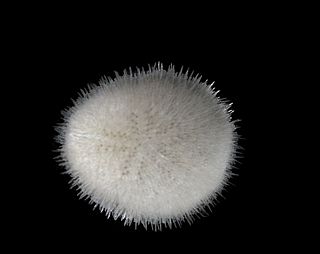
Echinocyamus pusillus, commonly known as the pea urchin or green urchin, is a species of sand dollar, a sea urchin in the family Fibulariidae, native to the northeastern Atlantic Ocean and the Mediterranean Sea. It buries itself in gravel or coarse sand at depths down to about 1,250 m (4,000 ft).
