
Count Alexander Vasilyevich Suvorov-Rymniksky, Prince of Italy, was a Russian general and military theorist in the service of the Russian Empire.

The Order of Saint Andrew the Apostle the First-Called is the highest order conferred by both the Russian Imperial Family and by the Russian Federation . Established as the first and highest order of chivalry of the Russian Tsardom and the Russian Empire in 1698, it was removed from the honours system under the USSR before being re-established as the top Russian civil and military order in 1998.
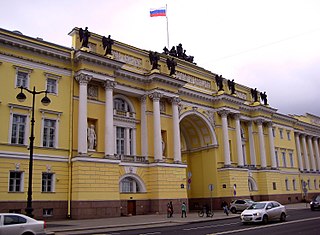
From 1711 to 1917, the Governing Senate was the highest legislative, judicial, and executive body subordinate to the Russian emperors. The senate was instituted by Peter the Great to replace the Boyar Duma and lasted until the very end of the Russian Empire. It was chaired by the Procurator General, who served as the link between the sovereign and the Senate; he acted, in the emperor's own words, as "the sovereign's eye".

Prince Pyotr Mikhailovich Volkonsky Russian: Пётр Миха́йлович Волко́нский, tr. Pyotr Mikhaylovich Volkonskiy; 6 May [O.S. 25 April] 1776 – 8 September [O.S. 27 August] 1852) was an Imperial Russian military commander, General-Field Marshal (1843), Adjutant General to Alexander I, member of the State Council (1821).
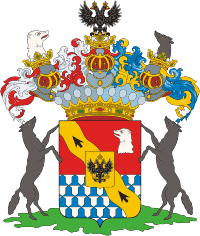
The House of Stroganov or Strogonov, French spelling: Stroganoff, was a Russian noble family of highly successful Russian merchants, industrialists, landowners, and statesmen. From the time of Ivan the Terrible they were the richest businessmen in the Tsardom of Russia. They financed the Russian conquest of Siberia and Prince Pozharsky's 1612 reconquest of Moscow from the Poles. The Stroganov School of icon-painting takes its name from them. The most recent common ancestor of the family was Fyodor Lukich Stroganov, a salt industrialist. His elder son, Vladimir, became the founder of a branch whose members eventually became state peasants; this lineage continues. The lineage from Fyodor Lukich Stroganov's youngest son, Anikey (1488–1570), died out in 1923. Anikey's descendants became members of the high Russian nobility under the first Romanovs.

The government reforms of Peter I aimed to modernize the Tsardom of Russia based on Western European models.
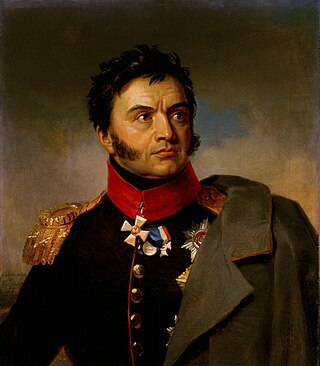
Nikolay Nikolayevich Raevsky was a Russian general and statesman who achieved fame for his feats of arms during the Napoleonic Wars. His family left a lasting legacy in Russian society and culture.
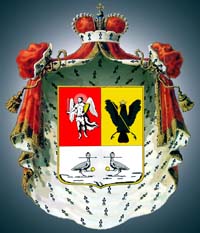
The House of Repnin, the name of an old Russian princely family of Rurikid stock. The family traces its name to Prince Ivan Mikhailovich Obolensky (+1523), nicknamed Repnya, i.e., "bad porridge". Like other Princes Obolensky, he descended from Mikhail Vsevolodovich, prince of Chernigov, who, in 1246, was assassinated by the Mongols.

Prince Grigory Grigorievich Gagarin was a Russian painter, Major General and administrator.
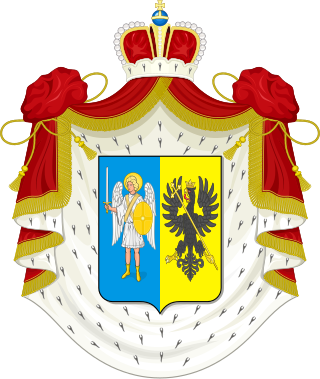
The House of Volkonsky, also spelled Volkonski or Wolkonsky and later times Wlodkowski after migration to Poland, is an ancient Russian noble family, belonging to the Rurikids. It was named after the Volkona river south of Moscow. The family held the title of Prince in the Russian Empire.
Prince Alexandr Mikhailovich Volkonsky was Russian military attaché and writer, who in later life, was ordained a priest by the Bulgarian Greek Catholic Church.

Prince Nikita Grigorievich Volkonsky was a Russian general from the Volkonsky family. He took part in the Napoleonic wars and later converted from Orthodoxy to Roman Catholicism.
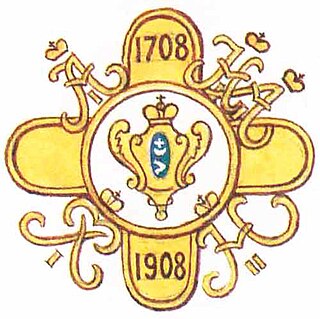
The 13th Belozersk Infantry Regiment, or 13th General Field Marshal Prince Volkonsky's Infantry Regiment, was an infantry regiment of the Russian Empire's Imperial Russian Army. It was known by different names for much of its existence but most of its designations included "Belozersk Infantry Regiment." Formed in 1708 in the reign of Czar Peter the Great and disbanded in 1918, the regiment fought in the Great Northern War, the Russian campaign of 1812, the War of the Sixth Coalition, the suppression of the Polish November Uprising, and the Crimean War, among other conflicts.

Prince Nikolai Grigoryevich Repnin-Volkonsky was a general in the Imperial Russian Army.
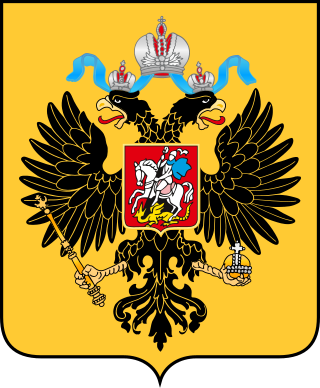
The Council at the Highest Court was the highest advisory institution in the Russian Empire that existed from 1768 to 1801.
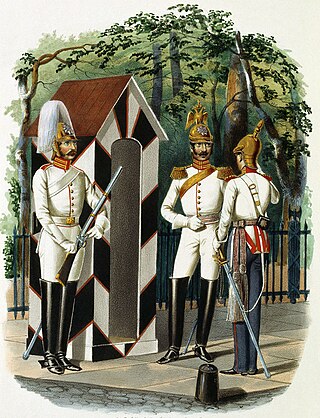
The Life Guard Horse Regiment was a cavalry regiment of the Imperial guard of Russian Empire. The regiment was founded in the reign of Peter the Great and was disbanded after the October Revolution in 1917. Its annual feast day was 25 March.
The 58th Rifle Division was an infantry division of the Red Army formed during the interwar period. Its second formation during World War II gained the Oder honorific.

Prince Mikhail Nikitich Volkonsky was a Russian statesman and military figure from the House of Volkonsky, General-in-Chief (1762), in 1771–1780 he was Commander-in-Chief in Moscow. The brother of General Alexei Volkonsky, uncle of Nastasya Ofrosimova.
