Guillaume Kornmann (born 1741, Strasbourg; died 1795, Paris) was a French banker. He is best known for the particularly sensational trial of his wife (prosecuted by Beaumarchais) in the 1780s.
In 1774, Kornmann married Catherine Marie Foesch, a young Swiss heiress, who bore him two children. They settled in Paris, where he managed his uncle's bank. The couple did not get on well, and Kornmann allowed his wife to take a lover, as long as she kept things in order. The lover was a certain Daudet de Jossan, a confidant of the powerful de Montbarey, Minister for War and magistrate for Strasbourg. But soon, the minister resigned, and the young man suddenly became much less respectable. Furthermore, Madame Kornmann, who did not hesitate to be seen with him in a scandalous way, threatened to demand a separation from her husband (as divorce did not yet exist). Fearing he would lose his wife and particularly her dowry, Guillaume Kornmann, who in the meantime was almost ruined, obtained a warrant from the police commissioner and had his adulterous wife arrested, then pregnant by her lover.
Thus, on the night of 3–4 August 1781, his wife was taken to Douai, a disciplinary institution on the Rue de Bellefond that housed "lost" and mad women. On the insistence of mutual friends, Beaumarchais rescued Madame Kornmann (whom he did not yet know). Thus began the Kornmann Affair. Once freed, she tried unsuccessfully to obtain a legal separation from her husband, arguing that her scandalous detention justified it.
The cheated husband decided to press charges against his spouse and her lover for adultery, against Beaumarchais and Police Commissioner Lenoir for defamation and as accessories to adultery. He took his friend Nicolas Bergasse, a fellow disciple of Anton Mesmer, as his lawyer.
Beaumarchais was declared innocent by order of the Parlement of Paris the 2 April 1789. Kornmann and his lawyer Bergasse were ordered to pay him damages but public opinion remained largely in their favour. In 1793 Madame Kornmann finally obtained a divorce, which had been permitted by the law of 20 September 1792.
This French business–related biographical article is a stub. You can help Wikipedia by expanding it.
Adultery is extramarital sex that is considered objectionable on social, religious, moral, or legal grounds. Although the sexual activities that constitute adultery vary, as well as the social, religious, and legal consequences, the concept exists in many cultures and shares some similarities in Christianity, Judaism and Islam. Adultery is viewed by many jurisdictions as offensive to public morals, undermining the marriage relationship.
Pierre-Augustin Caron de Beaumarchais was a French polymath. At various times in his life, he was a watchmaker, inventor, playwright, musician, diplomat, spy, publisher, horticulturist, arms dealer, satirist, financier and revolutionary.
Confidentially Yours is a 1983 French comedy mystery film directed by François Truffaut. Based on the 1962 novel The Long Saturday Night by American author Charles Williams, it tells the story of Julien Vercel, an estate agent who is suspected of murdering his wife and her lover. As Vercel is hidden in his office, his secretary Barbara Becker investigates these suspicious murders. It was the last film directed by Truffaut before his death in October of the following year. The film had a total of 1,176,425 admissions in France and was the 39th highest-grossing film of the year.
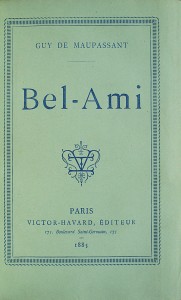
Bel-Ami is the second novel by French author Guy de Maupassant, published in 1885; an English translation titled Bel Ami, or, The History of a Scoundrel: A Novel first appeared in 1903.
Matthew 1:19 is the nineteenth verse of the first chapter in the Gospel of Matthew in the New Testament. It is part of the description of the events surrounding the birth of Jesus. In the previous verse, Joseph has found Mary to be pregnant, and in this verse he considers leaving her.
Matthew 5:32 is the thirty-second verse of the fifth chapter of the Gospel of Matthew in the New Testament and part of the Sermon on the Mount. This much scrutinized verse contains part of Jesus' teachings on the issue of divorce.
Nicolas Bergasse was a French lawyer, philosopher, and politician, whose activity was mainly carried out during the beginning of the French Revolution during its early Monarchiens phase.
The Guilty Mother, subtitled The Other Tartuffe, is the third play of the Figaro trilogy by Pierre Beaumarchais; its predecessors were The Barber of Seville and The Marriage of Figaro. This was the author's last play. It is rarely revived. Like the earlier plays of the trilogy it has been turned into operatic form, but it has not entered the general opera repertoire.
Marie-Lætitia de Solms née Bonaparte-Wyse, was a French author and literary hostess.
Charles-Guillaume Le Normant d'Étiolles is best known as being the husband of Madame de Pompadour or Jeanne-Antoinette Poisson, the illustrious mistress of King Louis XV of France.
A husband is a man involved in a marital relationship, commonly referred to as a spouse. The specific rights, responsibilities, and societal status attributed to a husband can vary significantly across different cultures and historical periods, reflecting a global perspective on this role.
A mistress is a woman who is in a relatively long-term sexual and romantic relationship with someone who is married to a different person.
Alice de Janzé, also known as the Countess de Janzé during her first marriage and as Alice de Trafford during her second marriage, was an American heiress who spent years in Kenya as a member of the Happy Valley set of colonials. She was connected with several scandals, including the attempted murder of her lover in 1927, and the 1941 murder of the 22nd Earl of Erroll in Kenya. Her life was marked by promiscuity, drug abuse and several suicide attempts.
Wife selling in England was a way of ending an unsatisfactory marriage that probably began in the late 17th century, when divorce was a practical impossibility for all but the very wealthiest. After parading his wife with a halter around her neck, arm, or waist, a husband would publicly auction her to the highest bidder. Wife selling provides the backdrop for Thomas Hardy's 1886 novel The Mayor of Casterbridge, in which the central character sells his wife at the beginning of the story, an act that haunts him for the rest of his life, and ultimately destroys him.
Catherine Noël Grand was a French courtesan and noblewoman. She was the daughter of a colonial officer in French India, who became the mistress and later the wife of French diplomat Charles Maurice de Talleyrand-Périgord, the first Prime Minister of France. From 1806 until her death she was Catherine Noël de Talleyrand-Périgord, Princesse de Bénévent. She was known for her beauty.
Holy Deadlock is a 1934 satirical novel by the English author A. P. Herbert, which aimed to highlight the perceived inadequacies and absurdities of contemporary divorce law. The book took a particularly lenient view of the need for divorces, which it characterised as "a relief from misfortune, not a crime", and demonstrated how the current system created an environment which encouraged the participants to commit perjury and adultery. The book was a major element in the popular debate about the liberalisation of divorce law in the mid-1930s, and helped pave the way for the 1937 statutory reforms.
Maria Caterina Brignole was Princess of Monaco by marriage to Prince Honoré III.
Sophie Françoise Trébuchet was a French painter and the mother of Victor Hugo.
Anne Manners, Lady Roos, formerly Lady Anne Pierrepont, was the first wife of John Manners, 1st Duke of Rutland. Their marital break-up caused a sensation and their divorce, in 1670, on the grounds of Lady Roos's adultery, was the first to be granted in England since the Reformation.
Adultery in Francoist Spain and the democratic transition was a criminal offense which was defined as sexual intercourse between a married woman and a man other than her husband, and could lead to prison terms of between six months and six years. By contrast, the related crime for male infidelity was not treated the same: it was called amancebamiento and was defined as a married man keeping a mistress in the conjugal home, or keeping a mistress in a notorious manner outside the conjugal home. Adultery (adulterio) was often prosecuted, but not amancebamiento, with male infidelity being "a state of mind in Spain".
This page is based on this Wikipedia article Text is available under the CC BY-SA 4.0 license; additional terms may apply. Images, videos and audio are available under their respective licenses.