
Alyattes, sometimes described as Alyattes I, was the fourth king of the Mermnad dynasty in Lydia, the son of Sadyattes and grandson of Ardys. He was succeeded by his son Croesus. A battle between his forces and those of Cyaxares, king of Media, was interrupted by the solar eclipse of 28 May 584 BC. After this, a truce was agreed and Alyattes married his daughter Aryenis to Astyages, the son of Cyaxares. The alliance preserved Lydia for another generation, during which it enjoyed its most brilliant period. Alyattes continued to wage a war against Miletus for many years but eventually he heeded the Delphic Oracle and rebuilt a temple, dedicated to Athena, which his soldiers had destroyed. He then made peace with Miletus.

Lydia was an Iron Age kingdom of western Asia Minor located generally east of ancient Ionia in the modern western Turkish provinces of Uşak, Manisa and inland İzmir. Its population spoke an Anatolian language known as Lydian. Its capital was Sardis.

Gyges was the founder of the Mermnad dynasty of Lydian kings. The dates of his reign are uncertain but have been tentatively estimated as c. 687 – c. 652 BC. He was a bodyguard of his predecessor Candaules whom he assassinated in order to seize the throne. His action was approved by the Delphic Oracle and that decision prevented civil war in Lydia. Once established on the throne, Gyges devoted himself to consolidating his kingdom and making it a military power.
The year 652 BC was a year of the pre-Julian Roman calendar. In the Roman Empire, it was known as year 102 Ab urbe condita. The denomination 652 BC for this year has been used since the early medieval period, when the Anno Domini calendar era became the prevalent method in Europe for naming years.
Sadyattes was the third king of the Mermnad dynasty in Lydia, the son of Ardys. According to Herodotus, he reigned for twelve years. He was succeeded by his son Alyattes. Sadyattes began a war with the Ionian Greek maritime city of Miletus that was continued by Alyattes.

Candaules, also known as Myrsilos (Μυρσίλος), was a king of the ancient Kingdom of Lydia in the early years of the 7th century BC. According to Herodotus, he succeeded his father Meles as the 22nd and last king of Lydia's Heraclid dynasty. He was assassinated and succeeded by Gyges.

The Lydians were an Anatolian people living in Lydia, a region in western Anatolia, who spoke the distinctive Lydian language, an Indo-European language of the Anatolian group.
The Ring of Gyges (Ancient Greek: Γύγου Δακτύλιος, Gúgou Daktúlios, Attic Greek pronunciation: [ˈɡyːˌɡoː dakˈtylios] is a mythical magical artifact mentioned by the philosopher Plato in Book 2 of his Republic. It grants its owner the power to become invisible at will. Through the story of the ring, Republic considers whether an intelligent person would be just if one did not have to fear any bad reputation for committing injustices.
Candaulism, or candaulesism, is a paraphilic sexual practice or fantasy in which one person exposes his partner, or images of her, to other people for their voyeuristic pleasure. Candaulism is also associated with voyeurism and exhibitionism.

Nationalmuseum is the national gallery of Sweden, located on the peninsula Blasieholmen in central Stockholm.

Der König Kandaules is an opera in three acts by the Austrian composer Alexander von Zemlinsky. Its libretto was adapted by the composer from Franz Blei's German translation of the play Le roi Candaule by French author André Gide.
Sabahattin Ali was a Turkish novelist, short-story writer, poet, and journalist.
Le Roi Candaule is a Grand ballet in four acts and six scenes, with choreography by Marius Petipa and music by Cesare Pugni. The libretto is by Jules-Henri Vernoy de Saint-Georges and is based on the history of King Candaules the Ruler of Lydia, as described by Herodotus in his Histories.
Ardys was the second king of the Mermnad dynasty in Lydia, the son of Gyges. According to Herodotus, he reigned for 49 years and was succeeded by his son Sadyattes.
Invisibility in fiction is a common plot device, found in both the science fiction and fantasy genres. In fantasy, invisibility is often invoked and dismissed at will, with a magic spell, a potion or a ring. In science fiction, invisibility is often conferred on the recipient as part of a complex process that is difficult or impossible to reverse, so that switching back and forth at frequent intervals is less likely to be done in science fiction.
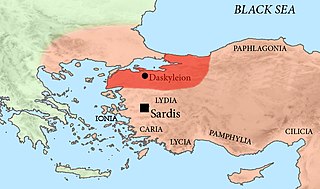
Dascylium, Dascyleium, or Daskyleion, also known as Dascylus, was a town in Anatolia some 30 kilometres (19 mi) inland from the coast of the Propontis, at modern Ergili, Turkey. Its site was rediscovered in 1952 and has since been excavated.
Lake Marmara is a lake in Manisa Province, western Turkey, bordered by the district areas of Gölmarmara to the northwest, whose name itself is inspired by the lake, and in larger part by Salihli.

In Greek mythology, the Hecatoncheires, or Hundred-Handers, also called the Centimanes,, named Cottus, Briareus and Gyges, were three monstrous giants, of enormous size and strength, with fifty heads and one hundred arms. In the standard tradition they were the offspring of Uranus (Sky) and Gaia (Earth), who helped Zeus and the Olympians overthrow the Titans.
Candaules, King of Lydia, Shews his Wife by Stealth to Gyges, One of his Ministers, as She Goes to Bed, occasionally formerly known as The Imprudence of Candaules, is a 45.1 by 55.9 cm oil painting on canvas by English artist William Etty, first exhibited at the Royal Academy in 1830. It shows a scene from the Histories by Herodotus, in which Candaules, king of Lydia, invites his bodyguard Gyges to hide in the couple's bedroom and watch his wife Nyssia undress, to prove to him her beauty. Nyssia notices Gyges spying and challenges him to either accept his own execution or to kill Candaules as a punishment. Gyges chooses to kill Candaules and take his place as king. The painting shows the moment at which Nyssia, still unaware that she is being watched by anyone other than her husband, removes the last of her clothes.
