
A hospital ship is a ship designated for primary function as a floating medical treatment facility or hospital. Most are operated by the military forces of various countries, as they are intended to be used in or near war zones. In the 19th century, redundant warships were used as moored hospitals for seamen.

HMHSBritannic was the third and final vessel of the White Star Line's Olympic class of steamships and the second White Star ship to bear the name Britannic. She was the youngest sister of the RMS Olympic and the RMS Titanic and was intended to enter service as a transatlantic passenger liner. She was operated as a hospital ship from 1915 until her sinking near the Greek island of Kea, in the Aegean Sea, in November 1916. At the time she was the largest hospital ship in the world.
Newfoundland is an island in North America and part of the province of Newfoundland and Labrador.

Marine Heavy Helicopter Squadron 461 (HMH-461) is a United States Marine Corps helicopter squadron consisting of CH-53K King Stallion transport helicopters. The squadron, known as "Ironhorse", is based at Marine Corps Air Station New River in North Carolina and falls under the command of Marine Aircraft Group 29 (MAG-29) and the 2nd Marine Aircraft Wing. With its lineage starting in 1944, HMH-461 is the oldest active Heavy Lift Helicopter Squadron in the Marine Corps.
Britannic means 'of Britain' or 'British', from the Roman name for the British.
Salta is a city in Argentina.

SS Letitia was an ocean liner built in Scotland for service with the Anchor-Donaldson Line. She continued to serve with its successor company Donaldson Atlantic Line. At the start of the Second World War in September 1939, the British Admiralty requisitioned the ship for service and had it converted to serve as an armed merchant cruiser. She was withdrawn from this service in 1941 to become a troop ship.

HMHS Rewa was a steamship originally built for the British-India Steam Navigation Company for their mail and passenger service but requisitioned in August 1914 and fitted out for use as a British hospital ship during the First World War. On 4 January 1918, she was hit and sunk by a torpedo from the German U-boat U-55.

HMHS Glenart Castle was a steamship originally built as Galician in 1900 for the Union-Castle Line. She was renamed Glenart Castle in 1914, but was requisitioned for use as a British hospital ship during the First World War. On 26 February 1918, she was hit and sunk by a torpedo fired from the German U-boat UC-56.

HMHS Gloucester Castle was a steam ship originally built for the Union-Castle Line, but requisitioned for use as a British hospital ship during the First World War. On 30 March 1917 she was torpedoed by German U-boat UB-32. She was, however, salvaged, and returned to civilian service after the war. She was sunk by the German commerce raider Michel in 1942 off Ascension Island in the South Atlantic.

SS Anglia was a steam ship requisitioned for use as a hospital ship during the First World War. On 17 November 1915 she hit a mine laid by the German U-boat, UC-5.
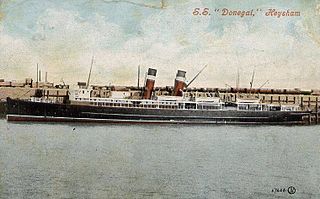
SS Donegal was a Midland Railway passenger ferry that served in the First World War as an ambulance ship. She was completed in 1904 and sunk by enemy action in April 1917.
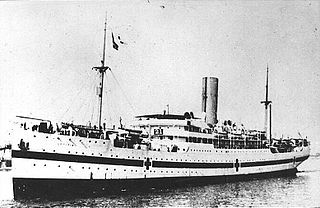
HMHS Letitia was a British hospital ship that ran aground at Portuguese Cove in Halifax Harbour, Canada on 1 August 1917 while carrying 546 wounded Canadian soldiers from Liverpool, United Kingdom to Halifax, Nova Scotia, Canada.

SS Athenia was the first Donaldson Line ship of that name to be torpedoed and sunk off Inishtrahull, by a German submarine (SM U-53) in 1917; the later SS Athenia, was similarly attacked in 1939.

HMHS Liberty was a hospital ship which served with the Royal Navy during the First World War. Formerly the steam yacht Liberty, she was built in 1908 for Joseph Pulitzer, then renamed to Glencairn when sold to James Clark Ross in 1912 before reverting to the Liberty in 1914 when sold to Lord Tredegar. The ship served as a hospital ship in World War I, before being broken up in 1937.
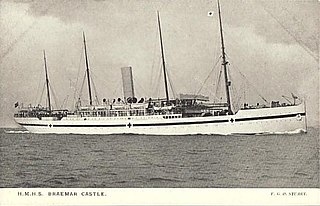
SS Braemar Castle was a passenger-cargo steamship, built for Castle Line in 1898, that spent more of her time in British government service than working for her owners. She served both as a troopship and as a hospital ship, prefixed HMT and HMHS respectively, before, during and after the First World War.

Archie Jewell was an English sailor who was on the crew of the Titanic. He survived the sinking of the Titanic and its sister ship the HMHS Britannic, but died during the sinking of the SS Donegal when it was torpedoed without warning by German forces during the course of World War I.
This page is based on this
Wikipedia article Text is available under the
CC BY-SA 4.0 license; additional terms may apply.
Images, videos and audio are available under their respective licenses.

