HNoMS Gyller

Last updated

Two ships of the Royal Norwegian Navy have borne the name HNoMS Gyller, after Gyller one of the twelve horses of the Æsir:

Royal Norwegian Navy branch of the Norwegian Armed Forces responsible for naval operations

The Royal Norwegian Navy is the branch of the Norwegian Armed Forces responsible for naval operations of the state of Norway. As of 2008, the RNoN consists of approximately 3,700 personnel and 70 vessels, including 5 heavy frigates, 6 submarines, 14 patrol boats, 4 minesweepers, 4 minehunters, 1 mine detection vessel, 4 support vessels and 2 training vessels. The navy also includes the Coast Guard.

Æsir principal pantheon in Norse mythology

In Old Norse, ǫ́ss is a member of the principal pantheon in Norse religion. This pantheon includes Odin, Frigg, Thor, Baldr and Týr. The second pantheon is known as the Vanir. In Norse mythology, the two pantheons wage war against each other, which results in a unified pantheon.

HNoMS <i>Gyller</i> (1938)

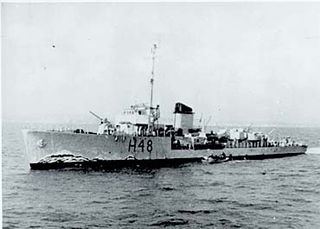
HNoMS Gyller was a Sleipner-class destroyer commissioned into the Royal Norwegian Navy in 1938. Along with the other Sleipner-class vessels in commission at that time, she took part in protecting Norwegian neutrality during the Second World War. After initially serving in the far north during the Finno-Soviet Winter War, she was redeployed to Southern Norway, escorting ships through Norwegian territorial waters. When the Germans invaded Norway on 9 April 1940, she was docked at Kristiansand. After taking part in the defence of the port city, she was captured intact by the invading Germans. Renamed Löwe, she sailed with Nazi Germany's Kriegsmarine for the duration of the war.
<i>Sleipner</i>-class destroyer ship class

The Sleipner class was a class of six destroyers built for the Royal Norwegian Navy from 1936 until the German invasion in 1940. The design was considered advanced for its time, and it was the first class of vessels for the Norwegian Navy that used aluminium in the construction of the bridge, the mast and the outer funnel. Extra strength special steel was used in the construction of the hull. Unlike the earlier Draug class the Sleipner class had comparatively good capabilities in both main guns, anti-aircraft artillery and anti-submarine weapons. The class was named after Sleipnir, the eight-legged horse of Odin.

Related Research Articles

Löwe or Loewe may refer to:

HNoMS Valkyrien, HNoMS Valkyrjen has been the name of several ships in the Royal Norwegian Navy. Most of them have been in some way connected to the Royal Norwegian Navy's torpedo boats. The name honours the valkyries of Norse mythology. It has also been said that the ships have been given this name in honour of all women. Some of the ships:

HMS P41 was a Royal Navy U-class submarine built by Vickers-Armstrong. She was transferred to the exiled Royal Norwegian Navy before completion and renamed HNoMS Uredd. She and one of the B-class in 1940 have so far been the only Norwegian submarine to have been sunk.

HNoMS <i>Odin</i> (1939)

HNoMS Odin was a Sleipner-class destroyer that entered service with the Royal Norwegian Navy in 1939. She and the other Sleipner-class vessels were built as part of a Norwegian rearmament scheme in the last years leading up to the Second World War. In 1940 she had taken part in protecting Norwegian neutrality, before being caught up in the German invasion of Norway on 9 April 1940. After fighting the invasion forces at Kristiansand, she was captured and pressed into Kriegsmarine service for the duration of the war. After the end of the war, she was returned to Norway. In 1948 she and her surviving sister ships were converted to frigatesand remained in service until being sold for scrapping in 1959.

HNoMS Utstein is a series of three submarines operated by the Royal Norwegian Navy. They were named after this historic Utstein Abbey which is located on the island of Klosterøy in Rennesøy, Norway. The three submarines that have borne this name are:

Three ships of the Royal Norwegian Navy have borne the name HNoMS Sleipner. The name is derived from Sleipnir - Odin's magical eight-legged steed, and the greatest of all horses:

Two ships of the Royal Norwegian Navy have borne the name HNoMS Ørnen, after the Norwegian word for The Eagle:

Two ships of the Royal Norwegian Navy have borne the name HNoMS Garm, after the Ragnarök hound Garmr:

Two ships of the Royal Norwegian Navy have borne the name HNoMS Draug, after the sea revenant Draugr:

Three ships of the Royal Norwegian Navy have borne the name HNoMS Thor or Tor, after the Norse god of thunder Thor:

Three ships of the Royal Norwegian Navy have borne the name HNoMS Tyr, after the Old Norse god of single combat, victory and heroic glory Týr:

Two ships of the Royal Norwegian Navy have borne the name HNoMS Uller, after the Norse god Ullr:

Two ships of the Royal Norwegian Navy have borne the name HNoMS Gor, after Gór – the mythological co-founder of Norway:

HNoMS Ellida may refer to one of the following Royal Norwegian Navy ships:

Two ships of the Royal Norwegian Navy have borne the name HNoMS Trygg. Trygg is Norwegian for safe, secure, dependable:

MS <i>Seattle</i>

MS Seattle was a German cargo ship. The cargo on board varied, but she transported mostly timber and lumber. On the last trip she also carried 30,000 boxes of oranges. The last trip of the ship had been dramatic. She was taken under blockade in the Dutch Antilles. The blockade was broken, the ship escaped and the course was set northwards to Iceland. From there she traveled to Tromsø in Northern Norway, from where the ship had received permission from the neutral Norwegian authorities to sail around the Norwegian coast and into the Baltic Sea. Her last stop in Norway was Kristiansand, where she was forced to port by the Norwegian Navy vessel HNoMS Gyller 8 April.

Three submarines of the Royal Norwegian Navy have borne the name HNoMS Ula, after the village of Ula in Norway.

Allied Forces South Norway (SONOR) was a NATO command tasked with the defense of Southern Norway. SONOR's area of responsibility included all of Norway with the adjacent sea territory excluding the three northernmost counties of Norway, which were under Allied Forces North Norway.