
Organic farming, also known as ecological farming or biological farming, is an agricultural system that uses fertilizers of organic origin such as compost manure, green manure, and bone meal and places emphasis on techniques such as crop rotation and companion planting. It originated early in the 20th century in reaction to rapidly changing farming practices. Certified organic agriculture accounts for 70 million hectares globally, with over half of that total in Australia. Organic farming continues to be developed by various organizations today. Biological pest control, mixed cropping, and the fostering of insect predators are encouraged. Organic standards are designed to allow the use of naturally-occurring substances while prohibiting or strictly limiting synthetic substances. For instance, naturally-occurring pesticides such as pyrethrin are permitted, while synthetic fertilizers and pesticides are generally prohibited. Synthetic substances that are allowed include, for example, copper sulfate, elemental sulfur, and ivermectin. Genetically modified organisms, nanomaterials, human sewage sludge, plant growth regulators, hormones, and antibiotic use in livestock husbandry are prohibited. Organic farming advocates claim advantages in sustainability, openness, self-sufficiency, autonomy and independence, health, food security, and food safety.

Conservation agriculture (CA) can be defined by a statement given by the Food and Agriculture Organization of the United Nations as "Conservation Agriculture (CA) is a farming system that can prevent losses of arable land while regenerating degraded lands.It promotes minimum soil disturbance, maintenance of a permanent soil cover, and diversification of plant species. It enhances biodiversity and natural biological processes above and below the ground surface, which contribute to increased water and nutrient use efficiency and to improved and sustained crop production."

Community-supported agriculture or cropsharing is a system that connects producers and consumers within the food system closer by allowing the consumer to subscribe to the harvest of a certain farm or group of farms. It is an alternative socioeconomic model of agriculture and food distribution that allows the producer and consumer to share the risks of farming. The model is a subcategory of civic agriculture that has an overarching goal of strengthening a sense of community through local markets.
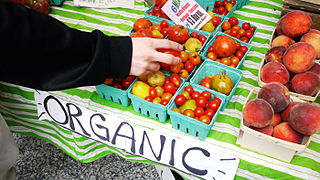
The organic movement broadly refers to the organizations and individuals involved worldwide in the promotion of organic food and other organic products. It started during the first half of the 20th century, when modern large-scale agricultural practices began to appear.

Organic certification is a certification process for producers of organic food and other organic agricultural products, in the European Union more commonly known as ecological or biological products. In general, any business directly involved in food production can be certified, including seed suppliers, farmers, food processors, retailers and restaurants. A lesser known counterpart is certification for organic textiles that includes certification of textile products made from organically grown fibres.
IFOAM – Organics International is a worldwide organization advocating for organics, with over 700 affiliates in more than 100 countries and territories.
Biodynamic agriculture is a form of alternative agriculture based on pseudo-scientific and esoteric concepts initially developed in 1924 by Rudolf Steiner (1861–1925). It was the first of the organic farming movements. It treats soil fertility, plant growth, and livestock care as ecologically interrelated tasks, emphasizing spiritual and mystical perspectives.
Traditional farming was the original type of agriculture, and has been practiced for thousands of years. All traditional farming is now considered to be "organic farming" although at the time there were no known inorganic methods. For example, forest gardening, a fully organic food production system which dates from prehistoric times, is thought to be the world's oldest and most resilient agroecosystem. The industrial revolution introduced inorganic methods, most of which were not well developed and had serious side effects. An organic movement began in the 1940s as a reaction to agriculture's growing reliance on synthetic fertilizers and pesticides. The history of this modern revival of organic farming dates back to the first half of the 20th century at a time when there was a growing reliance on these new synthetic, non-organic methods.

Organic farming is practiced around the globe, but the markets for sale are strongest in North America and Europe, while the greatest dedicated area is accounted for by Australia, the greatest number of producers are in India, and the Falkland Islands record the highest share of agricultural land dedicated to organic production.

Organic food, ecological food, or biological food are foods and drinks produced by methods complying with the standards of organic farming. Standards vary worldwide, but organic farming features practices that cycle resources, promote ecological balance, and conserve biodiversity. Organizations regulating organic products may restrict the use of certain pesticides and fertilizers in the farming methods used to produce such products. Organic foods are typically not processed using irradiation, industrial solvents, or synthetic food additives.
The Research Institute of Organic Agriculture, is an organic farming information and research centre. As an independent and non-profit organization, it promotes research and projects that help farmers improve their productivity with consideration of environmental and health impacts.

Agriculture in Albania is still a significant sector of the economy of Albania, which contributes to 22.5% of the country's GDP. The country spans 28,748 square kilometres of which 24% is agricultural land, 36% forest land, 15% pasture and meadow and 25% urban areas including lakes, waterways, unused rocky and mountain land. It can be separated into three main zones such as the lowland zone alongside the coastline of the country, the hill zone in the lowland and the mountain zone.
The Organic Foods Production Act of 1990 (OFPA) authorizes a National Organic Program (NOP) to be administered by USDA's Agricultural Marketing Service (AMS). The program is based on federal regulations that define standard organic farming practices and on a National List of acceptable organic production inputs. Private and state certifiers visit producers, processors, and handlers to certify that their operations abide by the standards. Once certified, these operations may affix the USDA Organic Seal. USDA has established four distinct categories for labeling organic products—100 percent organic, organic, "made with" organic ingredients, and specific organic ingredients—and only 100 percent organic and organic categories can use the USDA Organic Seal. It is illegal for anyone to use the word "organic" on a product if it does not meet the standards set in the law and regulations. The regulations under the OFPA are intended to set uniform minimum standards for organic production. However, states may adopt additional requirements after review and approval by USDA. AMS re-accredits certifying agents every 5 years, maintains federal oversight to assure truth in labeling, and provides assurance that imported organic products have been produced under standards that are equivalent to the U.S. standards.
Organic aquaculture is a holistic method for farming fish and other marine species in line with organic principles. The ideals of this practice established sustainable marine environments with consideration for naturally occurring ecosystems, use of pesticides, and the treatment of aquatic life. Managing aquaculture organically has become more popular since consumers are concerned about the harmful impacts of aquaculture on themselves and the environment.

The College of Natural Resources, Royal University of Bhutan is a college offering courses on natural resources management, that include organic agriculture, animal science, environment and climate, food science and technology, forest science and sustainable development The college is located in Lobesa, Punakha District, in central west Bhutan. The college campus is spread over 98 acres (40 ha) on the eastern slope of Lobesa and is about 140 km (87 mi) away from the Paro International Airport.

Martin Häusling is a German politician and member of the European Parliament from Germany. He is a member of the Alliance 90/The Greens, part of the European Green Party.
Torsten Müller is an agricultural scientist at the University of Hohenheim. He is chairman of the examination and admissions board of the European master's degree Course "Organic Agriculture and Food Systems" and Dean of Education of the Agricultural Science Faculty in Hohenheim.
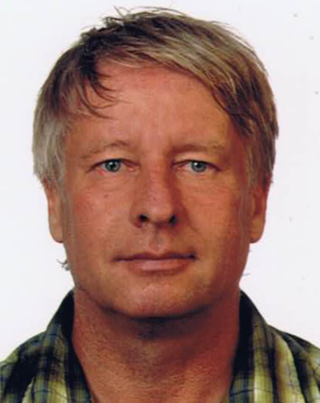
Gerold Rahmann is a German agricultural economist.
Hartmut Bossel is a German environmental scientist and systems scientist. Bossel was a professor of environmental systems analysis and director of the Scientific Center for Environmental Systems Research and Environmental Systems Analysis Group at the University of Kassel, Germany, until his retirement in 1997.

Bio Suisse is the main organisation of organic agriculture in Switzerland. This umbrella organization counts 33 organic farmers' associations among its members, as well as the Research Institute of Organic Agriculture FiBL. It notably manages the guidelines of the organic label "Bio Suisse".


