
Slide guitar is a technique for playing the guitar that is often used in blues music. It involves playing a guitar while holding a hard object against the strings, creating the opportunity for glissando effects and deep vibratos that reflect characteristics of the human singing voice. It typically involves playing the guitar in the traditional position with the use of a slide fitted on one of the guitarist's fingers. The slide may be a metal or glass tube, such as the neck of a bottle. The term bottleneck was historically used to describe this type of playing. The strings are typically plucked while the slide is moved over the strings to change the pitch. The guitar may also be placed on the player's lap and played with a hand-held bar.
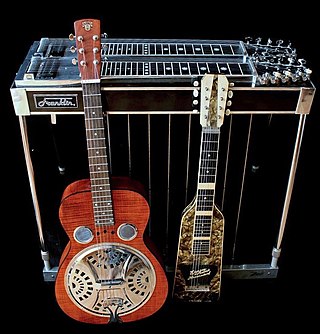
A steel guitar is any guitar played while moving a steel bar or similar hard object against plucked strings. The bar itself is called a "steel" and is the source of the name "steel guitar". The instrument differs from a conventional guitar in that it is played without using frets; conceptually, it is somewhat akin to playing a guitar with one finger. Known for its portamento capabilities, gliding smoothly over every pitch between notes, the instrument can produce a sinuous crying sound and deep vibrato emulating the human singing voice. Typically, the strings are plucked by the fingers of the dominant hand, while the steel tone bar is pressed lightly against the strings and moved by the opposite hand.
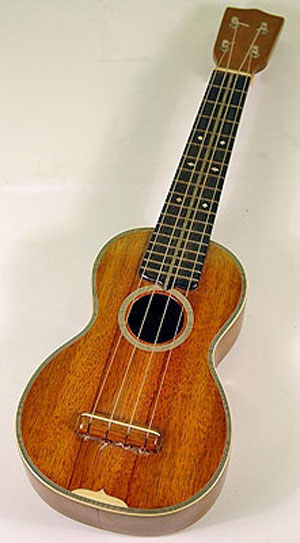
The ukulele, also called a uke, is a member of the lute family of instruments of Portuguese origin and popularized in Hawaii. It generally employs four nylon strings.

Jamieson "Junior" Brown is an American country guitarist and singer. He has released twelve studio albums in his career, and has charted twice on the Billboard country singles charts. Brown's signature instrument is the "guit-steel" double neck guitar, a hybrid of electric guitar and lap steel guitar.

The pedal steel guitar is a console-type of steel guitar with pedals and knee levers that change the pitch of certain strings to enable playing more varied and complex music than other steel guitar designs. Like all steel guitars, it can play unlimited glissandi and deep vibrati—characteristics it shares with the human voice. Pedal steel is most commonly associated with American country music and Hawaiian music.

The lap steel guitar, also known as a Hawaiian guitar, is a type of steel guitar without pedals that is typically played with the instrument in a horizontal position across the performer's lap. Unlike the usual manner of playing a traditional acoustic guitar, in which the performer's fingertips press the strings against frets, the pitch of a steel guitar is changed by pressing a polished steel bar against plucked strings. Though the instrument does not have frets, it displays markers that resemble them. Lap steels may differ markedly from one another in external appearance, depending on whether they are acoustic or electric, but in either case, do not have pedals, distinguishing them from pedal steel guitar.

Solomon Hoʻopiʻi Kaʻaiʻai was a Native Hawaiian lap steel guitarist. A virtuoso, he was one of the most famous original Hawaiian steel guitarists, along with Joseph Kekuku, Frank Ferera, Sam Ku West and "King" Bennie Nawahi.

A tiple, is a plucked typically 12-string chordophone of the guitar family. A tiple player is called a tiplista. The first mention of the tiple comes from musicologist Pablo Minguet e Irol in 1752. Although many variations of the instrument exist, the tiple is mostly associated with Colombia, and is considered the national instrument. The Puerto Rican version characteristically has fewer strings, as do variants from Cuba, Mallorca, and elsewhere among countries of Hispanic origin.

Paul V. Franklin is an American multi-instrumentalist, known mainly for his work as a steel guitarist. He began his career in the 1970s as a member of Barbara Mandrell's road band; in addition he toured with Vince Gill, Mel Tillis, Jerry Reed and Dire Straits. He has since become a prolific session musician in Nashville, playing on more than 500 albums. He has been named by the Academy of Country Music as Best Steel Guitarist on several occasions. He was inducted into the Steel Guitar Hall of Fame in 2000 and the Musicians Hall of Fame and Museum in 2019. With thirty, Franklin is the most nominated person in CMA history and is notable for having been nominated for the Country Music Association Award for Musician of the Year twenty nine times but has yet to win.

The console steel guitar is any type of electric steel guitar that is built in a frame supported by legs. It may be a lap steel or a pedal steel. Console steel guitars are typically heavier instruments that have multiple necks and/or more than six strings per neck and are therefore not manageable on the player's lap. This type of instrument was created when players in the late 1940s needed to play in different keys and with different chords than the lap steel afforded. To do this, they added additional necks to a lap steel. The player could then easily switch to a different neck on the same instrument, but this made the instrument so heavy and cumbersome that it could not be easily held on the lap. Trying to solve the problem with multiple necks led to the invention of the pedal steel guitar in the 1950s.

A resonator guitar or resophonic guitar is an acoustic guitar that produces sound by conducting string vibrations through the bridge to one or more spun metal cones (resonators), instead of to the guitar's sounding board (top). Resonator guitars were originally designed to be louder than regular acoustic guitars, which were overwhelmed by horns and percussion instruments in dance orchestras. They became prized for their distinctive tone, however, and found life with bluegrass music and the blues well after electric amplification solved the problem of inadequate volume.

An acoustic guitar is a musical instrument in the string family. When a string is plucked its vibration is transmitted from the bridge, resonating throughout the top of the guitar. It is also transmitted to the side and back of the instrument, resonating through the air in the body, and producing sound from the sound hole. The original, general term for this stringed instrument is guitar, and the retronym 'acoustic guitar' distinguishes it from an electric guitar, which relies on electronic amplification. Typically, a guitar's body is a sound box, of which the top side serves as a sound board that enhances the vibration sounds of the strings. In standard tuning the guitar's six strings are tuned (low to high) E2 A2 D3 G3 B3 E4.

The Rickenbacker Electro A-22, nicknamed the "Frying Pan" is the first electric lap steel guitar. Developed in 1931/1932, it received its patent in August 1937. A previous attempt, the Stromberg company‘s transducer-based "Stromberg Electro", was introduced in 1928. It used a "vibration-transfer rod" from the instrument's sounding board attached to magnets inside the guitar, and was not successful. George Beauchamp created the "Fry-Pan" in 1931, and it was subsequently manufactured by Rickenbacker Electro. The instrument gained its nickname because its circular body and long neck make it resemble a frying pan.
Electromuse was an American maker of musical instruments that operated in the 1940s and 1950s.

Paul Tutmarc was an American musician and musical instrument inventor. He was a tenor singer and a performer and teacher of the lap steel guitar and the ukulele. He developed a number of variant types of stringed musical instruments, such as electrically amplified double basses, bass guitar, and lap steel guitars. His second marriage was to his former student Bonnie Buckingham, known as Bonnie Guitar.
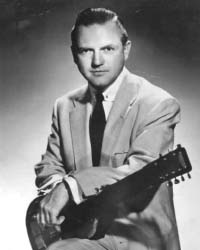
Gerald Lester Byrd was an American musician who played the lap steel guitar in country and Hawaiian music, as well as a singer-songwriter and the head of a music publishing firm. He appeared on numerous radio programs.

A steel bar, commonly referred to as a "steel", but also referred to as a tone bar, slide bar, guitar slide, slide, or bottleneck, is a smooth hard object which is pressed against strings to play steel guitar and is itself the origin of the name "steel guitar". The device can either be a solid bar which is held in the hand, or a tubular object worn around the player's finger. Instead of pressing fingertips on the strings against frets as a traditional guitar is played, the steel guitarist uses one of these objects pressed against the strings with one hand, while plucking the strings with the other to gain the ability to play a smooth glissando and a deep vibrato not possible when playing with fingers on frets.
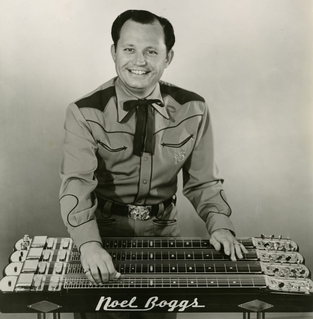
Noel Edwin Boggs (1917–1974) was an American musician who was a virtuoso on the lap steel guitar and a member of the Steel Guitar Hall of Fame. He was one of the pioneers in electric steel guitar who helped popularize the instrument beyond its native Hawaiian music into other genres of American popular music, specifically Western Swing. Boggs played and recorded with almost every major artist in the genre including Bob Wills and His Texas Playboys (1944-1945) and Spade Cooley's Dance Band. Bob Wills' band helped define the guitar's role in western swing; Wills discovered and coached innovative guitarists who deeply influenced country, rock and jazz music. Boggs appeared on some 2000 recordings as a soloist and his playing was prominent on several of Wills’ hits that became Western swing standards, including "Roly Poly" and "Stay a Little Longer".
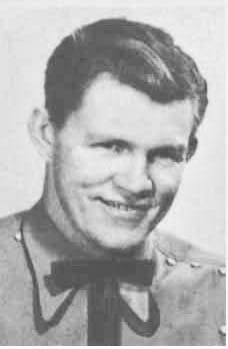
Forrest "Bud" Isaacs (1928–2016) was an American steel guitarist who made country music history in 1954 as the first person to play pedal steel guitar on a hit record. He is known for his playing his innovative technique on Webb Pierce's 1954 recording of a song called "Slowly" which became a major hit for Pierce and was one of the most-played country songs of 1954. Isaacs was the first to push a pedal while the strings were still sounding to create a unique bending of notes from below up to join an existing note; this was not possible on older lap steel guitars. The stunning effect he created was embraced by country music fans and many lap steel artists rushed to get pedals to imitate the unique bending chords that he played. Music historians pinpoint the actual dawning of country music's modern era to Isaac's performance on this song. He became a much-favored session player and performed on 11 top country records the year following the release of "Slowly". Even though pedal steel guitars had been available for over a decade before this recording, the instrument emerged as a crucial element in country music after the success of this song.

The Oahu Music Company was a music education program in the United States during the 1930s and 1940s to teach students to play the Hawaiian Guitar. Popular culture in America became fascinated with Hawaiian music during the first half of the twentieth century and in 1916, recordings of indigenous Hawaiian instruments outsold every other genre of music in the U.S. By 1920, sales of Hawaiian guitars and instruction had become well established and Oahu Music Company was the leading purveyor of these programs. The organization canvassed nearly every city in the United States, often door-to-door, selling both their Oahu-brand instruments and lessons for young people to join their weekly classes.
